

The October 2026 bulletin moved EB-3 fast, faster than EB-2. So many EB-2 people are asking: my EB-2 date isn't here yet, but EB-3's is. Should I switch to EB-3 so I can file my green card application now? That switch is called a "downgrade".
The short answer: it isn't right for everyone, and it isn't all upside. Some people can file right now by switching to EB-3. But October 2020 looked exactly the same, and afterwards EB-3 went backwards and EB-2 overtook it, so people who bet on EB-3 waited longer. The good news is you can switch back to EB-2 later, if you meet the conditions.
This article only lays out the data, the rules and the risks. Whether to downgrade is for you and your attorney to decide; we won't decide it for you.
Two terms first, since we use them throughout:
- Priority date: your place in line, meaning the day you got in line.
- Chart A and Chart B: each monthly bulletin has two charts. Chart A says "once your date is before this day, your green card can be approved". Chart B says "once your date is before this day, you may file your application (I-485) now". USCIS announces which chart to use each month. Filing is not approval; it just gets you in line.
01 This month, which band are you in?
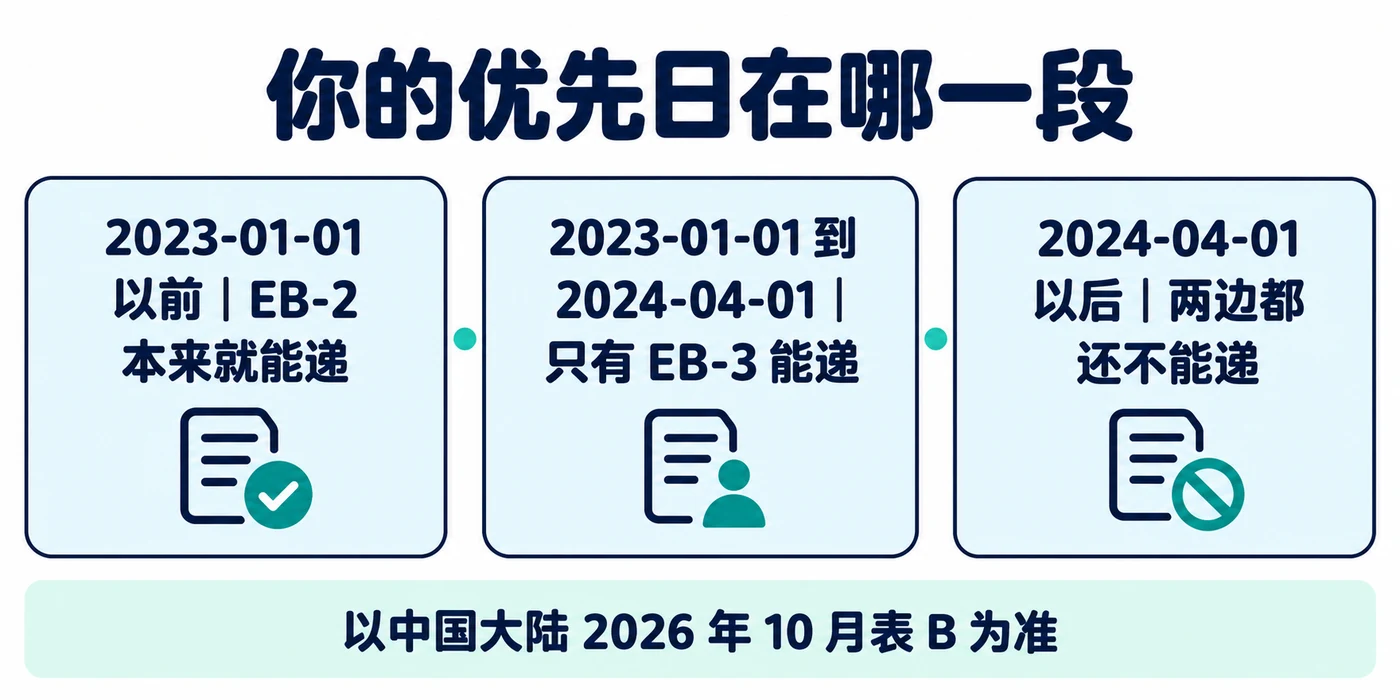
China mainland dates, October 2026:
| EB-2 | EB-3 | |
|---|---|---|
| Chart A (when a green card can be approved) | 2021-10-01 | 2022-01-08 |
| Chart B (when you may file) | 2023-01-01 | 2024-04-01 |
For October, USCIS told everyone to use Chart B. So look at your priority date:
- Before 2023-01-01: EB-2 can already file. No need to downgrade.
- Between 2023-01-01 and 2024-04-01: only EB-3 can file. This is the group facing the downgrade question.
- After 2024-04-01: neither can file yet.
Also, if your date is between 2021-10-01 and 2022-01-08, EB-3's Chart A has reached you, meaning EB-3 can already approve you, and EB-2 can't.
EB-3 is now about 15 months ahead of EB-2 on Chart B, which is rare.
02 The same thing happened in October 2020
In October 2020 China EB-3 also suddenly jumped ahead of EB-2. Here is how it went:
| Bulletin | EB-2 A | EB-3 A | EB-2 B | EB-3 B |
|---|---|---|---|---|
| Sep 2020 | 2016-01-15 | 2017-02-15 | 2016-08-01 | 2017-05-01 |
| Oct 2020 | 2016-03-01 | 2017-07-01 | 2016-10-01 | 2018-06-01 |
| Oct 2021 | 2018-07-01 | 2019-01-08 | 2018-09-01 | 2019-01-15 |
| Nov 2021 | 2018-11-15 | 2018-03-22 | 2019-02-01 | 2018-04-01 |
| Jul 2022 | 2019-04-01 | 2018-03-22 | 2019-05-01 | 2018-04-01 |
| Sep 2023 | 2019-07-08 | 2019-09-01 | 2019-10-08 | 2019-11-01 |
In plain words:
- From October to December 2020 USCIS accepted Chart B; in January 2021 it went back to Chart A.
- In November 2021 EB-3's Chart A moved backwards from 2019-01-08 to 2018-03-22, while EB-2 moved up to 2018-11-15 and passed it.
- EB-3 then stayed stuck at 2018-03-22 for months; by July 2022 EB-2 was at 2019-04-01. EB-3 only got back in front in September 2023.
So during that stretch, people whose priority date was after 2018-03-22 got a visa number sooner by staying on EB-2. People with earlier dates were current on both, so it made little difference.
Two things to be clear about: this is how the dates moved. We cannot count how many people downgraded or how it turned out for them, and we can't say downgraders caused EB-3 to stall. What USCIS itself said: on February 18, 2022 it urged eligible applicants to transfer their I-485 basis to EB-1 or EB-2, because that fiscal year had unusually many EB-1 and EB-2 numbers that, by statute, EB-3 could not use.
03 What a downgrade actually involves
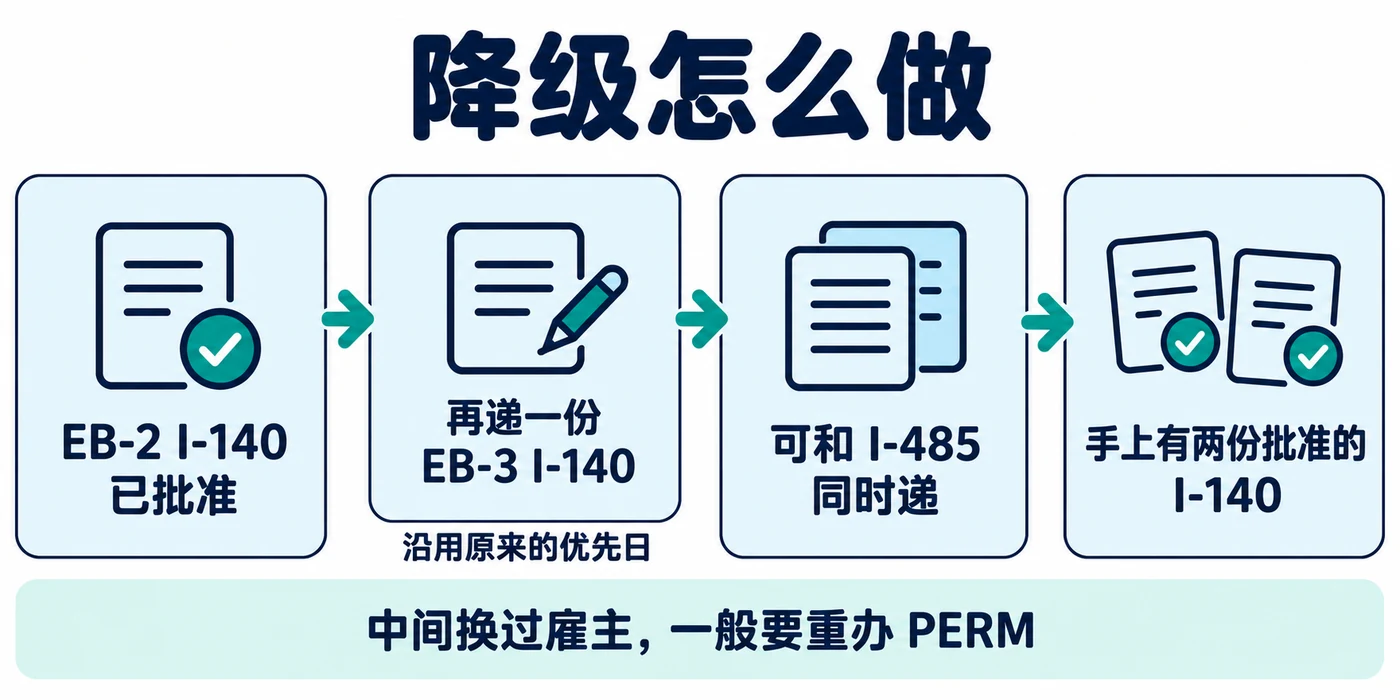
The usual approach (confirm details with your attorney):
- Your EB-2 petition (I-140) is already approved, and you file a second, EB-3 I-140. It can keep your old priority date, so your place in line doesn't change.
- Same employer all along: the existing labor certification (PERM) can usually be reused, which is faster. Changed employers: the new employer generally needs a new PERM, which takes much longer.
- The EB-3 I-140 can be filed together with the green card application (I-485), as long as your date has reached the chart USCIS uses that month.
- Once approved you hold two approved I-140s. The EB-2 one is not cancelled.
About the “180 days”: that is the rule that the first I-140 must be filed within 180 days of PERM certification (20 CFR 656.30(b)). It is not a time limit on downgrading.
04 Filing is not the same as getting the green card
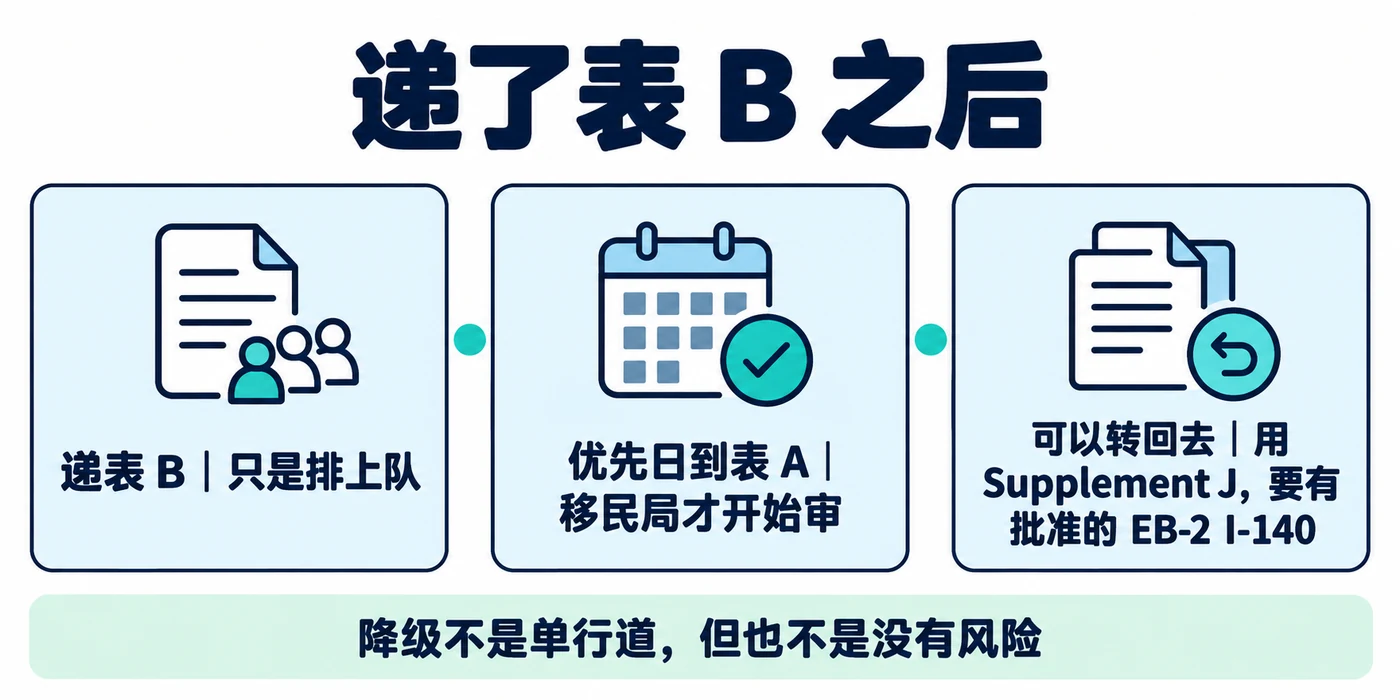
- Filing on Chart B only gets you in line. USCIS doesn't start reviewing until your date reaches Chart A. If dates move backwards, the wait gets longer.
- You can switch back. USCIS's August 2022 FAQ says you can use a form called Supplement J to move your pending green card application onto a different, already-approved I-140, and quotes: “A pending EB-3 petition in this scenario does not prevent USCIS from granting the applicant’s request to transfer the underlying basis of their pending Form I-485 to a separate, approved Form I-140.” The FAQ’s scenario is one where the EB-2 priority date is current under the Final Action Dates (Chart A). So a downgrade isn't one-way. But going back needs an approved EB-2 I-140, and your EB-2 priority date already current on Chart A.
- Work permit. After filing you can usually apply for a work permit (EAD) and a travel document. Since December 4, 2025, new or pending C09 EADs are capped at 18 months instead of five years, and the October 30, 2025 interim final rule ended automatic extensions for renewals. File renewals early; if an EAD expires before the renewal is approved, you may have to stop working.
- Using the work permit and keeping H-1B. This is tied to the downgrade decision, and attorneys differ. We have no official source that settles it for everyone. Ask what happens to your H-1B if you use the work permit, and what happens if the application is denied.
- Changing jobs. Once your application has been pending 180 days and other conditions are met, you can move to a same or similar job without starting over. See our job-change rules tool.
05 Ask yourself these first
- Where is my priority date? (The Chart B chance is this one month, October; we don't know which chart will be used from November.)
- Have I stayed with one employer, or do I need a new PERM?
- Will my employer cooperate, who pays, and can the attorney file within October?
- If EB-3 retrogresses or stalls after I downgrade, will I wait, or move back to EB-2?
- Is my H-1B stable, or do I need the EAD as a backstop?
If your priority date is already inside the EB-2 Chart B date, you don't need to downgrade this month just to be able to file.
Related tools
- Enter your priority date and compare EB-2 and EB-3 history: EB-2 vs EB-3 tool
- What to prepare for an I-485: I-485 checklist
- How long others actually waited after filing: I-485 progress
- Latest bulletin: October 2026 Visa Bulletin analysis
This is general information, not legal advice. For downgrade, EAD and status decisions, consult a qualified immigration attorney.
Sources
- Department of State Visa Bulletins, July 2020 to October 2026 (China mainland EB-2 and EB-3, Charts A and B), compiled in our bulletin history
- USCIS: Adjustment of Status Filing Charts from the Visa Bulletin
- USCIS: USCIS Urges Eligible Applicants to Switch Employment-Based Categories (February 18, 2022)
- USCIS: Fiscal Year 2022 Employment-Based Adjustment of Status FAQs (updated August 26, 2022)
- USCIS: December 4, 2025 policy manual update on EAD validity
- USCIS: Interim final rule ending automatic EAD extensions (October 30, 2025)
- The description of the 2020 movement and the 15-month gap are our own calculations from bulletin dates, not official statistics
One email each month when the bulletin lands. Unsubscribe anytime.