

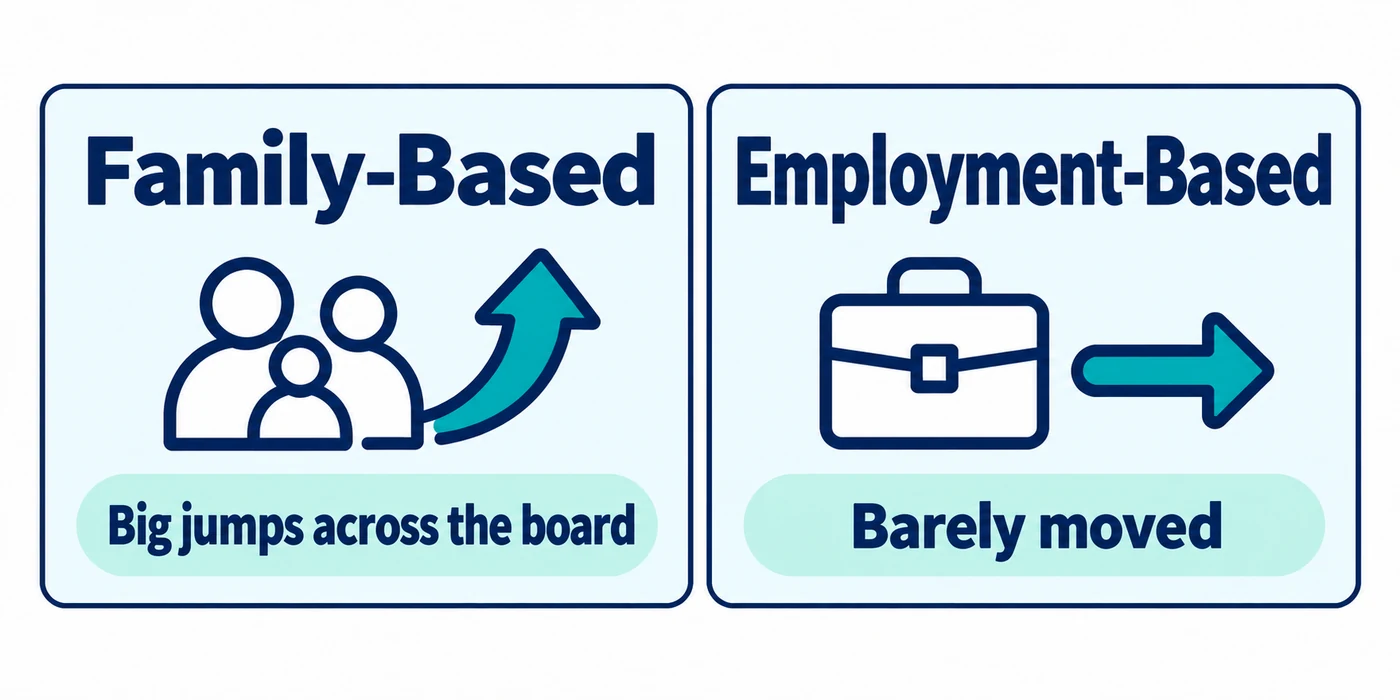
In one sentence: family-based categories posted their biggest single-month advance in eleven years, while employment-based categories barely moved. At the same time, the State Department for the first time locked in this year's visa numbers, and there are more than 30,000 more of them than last year.
First, what happened
The September 2026 visa bulletin is out. The two tables below are live data, from the same source as the visa bulletin tables on our home page.
Family-based: big jumps across the board
Categories starting with F are family-based (F1 is the first preference, unmarried adult sons and daughters of US citizens; F2A is spouses and minor children of green card holders; and so on).
Family-sponsored
(All chargeability areas except those listed)The "All Chargeability," "China mainland" and "India" columns are identical this month. Mexico and the Philippines barely moved, with only small adjustments to F1 (Mexico, +31 days) and F4 (Philippines, +21 days). India's F4 did not move either.
How rare is an advance this large? We have complete visa bulletin data for 131 bulletins, from November 2015 to today. Comparing each bulletin with the one before it, of the ten largest single-month advances ever in the family-based All Chargeability column, the September bulletin accounts for four:
| Category | September advance | Historical rank |
|---|---|---|
| F3 | 890 days | Largest in eleven years |
| F4 | 781 days | Third |
| F2B | 598 days | Fourth |
| F1 | 403 days | Seventh |
The previous record was F4's 858 days in October 2017.
For comparison: in the same data, the family-based All Chargeability column did not move at all in 39.9% of months. "No movement this month" is the norm; a month like this September comes along once in eleven years.
The chart below shows how F3 has actually moved over the years:
Employment-based: nothing moved except EB-4
Categories starting with EB are employment-based (EB-1 for people with extraordinary ability, EB-2 for advanced-degree professionals, EB-3 for skilled workers, EB-4 for special immigrants, EB-5 for investors).
Employment-based
(China (mainland-born))In the entire employment-based chart, the only movement was EB-4 and religious workers, up 61 days. China's EB-1, EB-2, EB-3 and EB-5 did not move a single day.
Why did family-based dates suddenly surge?
To understand this, you need to know how cutoff dates are set. The State Department spells this out in its own public documents; it is not outside speculation:
"If the monthly target is 3,000 and there is demand for 8,000 applicants, then it would be necessary to establish a cut-off date so that only 3,000 numbers would be allocated. In this case, the cut-off would be the priority date of the 3,001st applicant."
In other words: the visa bulletin is not a "forecast"; it is counting off a line. Line up everyone who is waiting by priority date from earliest to latest, count off as many numbers as can still be issued this year, and the priority date of the person where the count stops is this month's cutoff date.
The US immigration fiscal year ends on September 30. The 226,000 family-based numbers each year are settled by fiscal year. Numbers not issued by September 30 do not stay with family-based immigration; they roll into next year's employment-based categories (more on this below: that is exactly where this year's extra employment-based numbers came from).
Put another way, the State Department has a strong incentive to use up family-based numbers before the fiscal year ends. Unused numbers are not "wasted"; they are effectively handed from family-based to employment-based immigrants. So in the last month or two of every year, dates tend to be pushed forward to use up the remaining numbers.
This September's push was especially aggressive, which suggests the State Department had been conservative in the preceding months and built up a lot of unused numbers.
So will October retrogress?
This is the question most people asked this month, and what you read online is all over the place. We went straight to our own eleven years of historical data:
Over the past ten years, family-based Chart A (All Chargeability column) has never once retrogressed from September to October. Out of 50 "category × year" combinations, dates advanced 25 times, stayed put 25 times and retrogressed 0 times.
The reason makes sense: October 1 is the first day of the new fiscal year, when 226,000 numbers become available again and supply is at its most generous. The window where retrogression actually tends to happen is August to September (it has happened 4 times historically; for example, in September 2017 F4 retrogressed 858 days in one go), and that window has already passed safely this year.
So if you are worried about October retrogression: the data does not support that worry. But don't expect another leap of this size in October either. Historically, the most common result from September to October is "a small advance or no movement."
An easy-to-miss signal: Chart A has caught up with Chart B
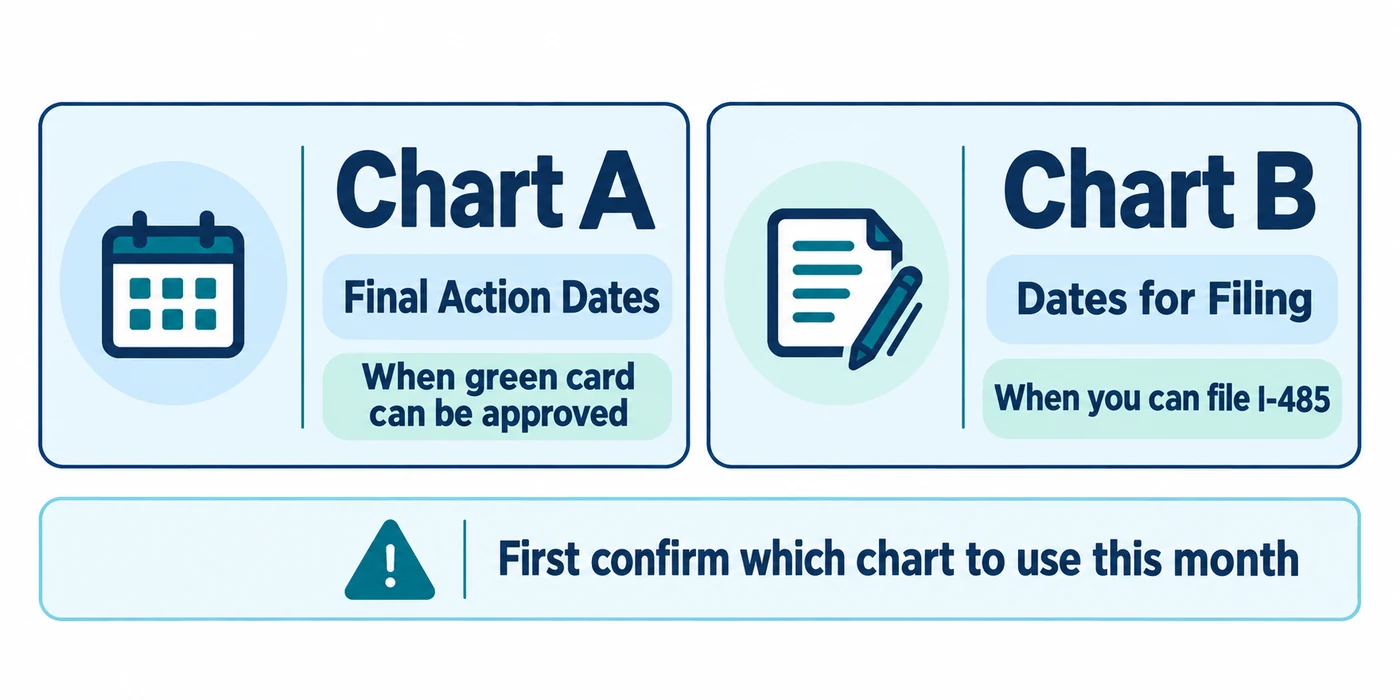
The visa bulletin has two charts: Chart A (Final Action Dates) determines when your green card can be approved; Chart B (Dates for Filing) determines when you can file Form I-485 (the adjustment of status application, the form you file to get a green card while inside the US).
Normally Chart B is well ahead of Chart A, because the State Department sets Chart B at roughly where it expects Chart A to be in 8 to 12 months. So the gap between the two charts is really the State Department's own forecast of the future.
In this September bulletin, the two charts for the four family-based categories are only 10 days apart (you can compare the Final Action Date and Date for Filing columns directly in the family-based table above).
Charlie Oppenheim, the former chief of the State Department's Visa Control and Reporting Division who ran this system for years, has explained what this means: when the two charts are nearly on top of each other, it is because the State Department already has enough applicants in the pipeline, so there is no need to open up new filings.
In plain terms: the State Department is telling you that everyone who needs to be in line is already in line. Pushing Chart A right up to Chart B in one move uses up the room for the next few months in advance. So while October probably won't retrogress, it is unlikely to bring any big moves either.
Good news: this year's numbers are official, and there are more of them
The September bulletin contains a technical passage that many people won't read, but it is actually the most substantive change this month.
In the August bulletin, the annual employment-based total was still listed as "at least 140,000," the statutory floor, a conservative placeholder estimate. The September bulletin gives a firm number for the first time:
| August bulletin (estimate) | September bulletin (official determination) | |
|---|---|---|
| Annual employment-based total | At least 140,000 | 186,317 |
| Per-country limit (7%) | 25,620 | 28,862 |
| Per-country limit including EB-5 carryover | — | 29,136 |
You may ask why it took until the last month of the fiscal year to set this. The bulletin explains that too: the State Department needs USCIS's actual usage data for "immediate relatives" from the previous year to do the calculation, and USCIS only sent over that data on July 24. Until then, the State Department had been issuing numbers based on the conservative floor.
The annual employment-based total can exceed the statutory 140,000 because the law provides that family-based numbers left unused in the previous year roll into the next year's employment-based categories. More than 40,000 rolled over into FY2026 (fiscal year 2026, running from October 1, 2025 to September 30, 2026).
So with more numbers, will this year be looser? As of August 22, no worldwide category for FY2026 had been announced as used up.
But don't get optimistic too fast: at this point last year, none had been either. All four "annual limit reached" notices for the previous fiscal year (FY2025) came in the final month:
- EB-2: September 2, 2025
- EB-1: September 8, 2025
- EB-3 and EW: September 9, 2025
- EB-5 unreserved: September 16, 2025
In other words, if you are waiting in an employment-based category, the real test is the next few weeks. Whether this year's extra 30,000-plus numbers hold up will be clear by the end of September.
But here's a reality check: a larger total does not automatically help China and India. USCIS says it plainly: the extra numbers are not automatically allocated to the applicants with the earliest priority dates, because the per-country limit still applies. What rises first is the ceiling for the "all other countries" column. If you were born in China or India, this has almost no direct effect on you. China and India only get extra numbers through the law's "spillover" provision when a category has more numbers than worldwide demand can use.
Two risk warnings you need to know
The State Department included two explicit warnings in the September bulletin, worded more tightly than in August:
1. EB-2 may retrogress or become unavailable before the fiscal year ends
Notice the change in wording, a detail many write-ups miss:
- August bulletin: it may be necessary to retrogress or make the category unavailable in the coming months
- September bulletin: it may be necessary to retrogress or make the category unavailable before the end of the fiscal year
September is the last month of the fiscal year. Going from "the coming months" to "before the end of the fiscal year" means the window has shrunk from several months to within this one month. This is a tightening, not a loosening. If your priority date is close to the EB-2 cutoff, watch closely this month.
This warning is not boilerplate: last year EB-2 was announced as used up on September 2, and once that happened it was unavailable for the rest of the month, until the new fiscal year began on October 1.
2. EB-5 (unreserved) gets the same warning for the first time
This passage was not in the August bulletin; it was added in September: the EB-5 unreserved category likewise may need to retrogress or become unavailable before the end of the fiscal year.
If you are in one of the three set-aside categories (rural 20%, high unemployment 10%, infrastructure 2%), they are all still "Current" and unaffected by this warning.
A note for applicants from India
India's EB-2 and EB-5 unreserved are already at "U" (unauthorized: no visa numbers available). This is not retrogression; it means India's per-country numbers for this fiscal year have been used up. The State Department issued separate notices announcing that India's per-country limit had been reached for these two categories (the pages were last updated on May 22, 2026 and June 10, 2026).
When will they come back? The State Department's notices are clear: the numbers will reset when the new fiscal year (FY 2027) starts on October 1, 2026, at which point embassies and consulates can resume issuing visas.
What should I do now?
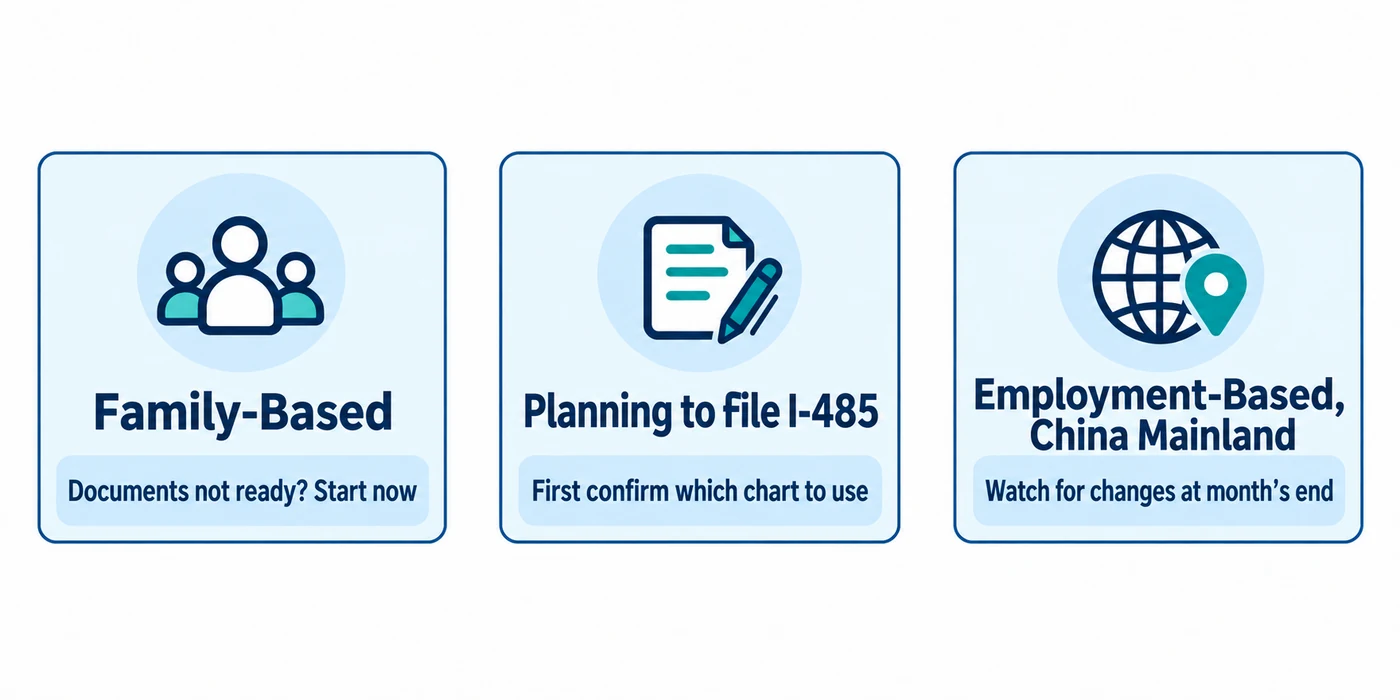
- Family-based, with a priority date before the new cutoff: Your case is "current" this month. If your documents are not ready yet, get started now; September's numbers expire on September 30.
- Planning to file an I-485: First confirm which chart to use this month. USCIS announces this separately each month, and as of publication, the USCIS page still shows the August guidance (Chart B for family-based, Chart A for employment-based). The September guidance is usually posted within a week after the bulletin comes out. Be sure to check the USCIS website again before you file.
- Employment-based, China mainland: Nothing changed this month and there is nothing you need to do. EB-2 carries an official retrogression warning, so if your priority date is close to the cutoff, watch for possible changes at the end of the month.
- Worried about October retrogression: Historical data does not support that worry (0 times in ten years). The October bulletin is usually released in mid-to-late September.
Data sources
- The State Department's Visa Bulletin, full text of the August and September 2026 issues (compared paragraph by paragraph)
- The State Department's official procedural description of its immigrant visa numerical control system (July 2025 edition)
- The State Department's visa news announcements page (notices of annual limits being reached)
- USCIS's "Adjustment of Status Filing Charts" page
- Career Engine's own visa bulletin database: November 2015 to September 2026, 131 bulletins
Data as of August 22, 2026.
One email each month when the bulletin lands. Unsubscribe anytime.