

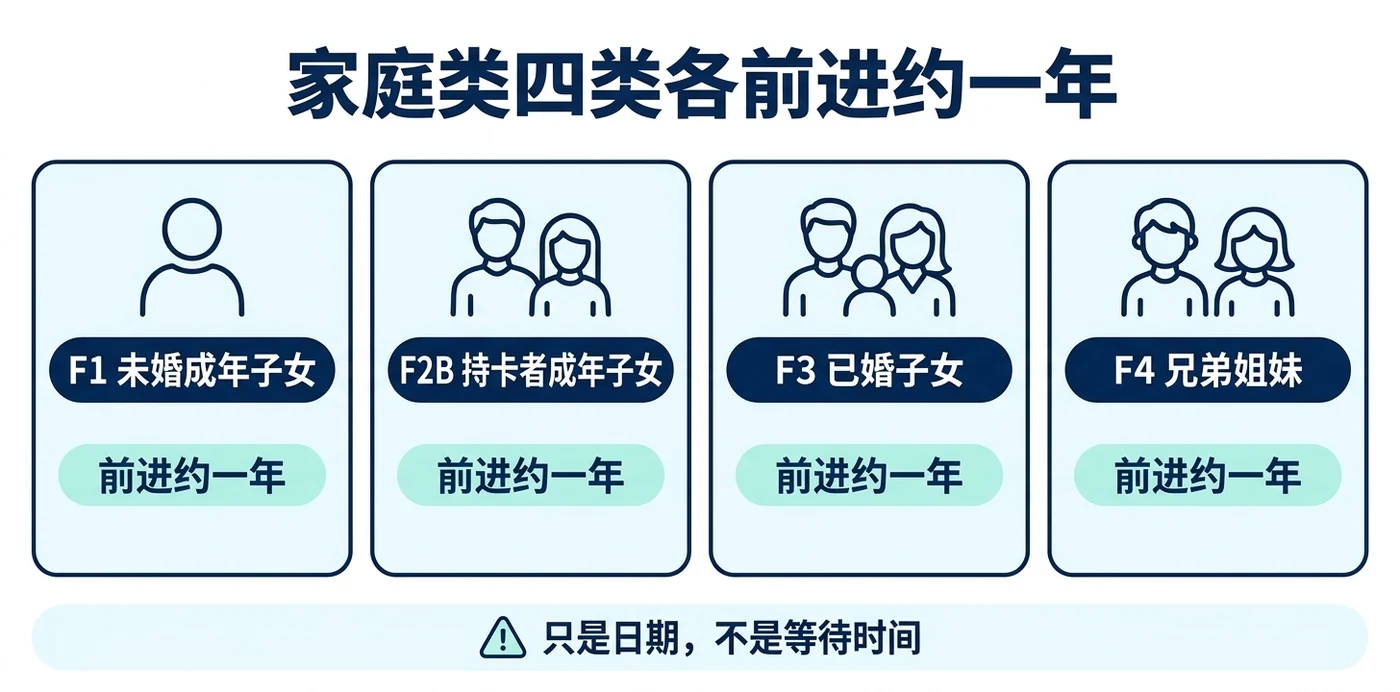
The short answer: no category went backward in the November 2026 bulletin. In family-based, F1, F2B, F3 and F4 each moved forward about a year from October (F4: October 22, 2011 to October 22, 2012), and F2A moved 30 days. In employment-based, worldwide EB-2 moved 90 days and EB-3 moved 31 days; EB-2 for people born in mainland China and in India did not move.
You only need to do one thing: find your priority date (usually the filing date of your I-140 (the employer's employment-based petition) or I-130 (the family petition)) and compare it with the row for your category and country of birth below.
01 How far did your category move in November?
CareerEngine recorded the State Department's Visa Bulletin for November 2026 on October 22, 2026, and every date below was checked against it. "Moved forward" means compared with October, for the Final Action Date (Chart A, which decides when a green card can be approved). The full tables are on the November 2026 dates page.
| Category | November Chart A | Change from October |
|---|---|---|
| F1 (unmarried adult sons and daughters of U.S. citizens) | 2021-01-22 | Forward 366 days |
| F2A (spouses and children under 21 of green card holders) | 2026-10-22; Mexico 2026-04-22 | Forward 30 days; Mexico forward 31 days |
| F2B (unmarried sons and daughters 21 or older of green card holders) | 2020-08-22 | Forward 366 days |
| F3 (married sons and daughters of U.S. citizens) | 2015-10-22 | Forward 365 days |
| F4 (siblings of U.S. citizens) | 2012-10-22 | Forward 366 days |
| EB-1 | Worldwide C; mainland China 2023-08-01; India 2023-02-01 | Mainland China forward 31 days, others unchanged |
| EB-2 | Worldwide 2025-04-01; mainland China 2021-10-01; India 2013-11-01 | Worldwide forward 90 days; mainland China and India unchanged |
| EB-3 | Worldwide 2024-06-15; mainland China 2022-01-22; India 2014-01-22 | Worldwide forward 31 days; mainland China forward 14 days; India forward 21 days |
The family dates are for all countries except India, Mexico and the Philippines; people born in mainland China use the same date. F4 for India, Mexico and the Philippines did not move (2006-12-15, 2001-04-22 and 2008-05-15).
02 Why do dates move forward, and why do they go backward?
This bulletin does not explain why F1, F2B, F3 and F4 all moved together. What follows is the general rule the State Department states in the bulletin, not a claim about the specific reason for November:
- Numbers have annual limits. The bulletin says the family-sponsored limit is at least 226,000 a year, the employment-based level at least 140,000 a year, and no single country can exceed 7% of the two combined (25,620).
- Dates come from comparing applications received with numbers available. The State Department allocates numbers in priority-date order. This month it used demand received by October 5. If it all fits, the date moves forward; if not, the category or country is "oversubscribed" and the Final Action Date stops at the priority date of the first applicant who could not be reached.
- Using numbers too fast can stop or reverse a date. The bulletin says that if a Final Action Date has to be retrogressed during the monthly allocation, it moves back; if an annual limit is reached, the category becomes "unavailable".
- Unused numbers flow to other categories. For example, F1 gets numbers not required by F4, and EB-2 gets numbers not required by EB-1.
Why can dates keep moving forward after a new fiscal year starts? These limits are counted per fiscal year (the bulletin's "Fiscal Year 2027" includes November 2026). A new year starts counting numbers again, and each month the State Department compares newly received applications with what is left, so a pause in October and a move in November do not contradict each other. The direction can also differ month to month in the same category: worldwide EB-3 went back 109 days in October and forward 31 days in November, and the bulletin gives no specific reason for that either.
03 Can you file your I-485 (adjustment of status) under Chart B in November?
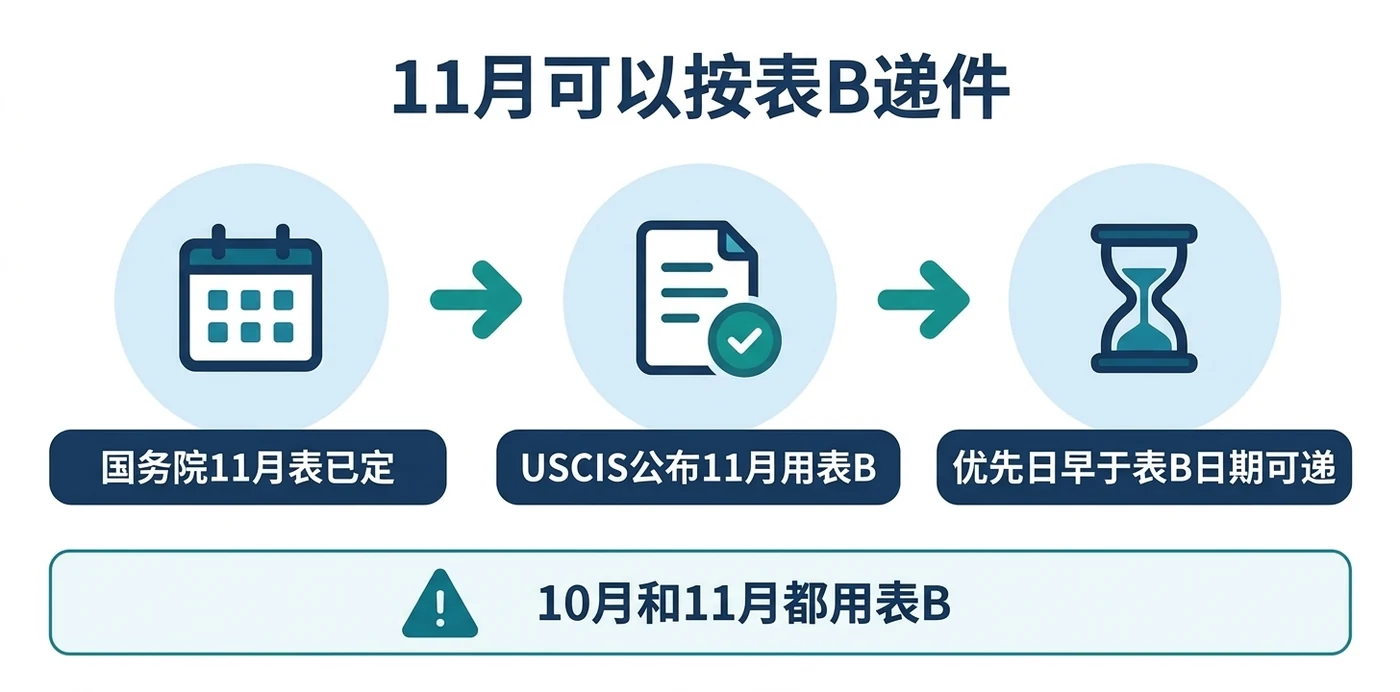
Yes. USCIS has announced that both family-based and employment-based applicants use Chart B (Dates for Filing) for the I-485 in November. When we checked on October 22, 2026, USCIS's filing charts page said so under "Next Month's"; October also uses Chart B.
- If your priority date is earlier than the Chart B date for your category and country, you can file an I-485 in November (confirm other eligibility with an immigration attorney).
- Exception: if a category's Chart A shows "C", or its Chart A date is later than its Chart B date, applicants in that category may use Chart A instead.
- Chart B only decides whether you can file; when the green card is approved depends on Chart A.
To get the December dates and USCIS's chart choice, subscribe to the bulletin email:
visa-updates
One email each month when the bulletin lands. Unsubscribe anytime.
04 A date on the chart is not a waiting time
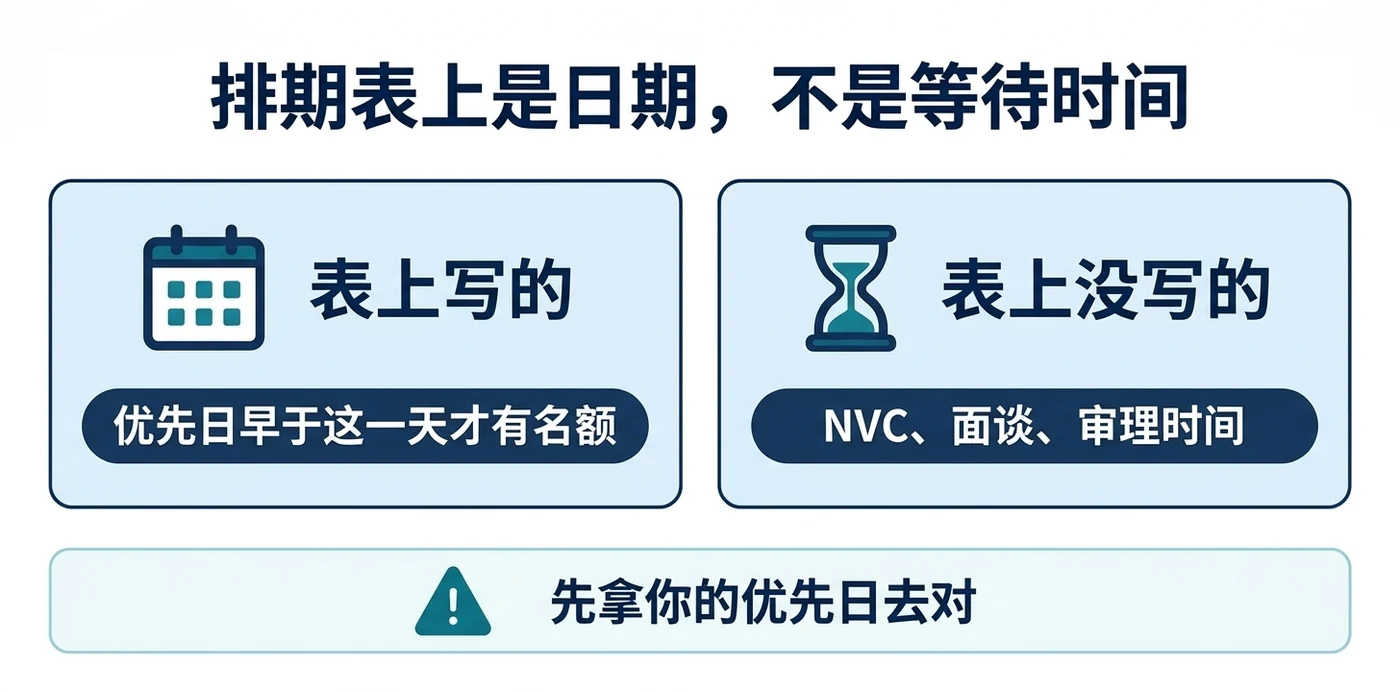
The chart says which priority dates can get a number, not how long you will wait. From filing the I-130 to getting the green card there is also NVC, the interview or I-485 processing time, and the chart does not show that.
FAQ
Did any category go backward in the November 2026 bulletin?
No. Every Final Action Date moved forward or stayed the same. Worldwide EB-3, which went back in October, moved forward 31 days but is not yet back to September's 2024-09-01.
When will the December 2026 bulletin come out?
The State Department publishes next month's bulletin on no fixed date. Across the 94 bulletins from January 2019 to October 2026, the median publication day is around the 13th or 14th; see when the visa bulletin is published. We do not predict December's dates: the same category can move in a different direction each month, so there is no basis for projecting from last month.
Sources: the State Department's Visa Bulletin for November 2026 (Section A, items 1, 2 and 4); USCIS's "Adjustment of Status Filing Charts from the Visa Bulletin" page (checked October 22, 2026). Last-month comparisons are from the CareerEngine bulletin archive. This is not legal advice; consult an immigration attorney about your situation.