

In short: in the first bulletin of the new fiscal year, China's employment-based Dates for Filing (Chart B) jumped, and USCIS has confirmed that employment-based applicants may use Chart B to file I-485 in October. EB-3 Chart B moved 814 days to April 1, 2024, and EB-2 Chart B moved a full year to January 1, 2023. The Final Action Dates (Chart A), which decide when a green card can be approved, moved only a few days, and the worldwide EB-2 and EB-3 columns went backward.
If you are in the US and your priority date is before those dates, you can file I-485 this month. Details below.
01 What moved this month
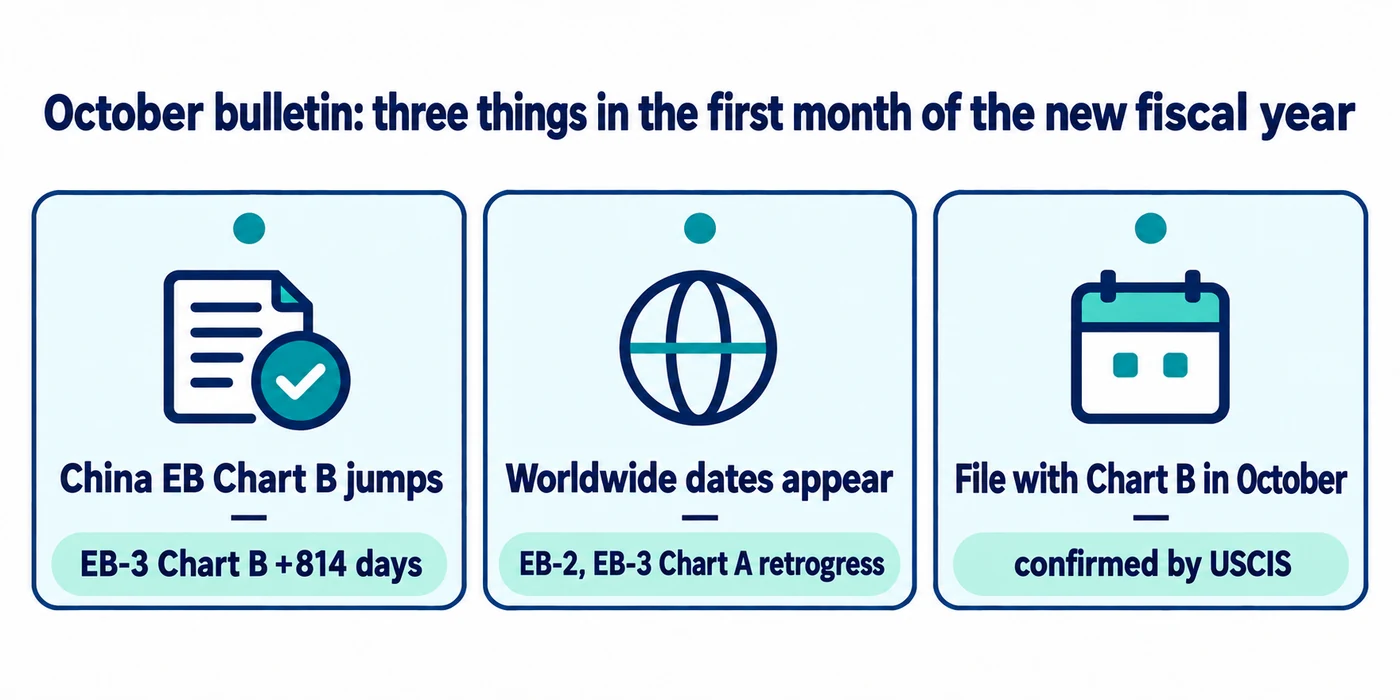
The October 2026 Visa Bulletin is out. It is the first bulletin of fiscal year 2027, which started October 1. The tables below are live data from the same source as the homepage tables.
China mainland: Chart B jumps, Chart A inches
EB categories are employment-based (EB-1 priority workers, EB-2 advanced-degree professionals, EB-3 skilled workers, EB-4 special immigrants, EB-5 investors).
Employment-based
(China (mainland-born))China mainland, side by side:
| Category | Chart A (Final Action) | Chart B (Dates for Filing) |
|---|---|---|
| EB-1 | 2023-07-01, no change | 2024-07-01, +213 days |
| EB-2 | 2021-10-01, +30 days | 2023-01-01, +365 days |
| EB-3 | 2022-01-08, +7 days | 2024-04-01, +814 days |
| EB-5 (non-regional) | 2016-12-01, no change | 2021-03-01, +1,461 days |
Chart B moved a lot and Chart A barely moved. The two only make sense read together, which section 03 does.
Worldwide: EB-2 and EB-3 went backward
"Worldwide" means every country except China mainland, India, Mexico and the Philippines.
Employment-based
(All chargeability areas except those listed)- EB-2 Chart A went from Current ("C") to January 1, 2025, and Chart B to March 15, 2026
- EB-3 Chart A retrogressed 109 days, from September 1, 2024 to May 15, 2024
The State Department explains this in the bulletin: with FY 2027 numbers available, many categories advanced, but "some employment-based visa categories for 'Rest of World' countries have retrogressed, and these retrogressions are necessary to keep visa issuances within FY 2027 quarterly and annual limits."
Family: only spouses of green card holders moved
Family-sponsored
(All chargeability areas except those listed)F2A (spouses and minor children of green card holders) Chart A moved 31 days to September 22, 2026. Nothing else moved. USCIS says family-based applicants keep using Chart B in October, and F2A's Chart B is "C". If you are the spouse of a green card holder and you are in the US, you can file I-485 at any time this month.
02 Why Chart B applies this month, and what it means for you
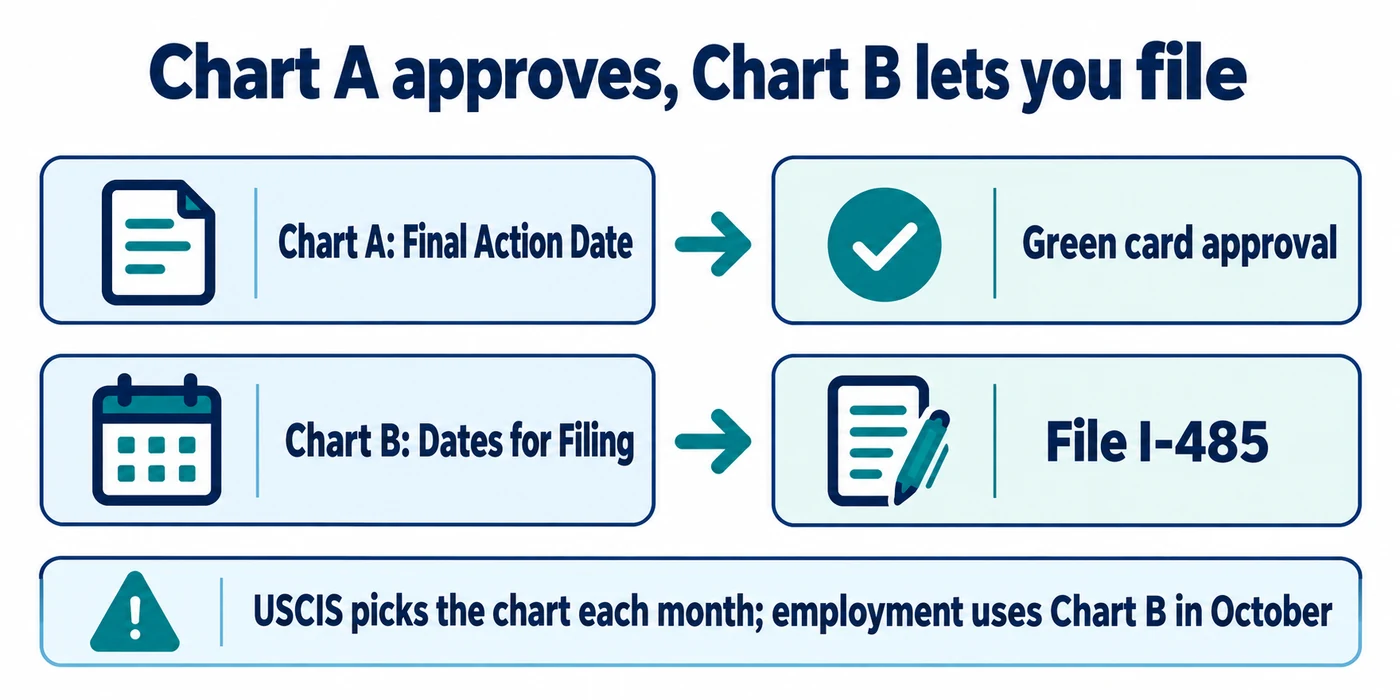
There are two charts. Chart A (Final Action Dates) decides when your green card can be approved. Chart B (Dates for Filing) decides when you can submit I-485 (the adjustment of status application you file to get a green card from inside the US).
USCIS decides each month which chart applicants must use and announces it within about a week of the bulletin. For October it says:
"For all employment-based preference categories, you must use the Dates for Filing chart in the Department of State Visa Bulletin for October 2026."
In September, employment-based applicants had to use Chart A, so this is a real change.
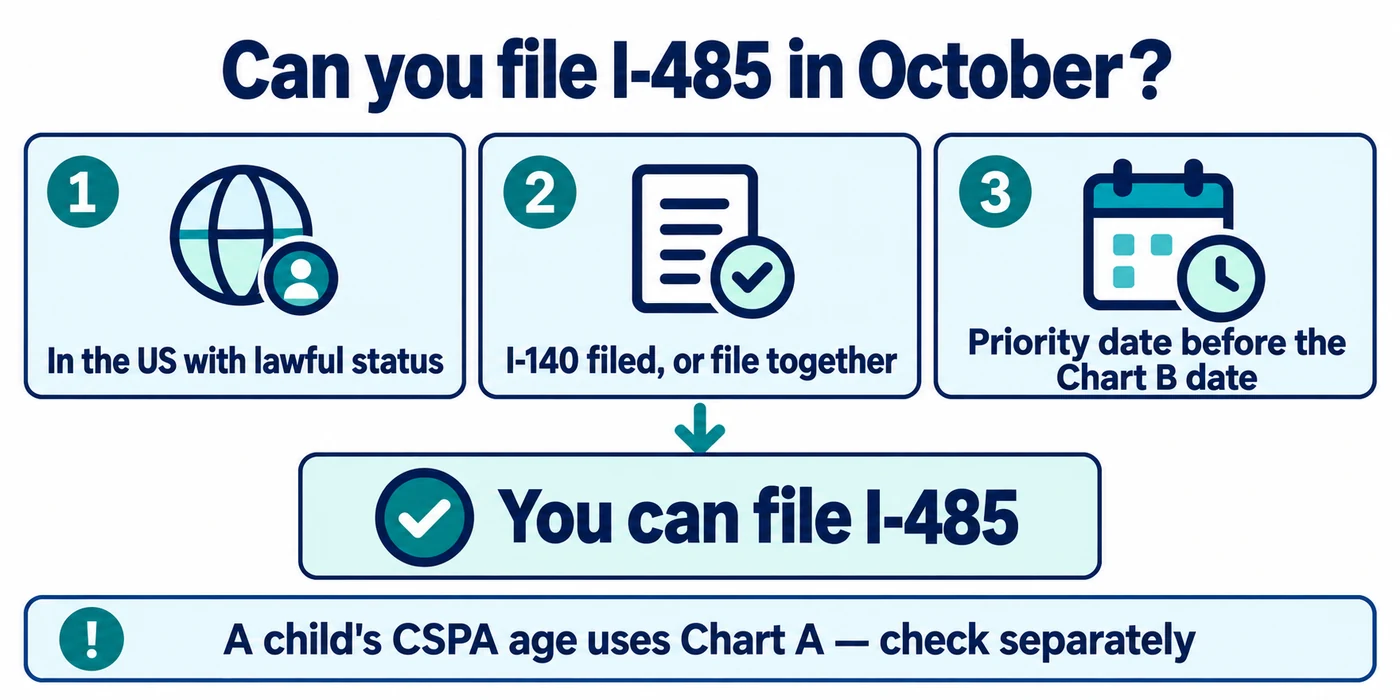
Can you file? Check three things
- You are in the US with lawful status (for example H-1B, F-1 OPT, L-1)
- Your I-140 has been filed or approved, or you file it together with the I-485 (concurrent filing)
- Your priority date is before your category's Chart B date. China mainland: EB-1 before 2024-07-01, EB-2 before 2023-01-01, EB-3 before 2024-04-01
Your priority date (PD) is the date your PERM labor certification was filed, or the I-140 filing date if there was no PERM. It is printed as "Priority Date" on the I-140 approval notice (I-797).
If all three hold, you can file this month. What filing gets you:
- Work permit (EAD) and advance parole (AP) while the I-485 is pending, so you no longer depend only on H-1B status to work
- AC21 job portability: once the I-485 has been pending 180 days, you can move to a same-or-similar job with a new employer without starting over
- Your family in line: your spouse and children can file as derivatives
But filing is not approval
Chart B only gets you into the line. The green card is approved when Chart A reaches your priority date. China EB-3 Chart A is January 8, 2022, more than two years behind Chart B's April 1, 2024.
One trap: a child's CSPA (Child Status Protection Act) age uses Chart A, not Chart B. Since August 2025, USCIS again calculates CSPA age using Final Action Dates. If your child is close to 21, filing under Chart B does not lock their age. Work this out with your attorney separately.
03 Chart B jumped. Will Chart A catch up?
This is the question worth thinking through this month.
Charlie Oppenheim, the former head of State's visa control office, has explained how Chart B is set: at "a point where we believe the final action dates will be anywhere from 8 to 12 months in the future." So the gap between Chart A and Chart B is State's own forecast for the next year.
Read that way, China EB-3 Chart B jumping to April 2024 says State expects meaningful EB-3 movement for China over the coming year. EB-2 Chart B moving to January 2023 sends the same signal.
Two things pull the other way, though.
First, the worldwide column now has cut-off dates. China and India sometimes move quickly because of spillover: when worldwide numbers go unused (shown as "C"), the extra numbers can go to the earliest China and India applicants without regard to the 7% per-country cap. This month worldwide EB-2 and EB-3 both have dates, which means worldwide demand alone is enough to use the numbers. In plain terms, that spillover channel is closed for now. State said the same about EB-1 in the past: once a worldwide date was set, "applicants from India are no longer able to receive EB-1 numbers" through that exception. The same logic applies to EB-2 and EB-3 this month.
Second, this is the first month of the fiscal year. Numbers reset every October, and State usually opens up first and tightens as demand appears. The April 2026 bulletin warned exactly this: after advancing, "retrogression may be necessary later in the fiscal year" as demand materializes.
The safer reading: the Chart B jump is a positive signal and a real filing window, but not a promise that Chart A will jump too.
Should EB-2 applicants consider downgrading to EB-3?
China EB-3 Chart B (2024-04-01) is now more than a year ahead of EB-2 Chart B (2023-01-01). If you are EB-2 with a priority date between 2023 and March 2024, you cannot file under EB-2 this month, but you could under EB-3.
A downgrade needs your employer to file an EB-3 I-140, and you can keep your priority date. It has several moving parts (whether your employer will do it, whether you can switch back, which Chart A moves first). We covered it in detail here: EB-3 Chart A catches EB-2 Chart B: should you downgrade now. Check with your immigration attorney before deciding.
One more thing to know: State cannot see who is planning to downgrade until those cases actually land. If many people move from EB-2 to EB-3 this month, EB-3 may slow later because of the sudden extra demand.
04 What to do now
- Find your priority date on your I-140 approval notice (I-797).
- Compare it with Chart B. China mainland: EB-1 before 2024-07-01, EB-2 before 2023-01-01, EB-3 before 2024-04-01 means you are in the window this month.
- Contact your attorney and start on documents now. The medical exam (I-693), birth and marriage records all take time. USCIS can switch back to Chart A any month, and Chart B in October does not guarantee Chart B in November.
- If you have a child near 21, work out CSPA separately with your attorney, because the age lock uses Chart A.
- Spouses of green card holders (F2A) in the US can file any time this month.
We will update this as soon as USCIS announces the chart for November. To get an email when it does, subscribe:
visa-updates
One email each month when the bulletin lands. Unsubscribe anytime.
Also: how the community predictions did
Last month, 1,125 votes were cast in the community prediction for the October bulletin. The results: EB-1 Chart A "no change", EB-2 Chart A "advance about 1 month" (30 days), EB-3 Chart A "no change" (7 days). 122 votes were right, about one in ten. November predictions are open, make your call.
Sources: U.S. Department of State, Visa Bulletin for October 2026; USCIS, "Adjustment of Status Filing Charts from the Visa Bulletin" (checked September 29, 2026); Charlie Oppenheim's public explanation of how the Dates for Filing chart is set; 8 USC 1152(a)(5) (the exception to the per-country limit). This article is not legal advice; please consult an immigration attorney about your situation.