

Since Chart B opened I-485 filing (the application to adjust status, the form you file to get a green card from inside the United States) in October, the question people ask most is about the immigration medical exam: when to go, which clinic, which vaccines, how much it costs, and whether the company pays.
The short answer: you can book the exam now, and doing it early does not make it expire. Look up designated doctors by ZIP code on the USCIS (U.S. Citizenship and Immigration Services) website, and when you call, ask what the price includes and whether missing vaccines can be given on the spot. You pay the exam fee yourself; whether your company reimburses it depends on company policy.
Below, one question at a time. For each point we checked the original text of the USCIS Policy Manual, the Form I-693 (Report of Immigration Medical Examination and Vaccination Record) instructions, and the official guidance the Centers for Disease Control and Prevention (CDC) gives to exam doctors.
01 When should I do the exam? Will it expire if I do it early?
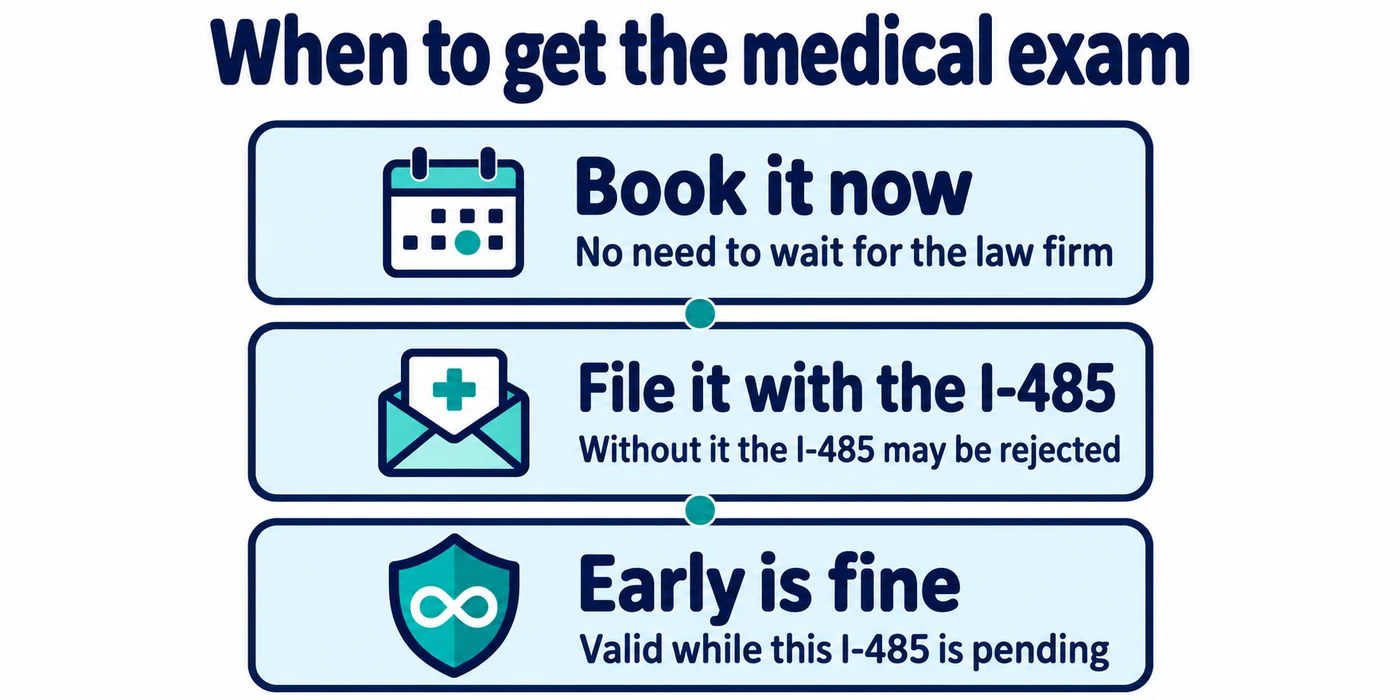
You can do it now; there is no need to wait for the law firm. Two rules set the timing:
- It must be filed with the I-485. USCIS states on its official Form I-693 page that from December 2, 2024, the medical form must be submitted together with Form I-485, otherwise USCIS "may reject your Form I-485." So if you want to file on Chart B this month, the exam has to be finished before you file.
- Doing it early does not make it expire. Policy Manual Volume 8, Part B, Chapter 4 says an I-693 signed by the civil surgeon on or after November 1, 2023 stays valid for the entire time "the immigration benefit application with which the Form I-693 is submitted" is pending. The old rule that the form had to be filed within 60 days of the doctor's signature was permanently removed by USCIS on March 31, 2023.
One thing to note: since June 11, 2025, the medical form is valid only for the application it was filed with. If you later file a different application (for example, a new I-485 after a denial), you need a new exam.
02 Where do I find an exam doctor?
The immigration medical exam can only be done by a doctor USCIS has designated as a civil surgeon; an exam by your regular family doctor does not count.
How to search: open the USCIS Find a Civil Surgeon page, enter an address, city or ZIP code, and it lists designated doctors nearby. It works nationwide, the same for the Bay Area, Boston, Seattle and New York. You can also call the USCIS Contact Center at 1-800-375-5283.
The I-693 instructions add a reminder: doctors on the list are generally still designated, but if you are unsure, call and ask directly, "Are you currently a civil surgeon?"
Five things worth asking on the phone:
- The total price, and whether it includes the blood tests (tuberculosis, syphilis) and lab fees.
- Whether missing vaccines can be given on the spot, and how much each shot costs.
- How many days the tuberculosis blood test takes, and roughly how long until you get the sealed envelope.
- Whether you should send your vaccine records in advance.
- Whether the doctor or front desk speaks Chinese (if you need it).
A common complaint in chat groups is "the quote looked cheap, then vaccines and blood tests were extra." Asking for the total price is more useful than comparing the visit fee alone.
03 What is checked on exam day, and what should I bring?
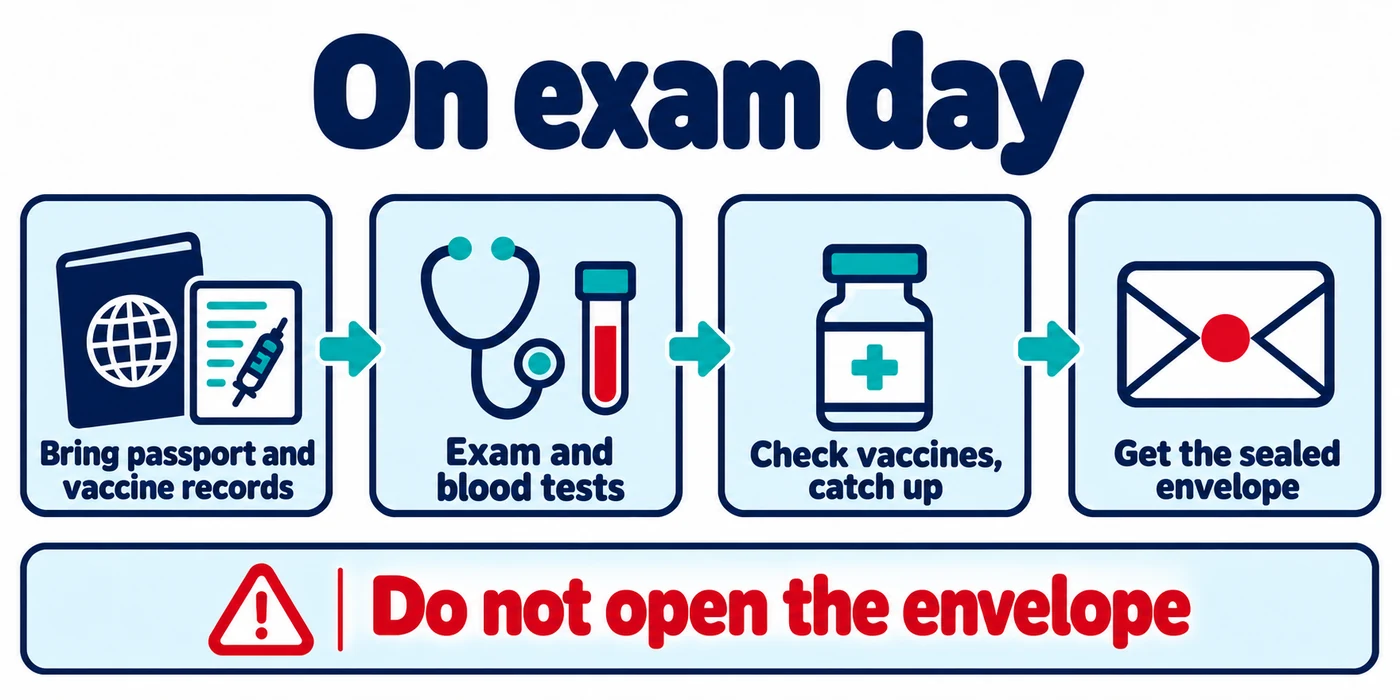
Bring:
- A valid government-issued photo ID, such as an unexpired passport or driver's license. The I-693 instructions say the doctor will verify your identity.
- Every vaccine record you can find. Your Chinese vaccination booklet and past checkup records can all come along; each shot needs a specific date.
What is checked:
- Under CDC guidance, everyone aged 2 and older gets a tuberculosis blood test (IGRA, interferon-gamma release assay, a blood test for TB infection).
- People aged 18 to under 45 are tested for syphilis.
- People aged 18 to 24 are tested for gonorrhea.
- Your vaccines are checked, and missing ones are caught up (see the next section).
The last step matters most: the doctor gives you the completed I-693 in a sealed envelope. The I-693 instructions say: do not accept the form unless it is in a sealed envelope; if the envelope is opened or altered in any way, USCIS will return the form. Never open it yourself. If you want to read it, ask the doctor for a separate copy.
Each family member needs their own exam and files their own I-693.
04 Which vaccines do I need? Do I need a flu shot now?
CDC's list has 15: diphtheria, tetanus, pertussis, polio, measles, mumps, rubella, rotavirus, Haemophilus influenzae type b, hepatitis A, hepatitis B, meningococcal disease, varicella, pneumococcal disease and influenza. They are age-based, so each person needs different ones; the doctor marks the ones that don't apply to your age.
Two points matter right now:
- You will likely need a flu shot now. CDC guidance says the flu vaccine is usually given from fall through early spring; outside that period, when it isn't available, the doctor notes "not flu season." October is flu season, so most people getting the exam this month will need one.
- The COVID-19 vaccine is no longer needed. USCIS announced on January 22, 2025 that it no longer requires proof of COVID-19 vaccination, and CDC's current list does not include it.
If you don't have a vaccine booklet, you can prove immunity with a blood test (CDC accepts this for measles, mumps, rubella, hepatitis A, hepatitis B, polio and varicella) or simply get the shots. How to track down old records and which option costs less is covered in our previous article: You Can File I-485 on Chart B in October: 7 Common Questions.
05 Who pays for the exam? Can I get vaccines at a pharmacy?
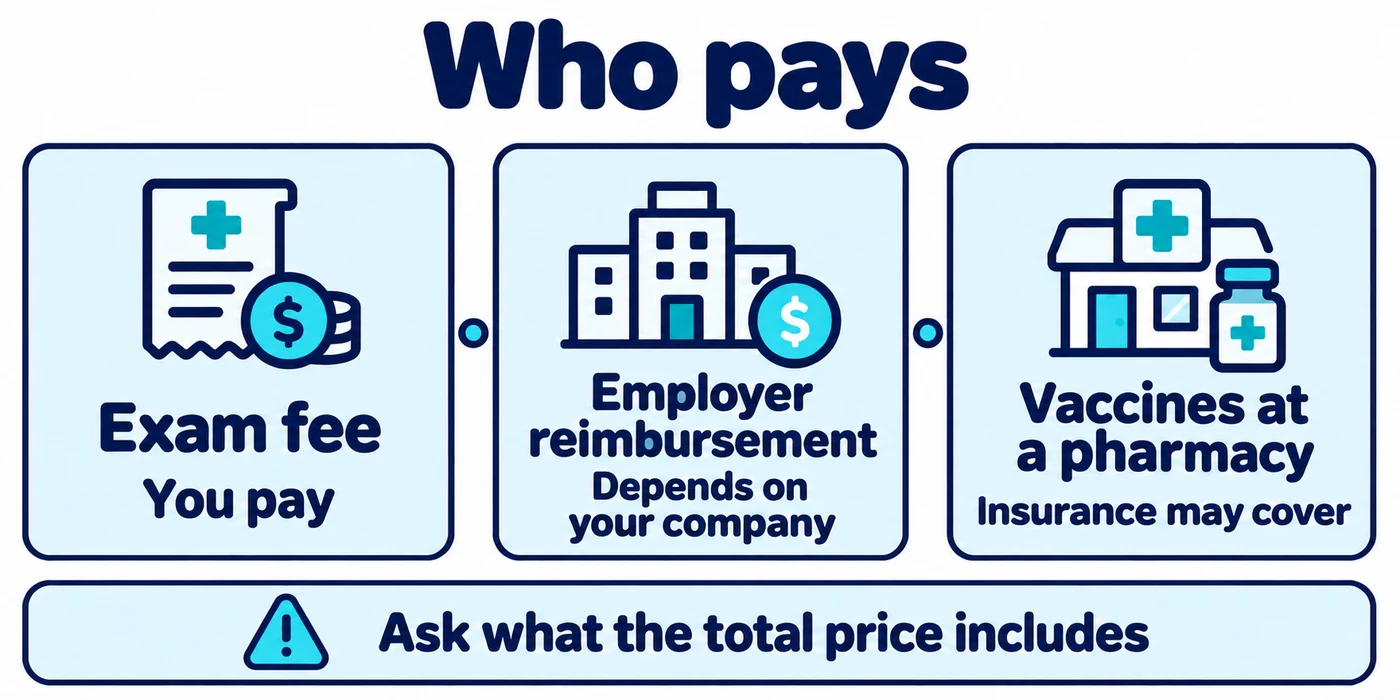
- The applicant pays for the exam. The I-693 instructions say the applicant must pay all costs of the medical exam, including any follow-up tests or treatment required, directly to the doctor. USCIS does not set the price; each clinic sets its own.
- Company reimbursement depends on company policy. Some companies count the exam fee as an immigration expense and reimburse it, others don't; if your spouse works for a different company, ask there separately. Asking HR or the law firm handling your case is fastest.
- Catching up vaccines at a pharmacy: yes, but it isn't always free. Many people first get missing shots at a pharmacy such as CVS or Walgreens, or from their own family doctor, which is usually cheaper through insurance. Under U.S. health insurance rules, many plans cover recommended vaccines with no out-of-pocket cost (see the healthcare.gov preventive services page), but whether yours is free depends on your insurance and the specific vaccine, so ask before you go. Then bring the vaccination record back to the exam doctor to be recorded.
06 The three most common mistakes
- Opening the envelope. Once opened it is void, and you have to go back to the doctor to have it resealed.
- Waiting for the law firm before booking. In busy areas an appointment can take a week or two, and the tuberculosis blood test needs time for results. If you want to file this month, call now.
- Comparing only the visit fee. Ask whether vaccines, blood tests and lab work are charged separately.
Help the next person
Which clinic did you use, how much did you pay, how long did you wait, and where did you get your vaccines? You can add it anonymously to our I-485 progress tracker. Once enough people report, we will turn it into a guide to exam clinics by area, so the next person doesn't have to ask around in chat groups one by one.
For everything you need to prepare for the I-485, check the Employment-Based I-485 Document Checklist.
Sources: USCIS Policy Manual Volume 8, Part B, Chapter 4 (I-693 validity; removal of the 60-day rule); USCIS Form I-693 page (must be filed with Form I-485 from December 2, 2024); Form I-693 instructions (edition 01/20/25: identification, sealed envelope, applicant pays the fee); USCIS Find a Civil Surgeon page; CDC Technical Instructions for Civil Surgeons, chapters on vaccination, tuberculosis, syphilis and gonorrhea (vaccination page updated March 11, 2025); USCIS notice of January 22, 2025 on COVID-19 vaccination; healthcare.gov adult preventive services page. All accessed September 29, 2026. This article is not legal or medical advice.
One email each month when the bulletin lands. Unsubscribe anytime.
Email alerts when your case status changes (in development)
We're building receipt-number tracking with automatic alerts and typical processing times. Join the waitlist to be first. This also subscribes you to the monthly bulletin email; unsubscribe anytime.