

"I left China more than five years ago, and under the Party constitution, six months without paying dues means you've automatically left the Party. So how do I answer this question on my 485?" That is the question former Chinese Communist Party members ask most often when they apply for a green card.
(In this article, 485 means Form I-485, the application to adjust status; on the forums, DY is shorthand for a Party member. Youth League members have a separate article: I-485 RFE for Proof of Leaving the Communist Youth League: Three Real Cases.)
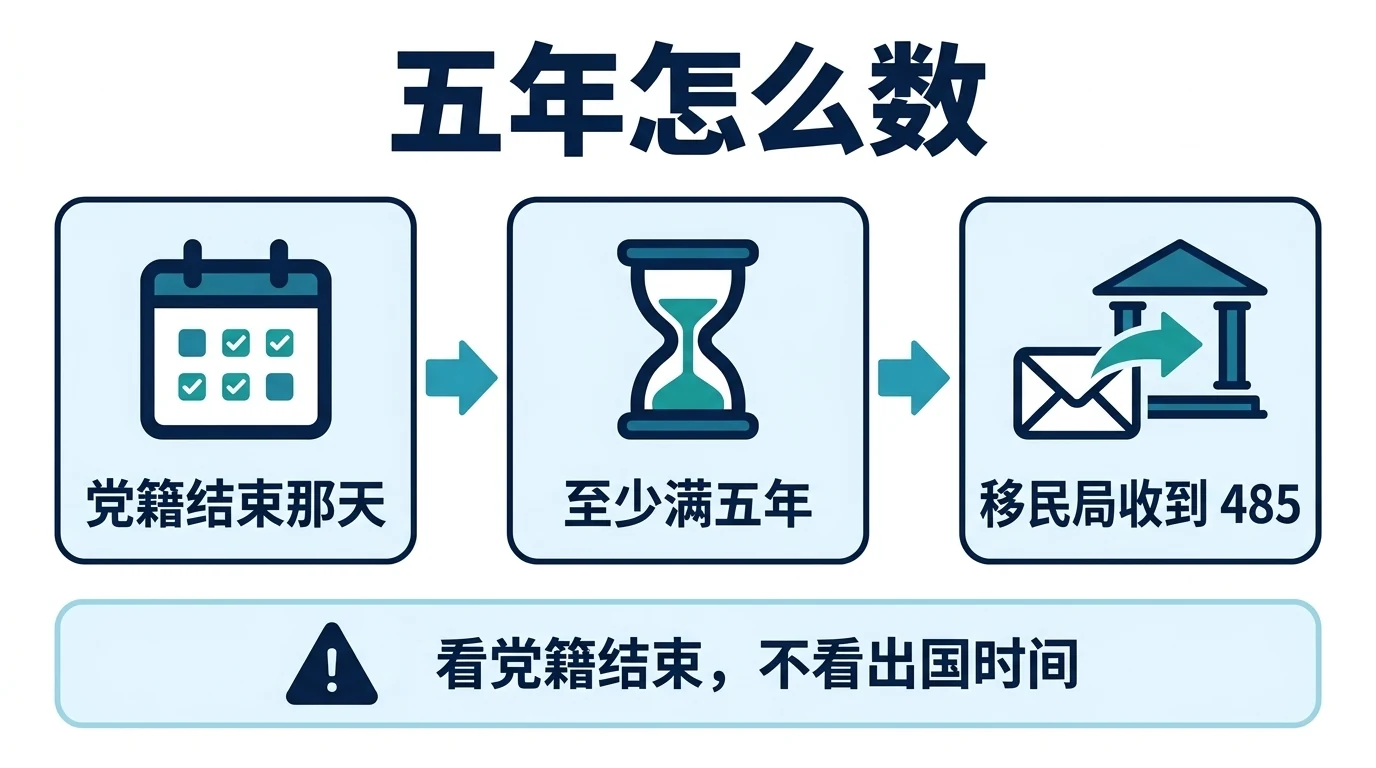
Bottom line first: the law doesn't count how many years you've been abroad. It counts how many years since your Party membership ended, all the way up to the day USCIS receives your 485. And the Party constitution adds one more step to "automatically leaving," which is exactly where USCIS evidence requests get stuck.
Below we cover the rules first, then four real cases with outcomes. All of the cases are the applicants' own accounts on a Chinese immigrant forum, not verified decision records. This article is a compilation, not legal advice.
What the rules say: former membership doesn't automatically rule out a green card
The legal basis is the Immigration and Nationality Act, INA 212(a)(3)(D). USCIS Policy Manual, Volume 8, Part F, Chapter 3 says:
Any immigrant who is or has been a member of or affiliated with the Communist or any other totalitarian party (or subdivision or affiliate thereof), domestic or foreign, is inadmissible.
The same chapter also lists exceptions. For Party members who have lived abroad for years, the most relevant one is "past membership." You need both of these:
- Your membership ended at least 5 years before the date USCIS receives your application (5 years for a party that controls the government of a totalitarian dictatorship; 2 years otherwise);
- You are not a threat to the security of the United States.
One line from the manual is worth remembering:
In cases that involve past membership, mere termination for the requisite time period is sufficient; active opposition is not required.
There is also a separate exception for membership that was involuntary, solely under age 16, or needed to get a job or the essentials of living. And if you have a U.S. citizen or green card holder relative, you may be able to apply for a waiver on Form I-601 (Application for Waiver of Grounds of Inadmissibility); more on that below.
The burden of proof is on you. The manual says the applicant must establish the exception. That's why USCIS asks you to "prove," not just "explain."
The hard part: when did "automatic withdrawal" actually end your membership?
Article 9 of the Constitution of the Communist Party of China (official English translation quoted in China Daily's "CPC Encyclopedia" entry):
A Party member who, without good reason, fails to take part in the regular activities of his or her Party organization, pay membership dues, or carry out work assigned by the Party for six consecutive months shall be regarded as having given up his or her membership. The Party branch concerned should, through a general meeting, decide on the removal of their name from the Party rolls and report it to the Party organization at the next level up for approval.
Many applicants' statements quote only the first sentence. But the second sentence says the branch still has to decide and the next level up has to approve. The RFE in Case 4 below cited exactly this point: not paying dues and "automatically leaving" isn't enough; leaving requires "discussion and approval by the higher Party organization."
The USCIS Policy Manual does not say what evidence it accepts to prove the date your membership ended. So on this point, standards may vary a lot from officer to officer, and the four cases bear that out.
There's another common mistake. In the replies to Case 3, someone pointed out to the poster: what matters is how long you haven't paid dues, not how long you've been abroad. The day you left China isn't necessarily the day your membership ended. Under the manual's wording, what you have to show is that your membership ended at least five years ago.
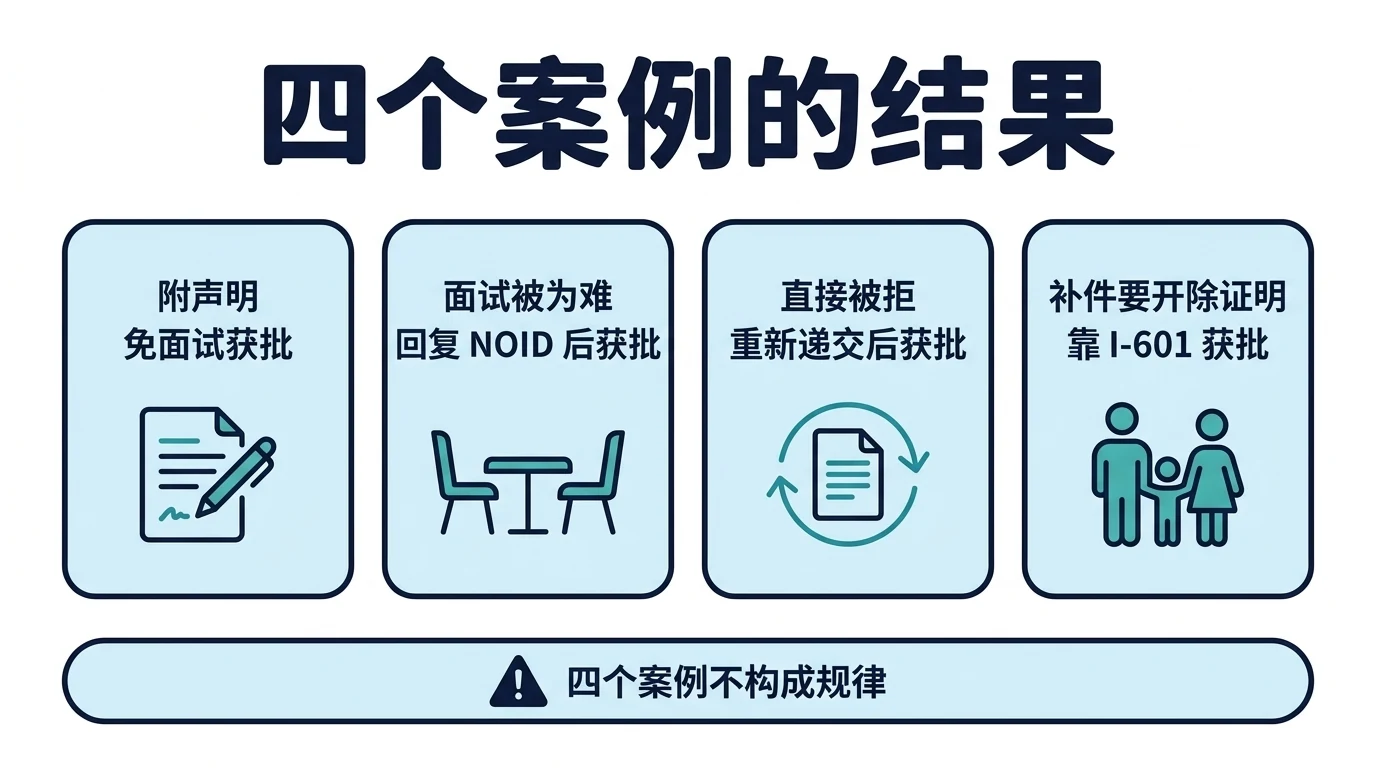
Case 1: Filed a statement, approved without an interview
An EB-1B (outstanding professors and researchers) principal applicant posted in April 2021. The applicant was a Party member, came to the U.S. in 2009, and the spouse was not a member.
- The applicant "never considered lying about the Party question" and told the lawyer early on.
- The 485 package included an affidavit explaining why the applicant had joined, stating that no dues had been paid since arriving in 2009, and citing the relevant part of the Party constitution.
- Timeline: 485 filed September 2020, fingerprints December 2020, approved April 2021, no interview.
In the applicant's own words: "Honestly, because of the Party issue, I never imagined I'd skip the interview... I had prepared for the worst."
One email each month when the bulletin lands. Unsubscribe anytime.
Case 2: Pressed at the interview, approved after answering a NOID
In September 2020, an EB-3 (third-preference employment) applicant interviewed at the USCIS field office in Hartford, Connecticut. Both husband and wife were Party members, and both had attached statements to their 485s.
- The officer got straight to the point: passive withdrawal was no longer accepted; it had to be active, with a letter to the Party branch.
- As he showed them out, the officer said this might have to do with people whose statements say they stopped paying dues but who are still members in private.
- On October 3 they received a NOID (Notice of Intent to Deny) with 30 days to respond. It said that simply resubmitting a statement would not be enough.
- Their response: the lawyer laid out the law, the applicant wrote a new statement, sent a letter to the Party branch, and had it translated and notarized through the company.
- On January 13, 2021, the case showed the card being produced.
Case 3: No RFE, no interview, denied outright; approved after refiling
In June 2023, an EB-1A (extraordinary ability) derivative applicant posted. They had been in the U.S. for 8 years and included a lawyer-written statement with the 485.
- The statement stressed "more than five years abroad." When others pressed, the poster added that it also said they hadn't paid dues for nearly eight years.
- With no interview, no RFE and no NOID, a denial notice arrived, based on Party membership. The notice said it could not be appealed but a motion to reopen was possible.
- The poster's question at the time: "Has the bar suddenly gone up... or did we get an unreasonable or careless officer who didn't see the statement?"
- In September 2025, when someone asked for an update, the poster replied: "Filed the 485 again and it was approved almost instantly."
The same statement was denied once and approved once. That suggests officers can differ a great deal. But one case is not a pattern.
Case 4: RFE demanded proof of expulsion; approved in the end through an I-601
In February 2024, an applicant who had joined the Party as a student and had been in the U.S. for more than 5 years posted. The lawyer had said that in New York, where the applicant lived, there "generally wouldn't be a problem," so the applicant truthfully answered "yes" and attached a statement.
- In January 2024 the case was transferred to the Hartford field office.
- Then came an RFE (Request for Evidence) demanding proof that the Party had expelled the applicant. It attached a web page saying that five years of unpaid dues and "automatic withdrawal" weren't enough, and that leaving requires "discussion and approval by the higher Party organization." The response deadline was only one month.
- The applicant had a U.S.-born child and filed an I-601 waiver.
- After that came: a denial because the RFE response was not received (reopened with Form I-290B, a motion to reopen or reconsider), a medical exam RFE, an interview, and another request for a withdrawal certificate from the embassy.
- Approved about 15 months after the original filing. The applicant's summary: "The certificate from China didn't help either... it all came down to the 601."
The applicant also wrote: "If you really could provide proof that you were expelled more than five years ago, I'd guess they'd ask why you didn't submit it with your 485 in the first place."
Keep your answers consistent
In all four cases, the applicants truthfully answered "yes" on the 485 and attached a statement. From their accounts, officers questioned whether and when the membership ended, not whether the applicant was hiding something. The Case 2 officer said plainly what worried him: statements claiming no dues were paid, from people who were still members in private.
That's why consistency matters more than wording:
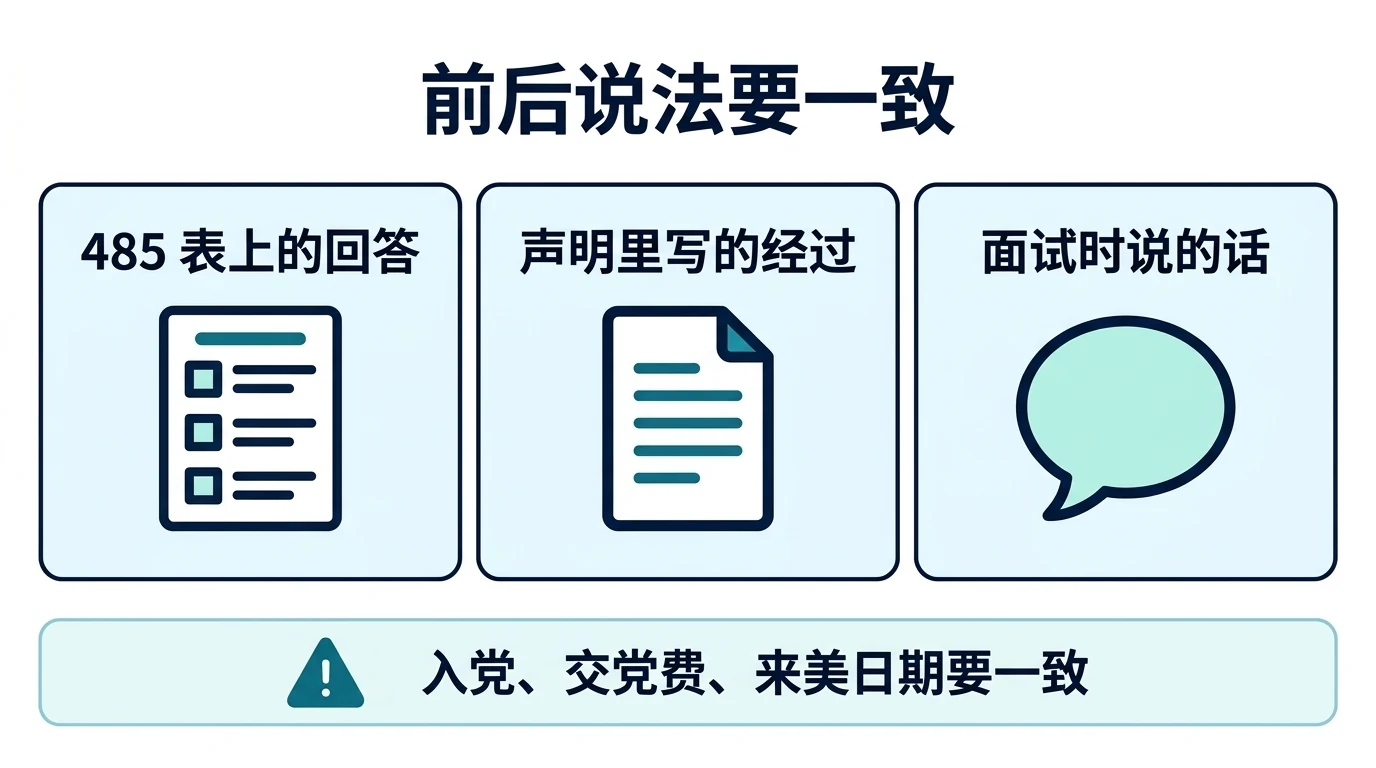
- Your answer on the 485, the history in your statement and what you say at the interview need to match. The date you joined, the last time you paid dues and the date you came to the U.S. should be the same everywhere.
- The officer may also see what you wrote on earlier visa applications.
- If you really did answer wrong before, the Policy Manual (Volume 8, Part J, Chapter 3) says that a correction made voluntarily and in time, before an officer exposes it and before the proceeding ends, means the misrepresentation is "eliminated as if it had never happened." If you find a mistake, work with a lawyer to correct it promptly rather than waiting.
One path not to take
On the forums, people often say "just answer no."
Policy Manual Volume 8, Part J, Chapter 2 says that obtaining an immigration benefit through fraud or willful misrepresentation is a ground of inadmissibility, and the person "will be barred from admission for the rest of his or her life unless the alien qualifies for and is granted a waiver." Past Party membership can be resolved through the five-year rule or an I-601; deliberately hiding it turns it into a bigger problem that's much harder to fix. The Case 4 applicant put it this way: if you're denied you can file again, but if you're caught lying, "you'll never be able to come to the U.S. again."
This article does not discuss that path.
If no exception applies: the I-601 waiver
The Policy Manual says this ground can be waived if:
- You are the parent, spouse, son, daughter, brother or sister of a U.S. citizen, or the spouse, son or daughter of a permanent resident;
- You are not a threat to the security of the United States; and
- You warrant a favorable exercise of USCIS's discretion.
The form is I-601. If you don't have a qualifying relative, this path isn't open to you. Case 4 worked because the applicant had a U.S.-born child.
What four cases can and can't tell you
What they show:
- All four former Party members ended up with green cards. But we picked threads with outcomes; people who were denied and never posted again aren't included.
- The paths were very different: one skipped the interview, one was denied and refiled, one took 15 months.
- The same kind of statement can get different results from different officers. The two cases pressed at an interview or through an RFE (Cases 2 and 4) were both at the Hartford office.
- The idea that not paying dues means you "automatically left the Party" has been explicitly challenged in at least one RFE.
What they can't show: four cases are not a pattern. We don't know how often people are denied or pressed.
Especially in these situations, talk to a qualified immigration lawyer:
- Fewer than five years between the end of your membership and your 485 filing;
- An RFE asking for proof of expulsion or a Party withdrawal certificate;
- No relative who would qualify you for an I-601;
- Discovering that earlier forms don't match the facts.
Compiled from applicants' own accounts on a Chinese immigrant forum, the USCIS Policy Manual and the text of the Constitution of the Communist Party of China. The cases have not been verified and are shared only to show others' experiences.
Email alerts when your case status changes (in development)
We're building receipt-number tracking with automatic alerts and typical processing times. Join the waitlist to be first. This also subscribes you to the monthly bulletin email; unsubscribe anytime.