

Our last piece covered the 7 questions people asked most about filing I-485 (the adjustment of status application you file to get a green card from inside the US) on Chart B in October: You Can File I-485 on Chart B in October: 7 Common Questions. Since then, three more questions keep coming up:
- My spouse and I are both current, at different companies. Can we each file, and also list each other as a derivative? Is that the safest setup?
- If I file now, can I still leave the US in early December? Some say you must stay until the receipt notice arrives.
- I have both a pre-2022 ("legacy") EB-5 investor petition and a PERM-based EB-2 (not NIW, the National Interest Waiver) that are current on Chart B. Which should I file on?
We take them one at a time. For each, we checked the text of the USCIS Policy Manual, the federal regulations and the form instructions. Where no official rule says something clearly, we say "USCIS does not say" rather than guess.
01 Both spouses are current at different companies. Can we each file, and also list each other as a derivative?
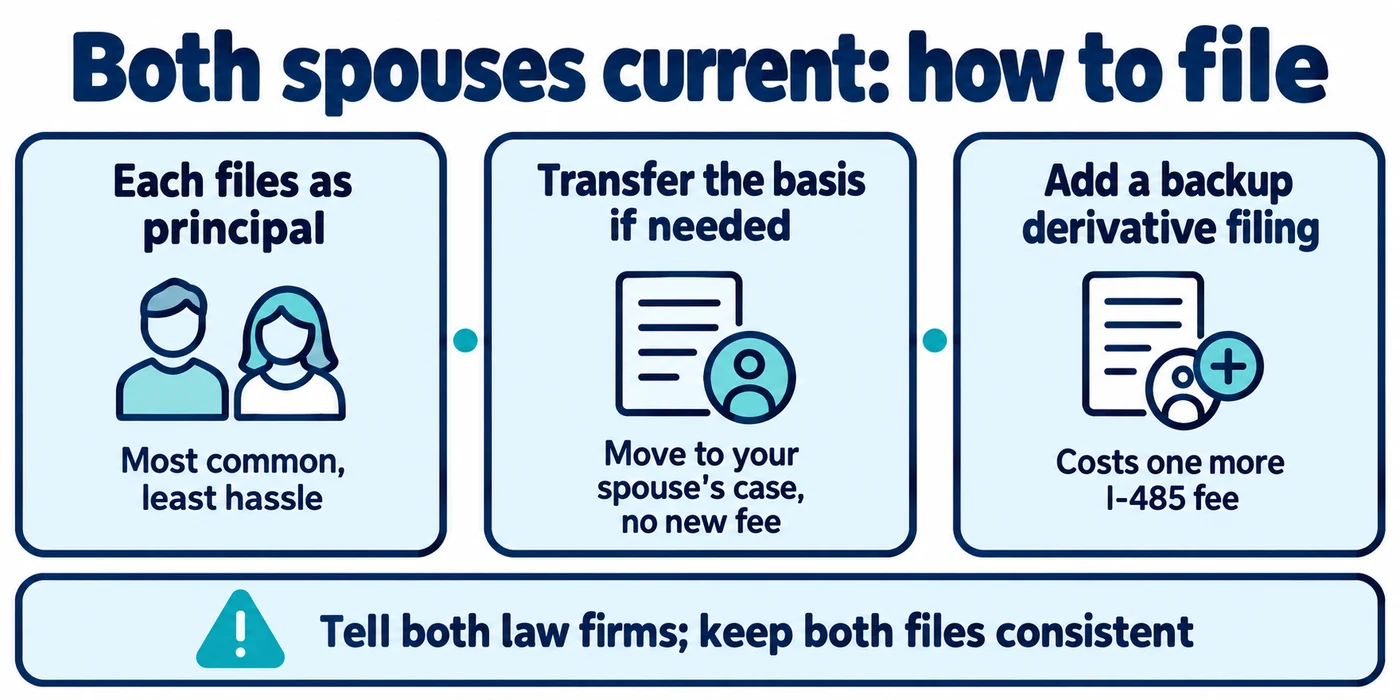
The short answer: each spouse filing as a principal on their own case is completely normal. You each have your own I-140 (the immigrant petition your employer files for you), and if both priority dates are current on Chart B, you can each file.
The real question is the second half: should you also file a second I-485 as a derivative on your spouse's case?
What USCIS says
- We found no rule saying a person may have only one pending I-485. In its employment-based adjustment FAQ, USCIS even mentions having to account for people "who have multiple pending adjustment of status applications in different categories." So a second filing is not prohibited, but USCIS also does not recommend it.
- Each I-485 needs its own fee. Under the fee schedule in effect since April 2024, I-485 is $1,440 on paper or $1,390 online. A work permit application (I-765) filed with a pending I-485 is $260, and advance parole (I-131, also called AP) is $630 on paper. USCIS does not say whether the backup filing also needs its own I-765 and I-131.
- The medical exam (I-693) goes with the application it is filed with. The Policy Manual says it is valid for "the entire period the immigration benefit application with which the Form I-693 is submitted is pending." Whether one exam can support two I-485s is not stated; ask your lawyer.
A derivative's case rides on the principal's
This is the key point. The Policy Manual is clear:
- Derivatives "do not independently have a basis to adjust status outside of their relationship to the principal immigrant"; they derive their status from the principal.
- "USCIS cannot approve the Form I-485 for a derivative applicant until the principal applicant has been granted lawful permanent resident status."
- If the principal is denied for fraud, the derivative's application must also be denied.
And the job-change protection after an I-485 has been pending 180 days (AC21, section 204(j) in the Policy Manual) is written for the principal, and only for EB-1, EB-2 and EB-3.
There is a way that costs nothing extra
USCIS has a formal process called a "transfer of the underlying basis": you ask USCIS to switch the petition your pending I-485 is based on. In the Policy Manual's words, "generally, no new adjustment application or filing fee is required."
In October 2022, USCIS added that spouses can transfer the basis from a petition filed for one spouse to a petition filed for the other, as long as the new category allows dependent spouses. All employment-based categories do.
The limits:
- Only transfers among EB-1, EB-2 and EB-3 count as "simple transfers." Other transfers are not guaranteed.
- Once your I-485 has a final decision (approved, denied or withdrawn), no transfer is possible. You have to act while the case is pending, not after a denial.
So what should you do
For most couples, the simplest setup is:
- Each spouse files as a principal.
- If one job or case runs into trouble, ask USCIS to transfer that I-485 to your spouse's petition while it is still pending. No new fee.
- If you want an extra layer and don't mind another fee, consider a backup derivative filing.
Whichever you choose, do one thing: make sure both companies' law firms know about each other. Addresses, marriage date and travel history must match across both filings. USCIS notices when two packages disagree.
02 If I file now, can I leave the US in early December?
First, a correction: we found no rule saying you must stay in the US until the receipt notice arrives. The form instructions say you must be physically present in the US when you file.
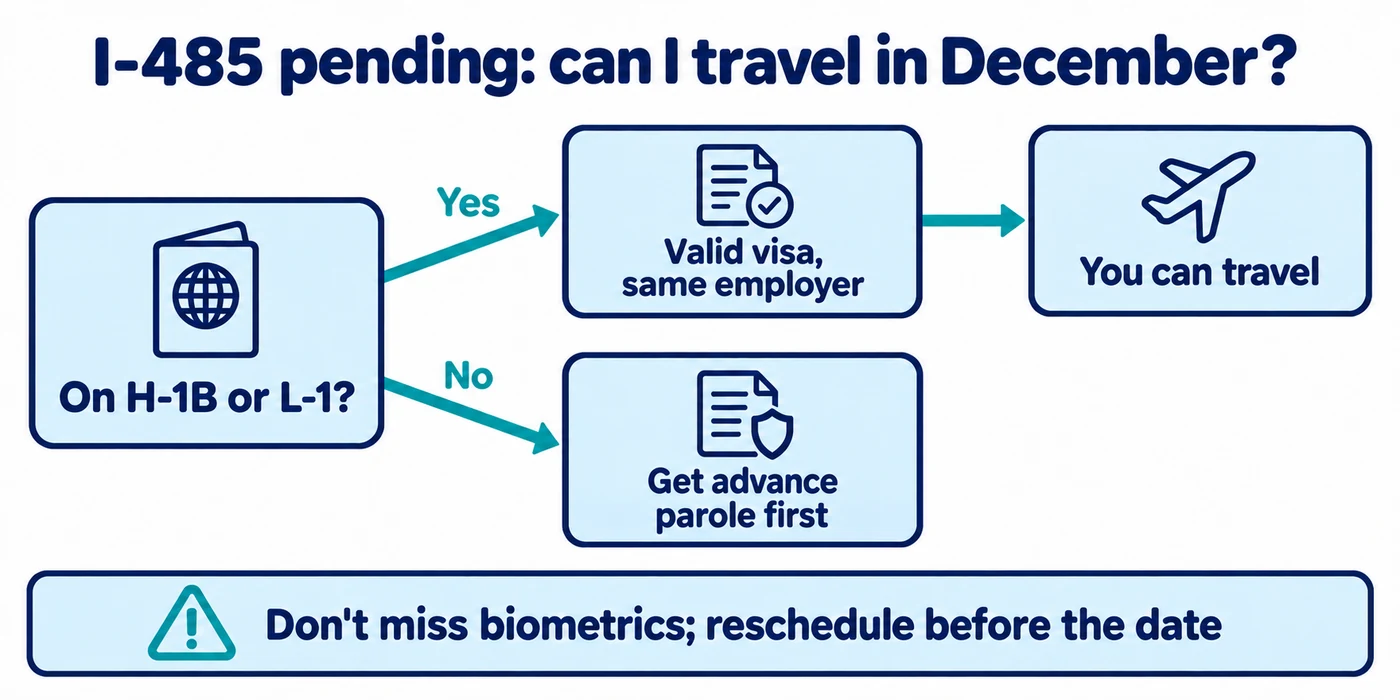
The rule that matters is a different one, 8 CFR 245.2(a)(4)(ii): leaving the US while your I-485 is pending is treated as abandoning it, unless one of these applies:
- You already have advance parole and are inspected when you return.
- You are in H-1B or L-1 status and meet all three conditions: when you return you are still eligible for H or L status; you are coming back to resume work for the same employer; and you hold a valid H or L visa. H-4 and L-2 family members are covered too, as long as the principal keeps H-1B or L-1 status and the family member holds a valid H-4 or L-2 visa.
So if you are on H-1B and your visa stamp is still valid, you can travel in early December without waiting for advance parole.
Be careful if
- Your visa stamp has expired. You would need a new stamp abroad, and administrative processing can hold you up for an unknown time. The safer path is to wait for advance parole.
- You rely on advance parole (for example on F-1 OPT, or with an expired stamp you don't plan to renew): don't leave before you have it in hand. The I-131 instructions say USCIS will generally consider the I-485 abandoned if you leave without first obtaining an advance parole document. USCIS's older adjudicator manual adds that leaving while the I-131 is pending also abandons the advance parole application itself.
- Your biometrics appointment. After you file, USCIS mails a fingerprint appointment notice, usually within a few weeks. The regulation says that if you don't appear and haven't asked to reschedule before the appointment time, the application is considered abandoned and denied. If you file in October and leave in early December, watch your mail and online account, and reschedule ahead of time if the date clashes with your trip.
Before you travel in December, check
- You are on H-1B/L-1 (or H-4/L-2), and your visa will still be valid on the day you return.
- You will come back to the same employer.
- Your fingerprints are done, or the appointment isn't during your trip.
If all three are yes, you can go. If any is unclear, ask your lawyer first.
03 A legacy EB-5 and an EB-2 (not NIW) are both current on Chart B. Which should I file on?
Here are the two China mainland rows from the October bulletin:
| Category | Chart A (Final Action) | Chart B (Dates for Filing) |
|---|---|---|
| EB-2 | 2021-10-01 | 2023-01-01 |
| EB-5 unreserved (where most legacy regional center cases sit) | 2016-12-01 | 2021-03-01 |
| EB-5 set-aside (rural, high unemployment, infrastructure) | C | C |
First, a common mistake
Many people think a legacy EB-5 (an I-526 investor petition filed before March 15, 2022) must be approved before you can file I-485. That's not right. The USCIS EB-5 Q&A says: "If you already have a pending Form I-526 or Form I-526E, including those Forms I-526 filed before March 15, 2022, you may also file a Form I-485 if you meet relevant requirements."
How the two paths differ
| EB-2 (not NIW) | EB-5 (legacy) | |
|---|---|---|
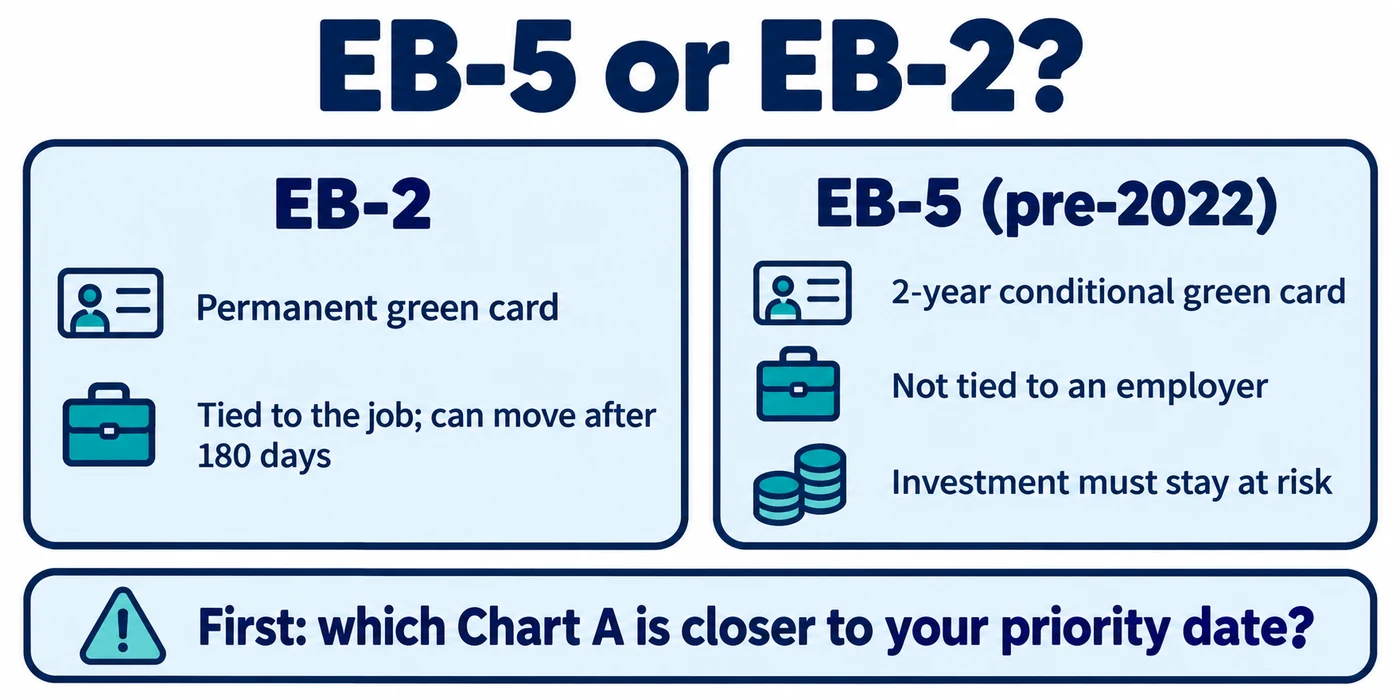
| The green card | Permanent | 2-year conditional; file I-829 (to remove conditions) within the 90 days before it expires |
| Tie to a job | You must intend to take the job after the green card; after 180 days you can move to a same-or-similar job under AC21 | Not tied to an employer; changing jobs or quitting doesn't matter |
| Investment | None | Legacy investors must keep the investment "at risk" throughout the 2-year conditional period |
| Switching later | Transfers among EB-1/2/3 are simple | Transfers between EB-5 and EB-2 are not "simple," so USCIS may not grant them |
How to decide
Don't just ask which category is "faster." Ask how far your own priority date is from each category's Chart A. For example:
- Your EB-5 priority date is June 2019: about two and a half years behind EB-5 Chart A (2016-12-01).
- Your EB-2 priority date is March 2022: only about five months behind EB-2 Chart A (2021-10-01).
In that case EB-2 will probably be approved first. The opposite can also happen, so work it out with your own two dates.
Then ask yourself three questions:
- Might you change jobs, leave or start a business in the next two years? If so, EB-5's lack of an employer tie gives you more room.
- How healthy is your EB-5 project? Two years after the conditional card you file I-829, and problems with the project directly affect removing conditions.
- Do you have a child close to 21? A child's CSPA (Child Status Protection Act) age is locked using Chart A, so whichever Chart A reaches you first is better for the child.
Can you file on both? We found no rule against it, but it means two I-485 fees, and switching the basis between EB-5 and EB-2 later is not guaranteed. Work this out with your lawyer.
When you really need a lawyer
- You and your spouse plan a backup derivative filing, or may need to transfer the basis later
- You need to travel while the I-485 is pending and your visa has expired, or you are not on H-1B/L-1
- You have both an EB-5 and an EB-2 (or another category) case
- You have a child close to 21
For the documents to prepare before filing, use our printable employment-based I-485 document checklist. Other common questions are in our previous piece: You Can File I-485 on Chart B in October: 7 Common Questions.
Sources: USCIS Policy Manual, Vol. 7, Part A, Ch. 6 and 8 (derivatives, transfer of underlying basis), Vol. 7, Part E, Ch. 5 (AC21 and 204(j)), Vol. 8, Part B, Ch. 4 (I-693 validity); USCIS "Fiscal Year 2023 Employment-Based Adjustment of Status FAQs"; USCIS fee schedule G-1055 (edition 09/09/26); Form I-485 instructions (edition 09/18/26); Form I-131 instructions; 8 CFR 245.1, 245.2(a)(4)(ii), 103.2(b)(13); USCIS "EB-5 Questions and Answers" (updated April 2026); INA 216A and 245(n); U.S. Department of State, Visa Bulletin for October 2026. All checked September 29, 2026. This article is not legal advice.
One email each month when the bulletin lands. Unsubscribe anytime.
Email alerts when your case status changes (in development)
We're building receipt-number tracking with automatic alerts and typical processing times. Join the waitlist to be first. This also subscribes you to the monthly bulletin email; unsubscribe anytime.