

In October, employment-based applicants can file I-485 (the adjustment of status application you file to get a green card from inside the US) using Chart B, the Dates for Filing chart. Many people have waited years for this. The moment the bulletin came out, the same questions started showing up in Chinese workplace chat groups:
- My PERM was filed for my old city, but I have since moved. Can I still file?
- My company's immigration lawyers haven't contacted me. Should I chase them?
- EB-3's Chart B is more than a year ahead of EB-2's. Should I downgrade?
- How long does Chart B usually stay open?
- Chart A is months away. Can I book the medical exam now? What if I have no vaccination record?
- I'm flying home for a few weeks. What should I get done?
- Does filing I-485 count as "settling abroad" under Chinese rules? Can I still renew my Chinese ID card?
We take them one at a time. For each, we separate rules with an official source from what people say in forums and groups. The second is useful, but it is not a rule.
01 My PERM is in city A, but I moved to city B. Can I still file?
The rules first
First, a PERM is tied to a worksite. A labor certification is valid only for the particular job, the person named, and the "area of intended employment" (20 CFR 656.30(c)(2)). There is no fixed mileage; it generally means normal commuting distance, roughly the same metro area. Moving to another state almost certainly takes you out of it.
Second, I-485 looks at your future job. In USCIS's words, at the time of filing the adjustment application, "the original petitioner must have had the intent to employ the beneficiary, and the beneficiary must also have intended to undertake the employment upon adjustment" (USCIS Policy Manual, Vol. 7, Part E, Ch. 5).
In other words, the rule cares about whether you will do the PERM job, at that location, after you get the green card. Where you work today is not the direct test.
Third, after 180 days you can change. This is AC21: with an approved I-140 and an I-485 pending 180 days or more, you can move to a job in the same or a similar occupation. USCIS says "the new job offer may be through the same employer that filed the petition or a different employer," so a different location with the same company counts. You report it with Form I-485 Supplement J.
So do you really have to move back?
Someone in a group said you "definitely have to relocate back to the original city to file." Someone else asked whether that means your home address or your job.
It means your job, not your address. The requirement is a genuine intent to take that job. Many corporate law firms ask employees to move back to the PERM city and work there for a while before filing, or at least to have a concrete plan to go back. That is how the firm makes the intent provable and lowers risk; it is not a rule that says "you must live there for X months."
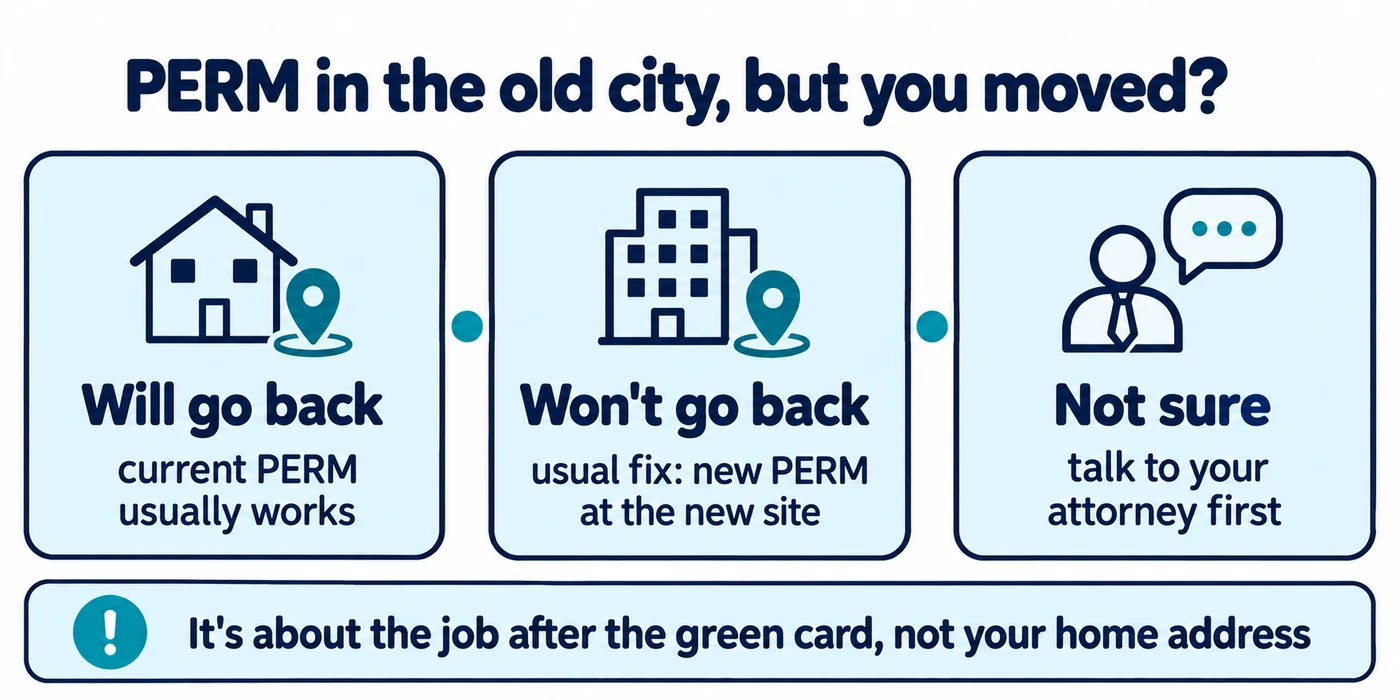
So the real question is: after you get the green card, will you work at the PERM location?
- Yes (for example a temporary assignment or temporary remote work): you can usually file on the current PERM, but confirm with your company's attorney and keep documentation.
- No (you have settled in the new city and the company does not expect you back): the current PERM probably cannot support that intent. The usual fix is a new PERM and I-140 for the new location. An approved I-140 lets you keep your original priority date, but you go through the process again.
- Not sure: that is exactly the conversation to have with your attorney.
What people report in forums
The following are people's own accounts, not verified decisions.
- One reader's PERM was in a Midwestern state while they worked fully remote from another state. Their attorney asked them to move back to the PERM state for about 6 months before filing I-485.
- Another reader changed cities within the same company, and the company filed a new PERM for the new location. The new PERM listed the company's original address plus "remote work allowed," not their home address.
- A third reader's office was closing. Their attorney said short-term remote work was fine as long as they could return to that office; if the company would no longer have an office in that city, a new PERM was needed.
Three people, three outcomes. The difference is whether "I will go back" is actually true. One case does not make a rule, but these point the same way.
A popular theory: "stay at the PERM location from approval until 180 days after filing"
Some forum users reason that you only need to work at the PERM location from the day I-485 is approved until it has been 180 days since filing, and that if approval takes longer than 180 days, you can simply move with Supplement J.
It captures part of the AC21 logic, but it is a user's calculation; USCIS has no such rule. The weak point is that your intent at filing must be genuine. If you file already planning not to go back and are only counting days, the risk is yours if anyone asks. Treat it as a question for your attorney, not as a rule.
One path not to take: rent an apartment, change your address, don't actually move
A forum user asked whether they could rent an apartment in the PERM city and change their company, bank and credit card addresses without actually moving. One reply said: "Yes, don't tell anyone, including your lawyer."
We clearly advise against this.
- A willful misrepresentation in an immigration application is its own ground of inadmissibility, and it is permanent (INA 212(a)(6)(C)(i)). That is far worse than filing a few months later.
- Most people in this position are on H-1B, which is also tied to a worksite. Working in a different metro area already requires an H-1B amendment.
- State taxes, company records and login locations all show where you actually work.
A specific case: my H-1B is moving back to the original city, but the LCA is still pending. Can I file I-485 first?
One reader was already transferring their H-1B back to the original city, but the Labor Condition Application (LCA, which must be filed with the Department of Labor before an H-1B worksite change) was still pending.
The I-485 itself does not require your current H-1B worksite to match the PERM; it looks at the future-job intent described above. So in principle you do not have to wait for the H-1B amendment. Many firms still prefer to line up the H-1B first so the records match. That is the firm's risk management, so follow your own firm's plan, and ask them directly: "Can I file I-485 now and do the H-1B amendment in parallel?"
02 My company's lawyers haven't contacted me. Should I chase them?
Yes, and do it now.
Large companies usually hand immigration cases to an outside law firm that works in batches. When the bulletin moves, hundreds or thousands of employees become eligible at once, and the firm sends questionnaires and collects documents one by one. Waiting to be contacted can cost you weeks. More importantly, USCIS can switch back to Chart A any month, so Chart B in October does not guarantee Chart B in November.
What to do:
- Email your company's immigration contact (the HR immigration team, or your case contact at the law firm) with your priority date, category and I-140 status, and say that Chart B is current in October and you would like to file I-485 this month.
- Ask three things:
- Does the company allow filing under Chart B? Some companies wait for Chart A.
- What documents do they need from you, and by when?
- If your worksite no longer matches the PERM (see above), how will they handle it?
- Start preparing in parallel: passport, notarial birth certificate, marriage certificate, and the medical exam, which takes the longest (see below).
03 EB-3 is so far ahead of EB-2. Should I downgrade?
For China mainland in October, EB-3 Chart B is April 1, 2024 and EB-2 Chart B is January 1, 2023, more than a year apart. If you are EB-2 with a priority date between 2023 and March 2024, you cannot file under EB-2 this month, but you could under EB-3.
A downgrade needs your employer to file an EB-3 I-140, and you can keep your priority date. There are several moving parts: whether your employer will do it, whether you can switch back, and which Chart A moves first. We covered it in detail here:
https://visa.careerengine.us/en/cases/eb2-eb3-downgrade-2026-09
For how the October bulletin moved overall and whether Chart A will catch up, see our analysis:
https://visa.careerengine.us/en/analysis/visa-bulletin-2026-10
04 How long does Chart B usually stay open?
USCIS decides the chart month by month, and nobody can promise anything. But we have the designation for all 133 months from October 2015 to now, so we can look at what happened before:
- In 11 of the last 12 Octobers, employment-based filings used Chart B. The one exception was 2017.
- Every time October opened Chart B, November used Chart B too, ten out of ten.
- Each Chart B run lasted 2 to 8 months, and most ended between January and March of the following year.
So historically this run is likely to last at least through November, and often into early next year. That is only the past pattern; nobody can guarantee it. File in October if you can, and treat November as a backup.
05 Chart A is months away. Can I book the medical exam now? No vaccination record?
Book it now
The medical exam does not wait for Chart A. Since December 2, 2024, Form I-693 (the immigration medical exam) must be filed together with I-485, or USCIS may reject the I-485. So if you want to file under Chart B this month, you need the exam now.
Many people worry the exam will "expire." Under current policy, an I-693 signed by a civil surgeon on or after November 1, 2023 remains valid for the whole time your I-485 is pending. The old rule requiring filing within 60 days of the doctor's signature was permanently removed on March 31, 2023 (USCIS Policy Manual, Vol. 8, Part B, Ch. 4).
The exam is done by a USCIS-designated civil surgeon. Appointments in busy areas can take a week or two, so call early.
Which vaccines
The rules are in the CDC's technical instructions for civil surgeons. The list: diphtheria, tetanus, pertussis, polio, measles, mumps, rubella, rotavirus, Hib, hepatitis A, hepatitis B, meningococcal, varicella, pneumococcal and influenza. What you need depends on your age; the doctor marks the rest "not age appropriate." Influenza is required only during flu season. As of the CDC page's March 2025 update, COVID-19 is no longer on the list.
Do old records count? Are copies OK?
The CDC says acceptable documentation "must come from a vaccination record, either a personal vaccination record or a copy of a medical chart with entries made by a physician or other appropriate medical personnel," and every dose needs the month, day and year. "Self-reported vaccine doses without written documentation are not acceptable."
So:
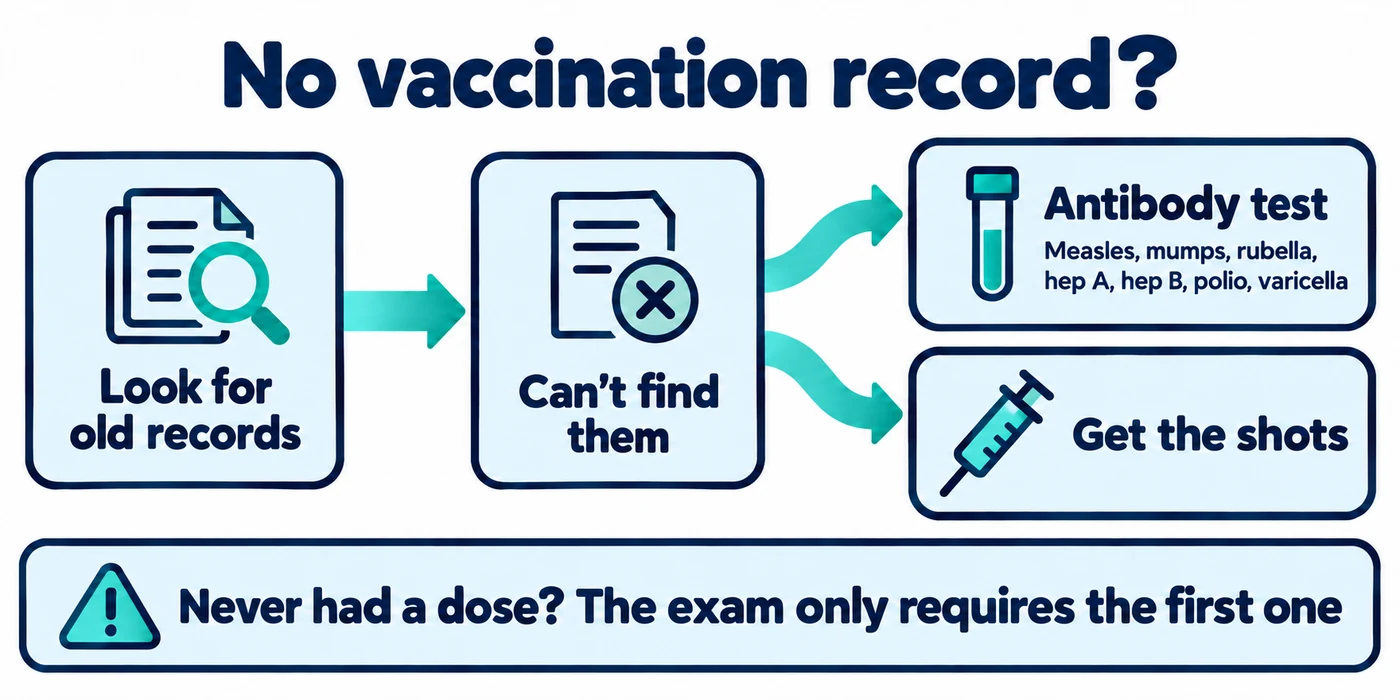
- A Chinese vaccination booklet, or school or workplace health records, can usually be shown to the doctor if medical staff made the entries with full dates. Whether a copy is enough is the civil surgeon's call, so bring the original.
- Many US states keep electronic immunization records. In California, for example, you can pull your digital record from the state's vaccine record system. Other states have similar registries.
No records: antibody test or just get the shots?
The CDC accepts lab evidence of immunity (an antibody test) for measles, mumps, rubella, hepatitis A, hepatitis B, polio and varicella. If the test shows immunity, you do not need that shot.
Something many people don't know: if you have never had any dose of a vaccine, the exam only requires the first dose of the series, not the whole series on the spot.
How people in the groups choose:
- Probably vaccinated as a child and don't want many shots at once: test antibodies first.
- Want it simple and don't want to wait for lab results: get the shots. Some get them from their own doctor through insurance, which can be cheaper than at the civil surgeon.
Which is cheaper depends on your insurance and the civil surgeon's prices, so ask for a quote.
06 I'm flying home for a few weeks. What should I get done?
A reader whose Chart B date just became current was flying back to China for three weeks the next day. They asked whether to get their birth certificate there, do the medical exam on return, contact the lawyers, and think about downgrading. That plan is right. A few additions:
- Birth certificate: easiest to get in China. The State Department's reciprocity schedule lists a notarial birth certificate issued by a notary office for China mainland. While you are there, go to the notary office where your household registration is. Whether you need the Chinese original or an English translation too, follow your law firm's document list.
- Contact the lawyers before you leave. Tell them your dates so they can start preparing forms while you are away, and you can sign and file as soon as you are back.
- Do the medical exam as soon as you return. It has to be filed with the I-485 (see above).
- Work out the timing. Back in three weeks means late October, and the exam plus signatures take time. Count backward with your lawyers to see whether you can file before October 31. If not, don't panic: historically November has also used Chart B (see section 04), but that is not guaranteed.
- Ask about downgrading now. If you want to move from EB-2 to EB-3, your employer has to file an EB-3 I-140 first, which takes time. Raise it before you leave.
- Be careful about travel after filing. Leaving the US while I-485 is pending generally requires advance parole first, or the I-485 is treated as abandoned. People who hold a valid H-1B or L-1 visa and have maintained that status are an exception and can return on it (8 CFR 245.2(a)(4)(ii)(C)). This trip is before filing, so it is not affected, but check this rule before any future trip.
07 Does filing I-485 count as "settling abroad"? Can I still renew my Chinese ID card?
Someone asked whether filing I-485 under Chart B makes you a Chinese citizen "settled abroad," and whether you can still renew your Chinese resident ID card.
Filing I-485 is not getting a green card. While it is pending, you do not have US permanent residence.
China has an official definition of "settled abroad," from the Overseas Chinese Affairs Office of the State Council: a citizen who has obtained long-term or permanent residence in the country where they live and has lived there continuously for two years, with at least 18 months there within those two years. There is also a clause people often miss: someone without permanent residence who has had lawful residence abroad continuously for five years or more, with at least 30 months there within those five years, is also treated as an overseas Chinese. So some people who have worked in the US for years may already meet the definition, regardless of filing I-485.
How ID cards and household registration are handled in practice varies by locality, so follow your local public security bureau's rules.
Someone in the group suggested reporting the ID card lost now to get a new one that lasts 20 years. Reporting a card lost when it is not is a false report, and we don't recommend it.
When you really need a lawyer
For the documents to gather, use our employment-based I-485 document checklist: separate lists for the principal, spouse and children, ready to print and tick off.
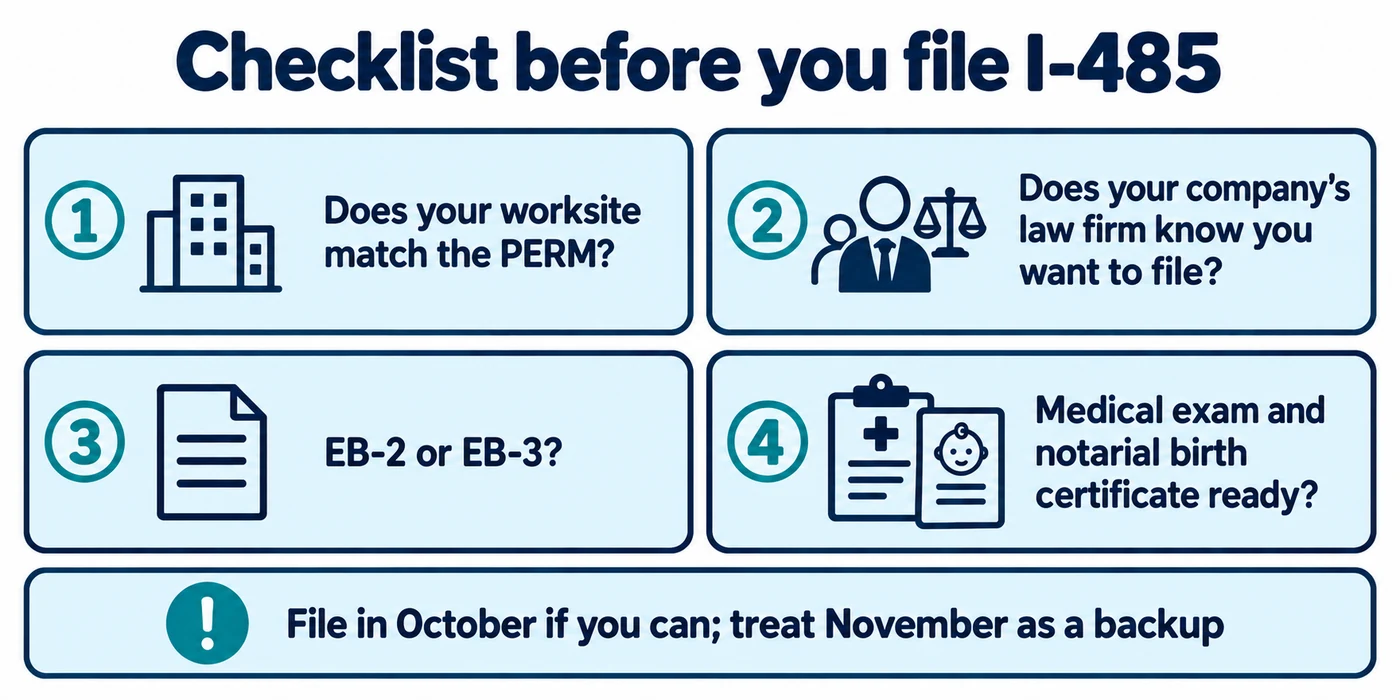
This article gathers the rules and people's experience. It does not replace a lawyer, especially if:
- your current worksite is in a different metro area from the PERM and you are not sure you will go back after the green card
- your company's office has closed or is closing
- you are considering a downgrade from EB-2 to EB-3
- you need to travel after filing I-485
- you have a child close to 21 (CSPA age uses Chart A, not Chart B)
Sources: 20 CFR 656.30(c)(2); USCIS Policy Manual, Vol. 7, Part E, Ch. 5 (AC21 and Supplement J); INA 212(a)(6)(C)(i); USCIS Policy Manual, Vol. 8, Part B, Ch. 4 (I-693 validity); 8 CFR 245.2(a)(4)(ii)(C); CDC, Vaccination Technical Instructions for Civil Surgeons (updated March 2025); USCIS chart designations October 2015 to October 2026 (this site's database); Overseas Chinese Affairs Office of the State Council, Provisions on Defining the Status of Overseas Chinese. Forum cases come from public discussions on a Chinese immigration forum and are people's own accounts, not verified. This article is not legal advice.
One email each month when the bulletin lands. Unsubscribe anytime.
Email alerts when your case status changes (in development)
We're building receipt-number tracking with automatic alerts and typical processing times. Join the waitlist to be first. This also subscribes you to the monthly bulletin email; unsubscribe anytime.