

You have a pending I-485 and both EB-2 and EB-3 I-140 petitions. EB-2 is now current. Can you switch the I-485 back to EB-2? You can ask, but the switch is not automatic. USCIS may approve or deny the request. [1]
Two I-140 petitions can coexist, but one I-485 follows only one petition at a time. USCIS calls switching that petition a transfer of underlying basis. This article calls it a switch. It is separate from the AC21 rules for changing jobs. [1]
Which I-140 supports the pending I-485?
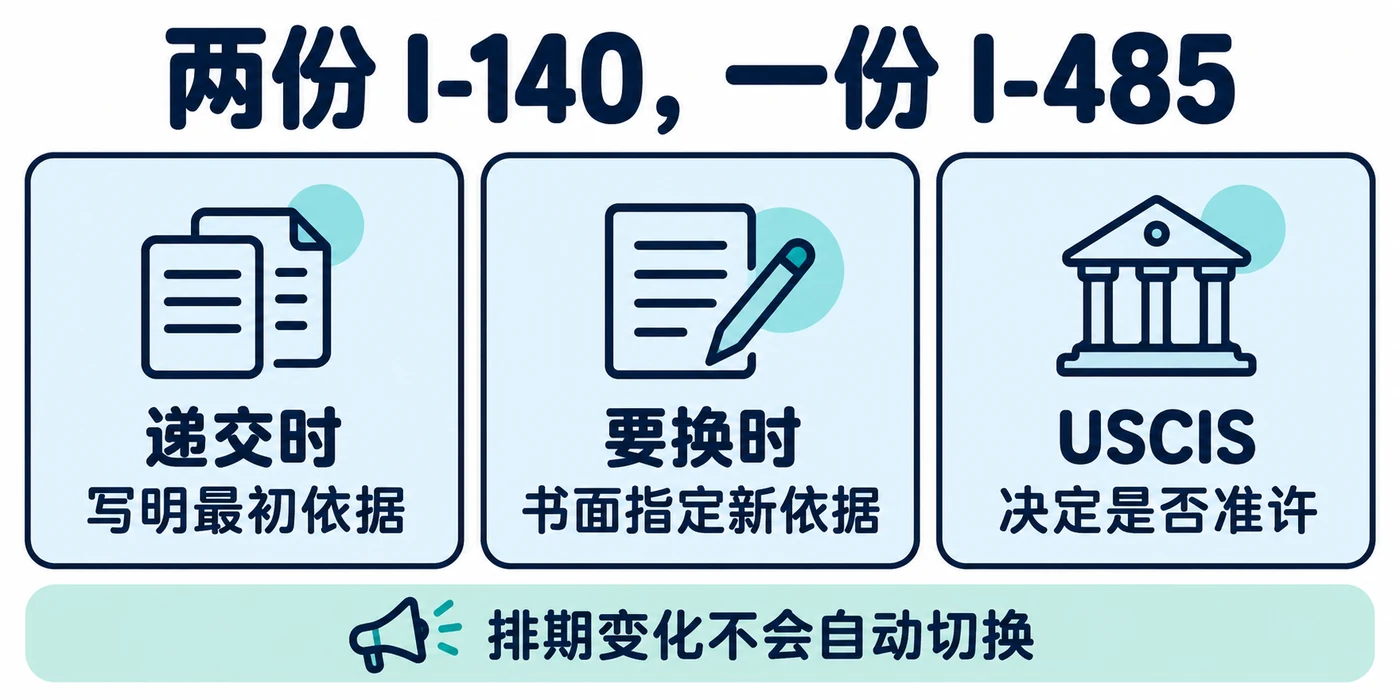
Check which I-140 was named when the I-485 was filed, and whether USCIS approved a later switch. A faster moving category does not replace it automatically. To ask for a switch to an approved EB-2 I-140, write a letter naming the target I-140 and the pending I-485 receipt number. Include the receipt and proof that you qualify for the new category. The I-485 must still be pending, the new category must have a visa available when you make the request, and your earlier adjustment eligibility must not have lapsed. Usually you do not need a new I-485 or another I-485 fee. Check current mailing instructions and case specific materials with counsel. [1]
Which priority date applies after the switch? Generally, it is the date attached to the replacement I-140. If you switch back to EB-2, check the priority date recognized on that EB-2 petition. Do not assume the EB-3 petition's date follows the I-485. EB-1, EB-2 and EB-3 petitions may retain an earlier date when the rules allow it. [1]
What if EB-2 becomes current after an EB-3 downgrade?
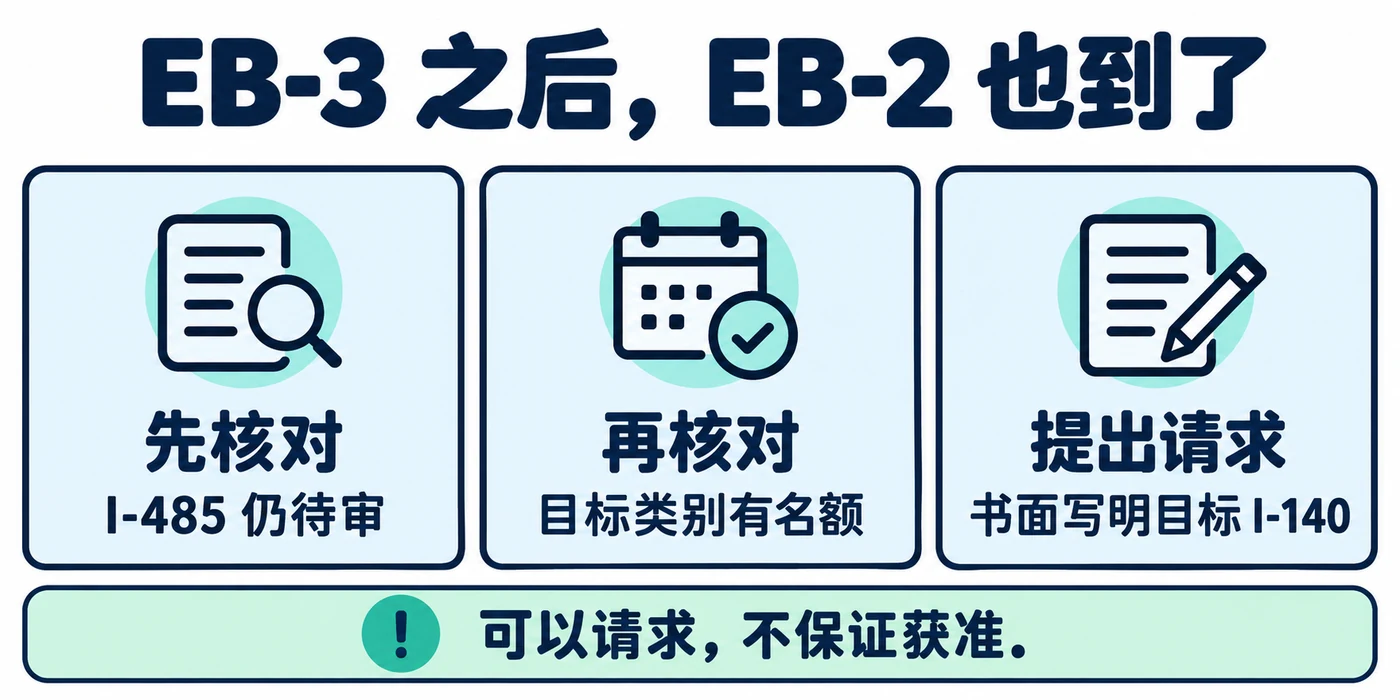
You can ask, but approval is not guaranteed. USCIS's FY2022 FAQ discusses a specific case: the EB-2 priority date is current under Final Action Dates and a separate EB-3 petition is pending. USCIS says the pending EB-3 alone does not block a request to switch the pending I-485 to another approved I-140. That answer does not mean every case can switch at any time. USCIS still checks the pending I-485, continued eligibility, and visa availability on the request date. [2][1]
What does Supplement J do?
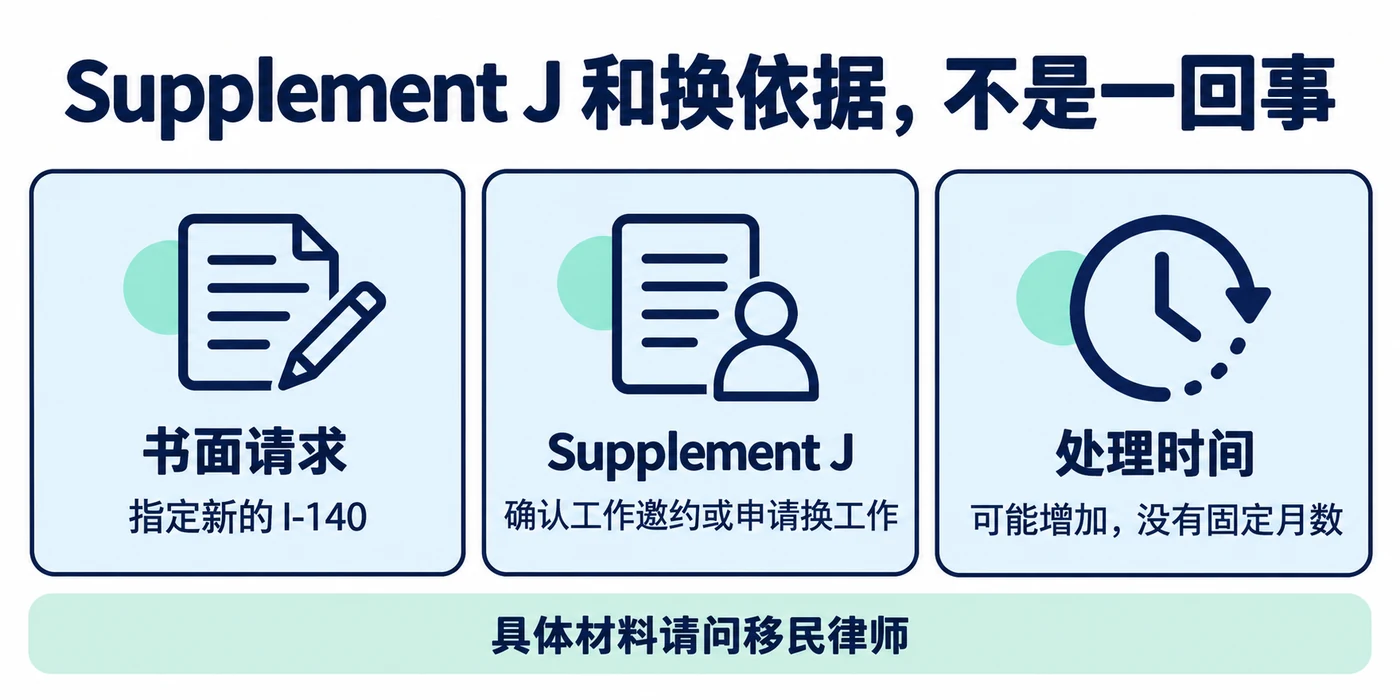
The letter says which I-140 should support the I-485. Supplement J confirms that a job offer still exists or, when eligible, requests a job change. Filing Supplement J alone does not replace the letter. For a switch to a previously approved I-140, USCIS says a new Supplement J is generally needed to confirm the offer. NIW and EB-1A applicants do not need it for this job offer requirement. Check the current form, signatures, and your case with counsel. [3][4]
If I filed on an NIW and then left my job
An NIW filer does not file Supplement J, and there is no “wait 180 days before changing jobs” rule for it. USCIS's I-485 instructions (edition 09/18/26) say people seeking or granted a National Interest Waiver, and people in the extraordinary-ability category (EB-1A), do not need to file Supplement J, because these categories are not tied to a specific job offer. The “job portability after 180 days” rule (INA 204(j)) is for categories that require an employer job offer.
That does not mean “work at anything.” The same instructions say a self-petitioner must intend to work in the occupational field specified in the I-140, and, unless you filed the I-485 at the same time as the I-140 or while the I-140 was still pending, must provide a signed statement confirming that intent.
The instructions give no further test for what you may do after leaving, how long a gap is acceptable, or whether to add that statement. Ask your immigration lawyer.
Does a transfer put the case in a “black hole”?
We found no USCIS source establishing that a transfer automatically loses a case or adds a fixed number of months. USCIS does say that matching the replacement petition to the I-485, collecting evidence, and retrieving files may add processing time; a request made too close to final adjudication may be too late. Keep proof of submission and monitor notices. Withdrawing the original I-140, changing employers, or including derivatives can affect eligibility; ask your immigration lawyer about your own facts. [1]
For the earlier decision about whether to downgrade, see EB-2 to EB-3 downgrade after the October Chart B jump and compare priority dates with the EB-2 versus EB-3 tool. This article provides general information, not individual legal advice.
Sources
- USCIS 政策手册第 7 卷 A 部分第 8 章「转换 I-485 的申请依据」(Policy Manual, Vol. 7, Part A, Ch. 8, “Transfer of Underlying Basis”),2026-09-30 核对。包括优先日规则、资格不中断、提出请求时有名额、书面请求、一份 I-485 同时只跟一份 I-140、通常无须重递 I-485,以及与换工作的区别。https://www.uscis.gov/policy-manual/volume-7-part-a-chapter-8
- USCIS「2022 财年职业移民调整身份常见问题」(Fiscal Year 2022 Employment-Based Adjustment of Status FAQs),存档页更新于 2022-08-26,2026-09-30 核对。相关答复只谈 EB-2 优先日已达表 A、另有待审 EB-3 的情形。https://www.uscis.gov/archive/fiscal-year-2022-employment-based-adjustment-of-status-faqs
- USCIS「I-485 Supplement J 填写说明」(Instructions for Supplement J),当前下载文件版本日期 2026-09-18,2026-09-30 直接下载 PDF 核对;当前表格 PDF 也显示 2026-09-18。说明书区分确认工作邀约与 INA 204(j) 换工作,并列明签名要求。实际递件前再核对官方表格页。https://www.uscis.gov/sites/default/files/document/forms/i-485supjinstr.pdf ; https://www.uscis.gov/i-485supj
- USCIS 官方公开信件「待审 I-485、Supplement J 与转换依据」(official FOIA correspondence, “Pending Form I-485, Supplement J Transfer of Underlying Basis Filings”),2026-09-30 核对。说明可另交书面请求换回原依据;转向以前已批准的 I-140,通常要交新的 Supplement J 来确认工作邀约。https://www.uscis.gov/sites/default/files/document/foia/Employment-based_adjustment_of_status-ODonoghue.pdf
- USCIS, Instructions for Form I-485, edition 09/18/26, section on Supplement J (NIW and EB-1A filers do not file Supplement J; a self-petitioner must intend to work in the I-140 field), downloaded and checked 2026-09-30. https://www.uscis.gov/sites/default/files/document/forms/i-485instr.pdf
One email each month when the bulletin lands. Unsubscribe anytime.