

If this month's visa bulletin shows an earlier date for your category than last month, don't panic: that is called retrogression, and it means very different things for people who have already filed Form I-485 and people who have not.
The short answer: if you already filed I-485, USCIS's stated practice is to hold your case "in abeyance" until your priority date is reached again; if you have not filed, you compare your priority date with the chart USCIS designates that month, and if it no longer qualifies you cannot file yet. Every point below quotes USCIS or the State Department, and the last section is our own retrogression history.
What does visa retrogression mean?
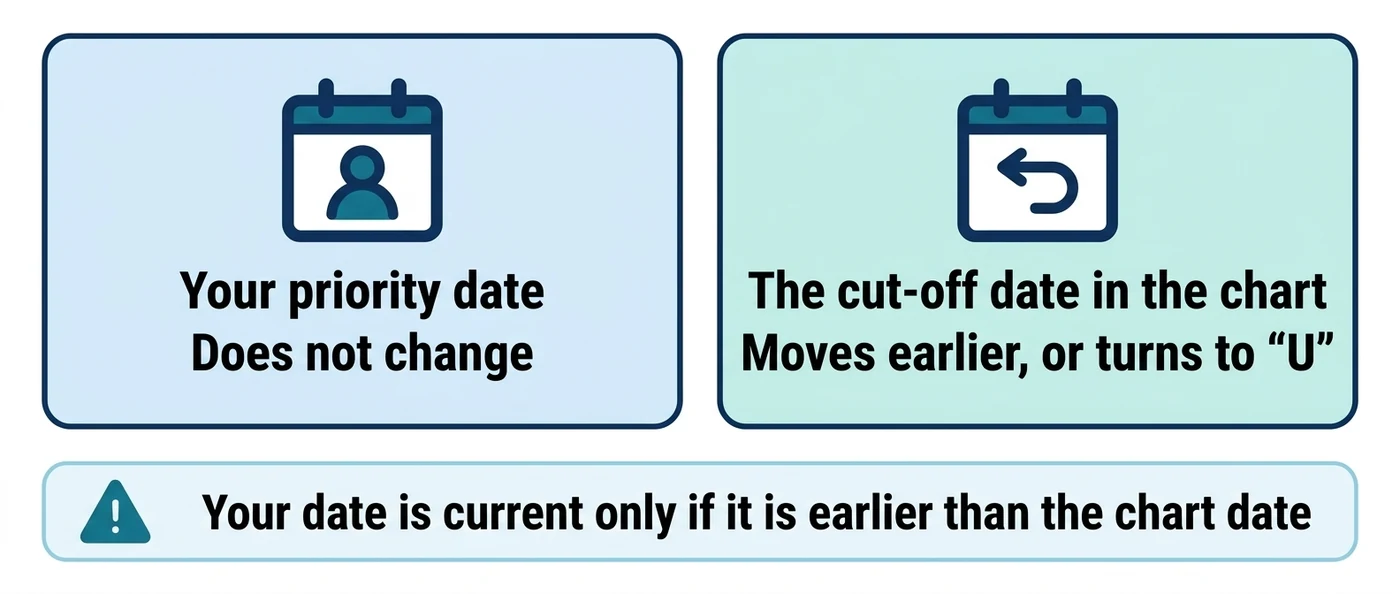
USCIS's Visa Retrogression page says: "Visa retrogression occurs when more people apply for a visa in a particular category than there are visas available for that month. … Sometimes a priority date that meets the cut-off date one month will not meet the cut-off date the next month."
In plain words: what moves is the cut-off date in the chart, not your priority date. A date that moves earlier (for example from September 2024 back to May 2024), or a category that turns to "U" (unavailable), is retrogression. The same page says retrogression typically happens toward the end of the fiscal year, and that when the new fiscal year starts on October 1 the new supply "usually, but not always" returns the dates to where they were.
A retrogression that just happened
In the October 2026 bulletin, three employment categories in the "All Chargeability" column are earlier than in September:
| Category (all chargeability) | September 2026 bulletin | October 2026 bulletin |
|---|---|---|
| EB-2 | C (current) | 2025-01-01 |
| EB-3 | 2024-09-01 | 2024-05-15 |
| Other Workers | 2022-04-01 | 2022-01-01 |
Section B of the October bulletin says: "some employment-based visa categories for 'Rest of World' countries have retrogressed, and these retrogressions are necessary to keep visa issuances within FY 2027 quarterly and annual limits."
The China and India columns did not retrogress that month (EB-2 China went from 2021-09-01 to 2021-10-01, India from U to 2013-11-01, both forward). So retrogression has to be read in your own category and country column, not for the whole chart.
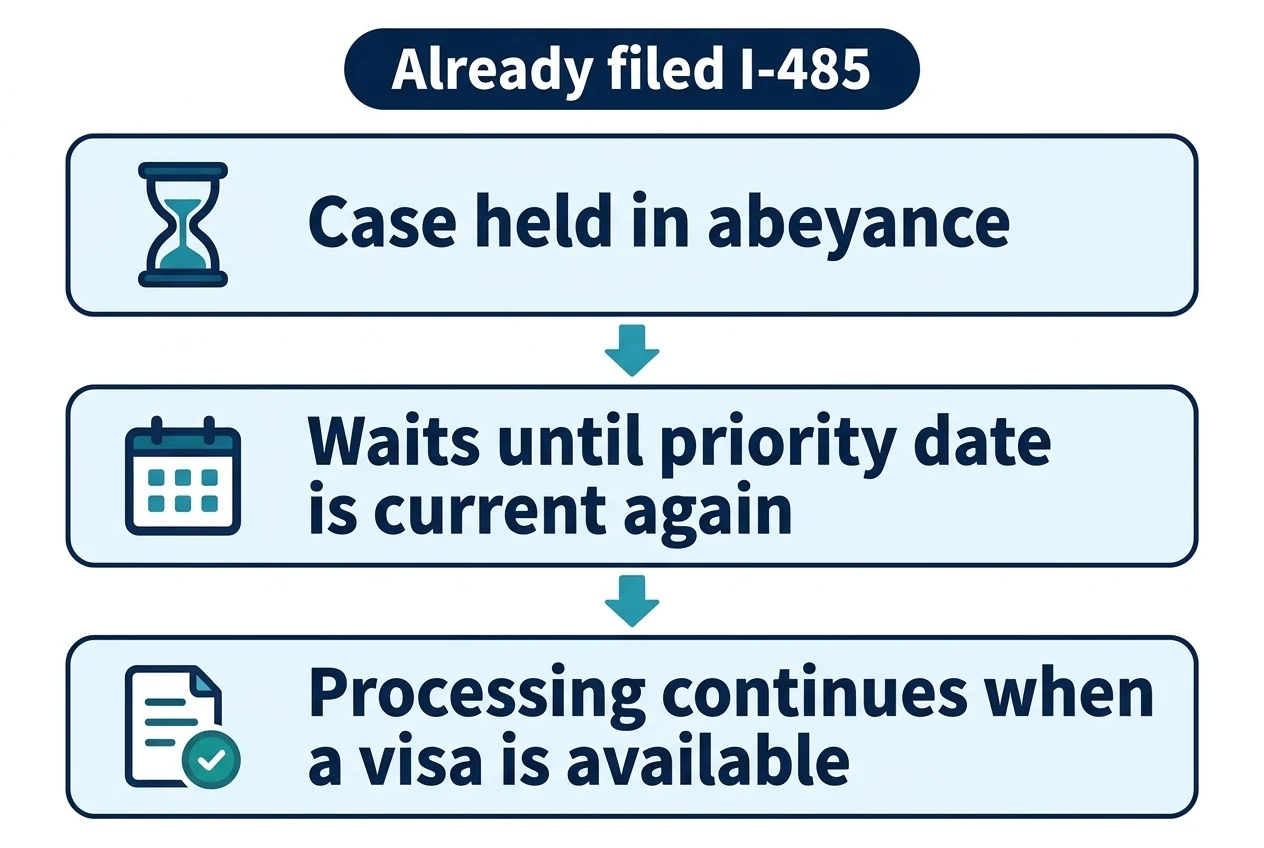
If I already filed I-485, what happens when dates retrogress?
USCIS (How USCIS Processes Retrogressed Visas Cases): "If, at the time of adjudication, an applicant's priority date no longer meets the cut-off date published in the Visa Bulletin, due to retrogression, his or her case must be held in abeyance until a visa once again becomes available."
The same page adds:
- Cases that need no interview are held at the service center where you filed; for interviewed cases, USCIS may hold employment-based and family-based cases at the National Benefits Center.
- When visas are available again, USCIS finishes the case based on the current month's bulletin. It may send a request for evidence or an interview notice, so keep your address current.
- People who properly filed I-485 before retrogression "can generally apply for" an employment authorization document (I-765) and travel permission (I-131).
See also What happens after you file I-485 for status messages. While a case is held the status page may not change for a long time; USCIS's page does not say that means something is wrong.
One email each month when the bulletin lands. Unsubscribe anytime.
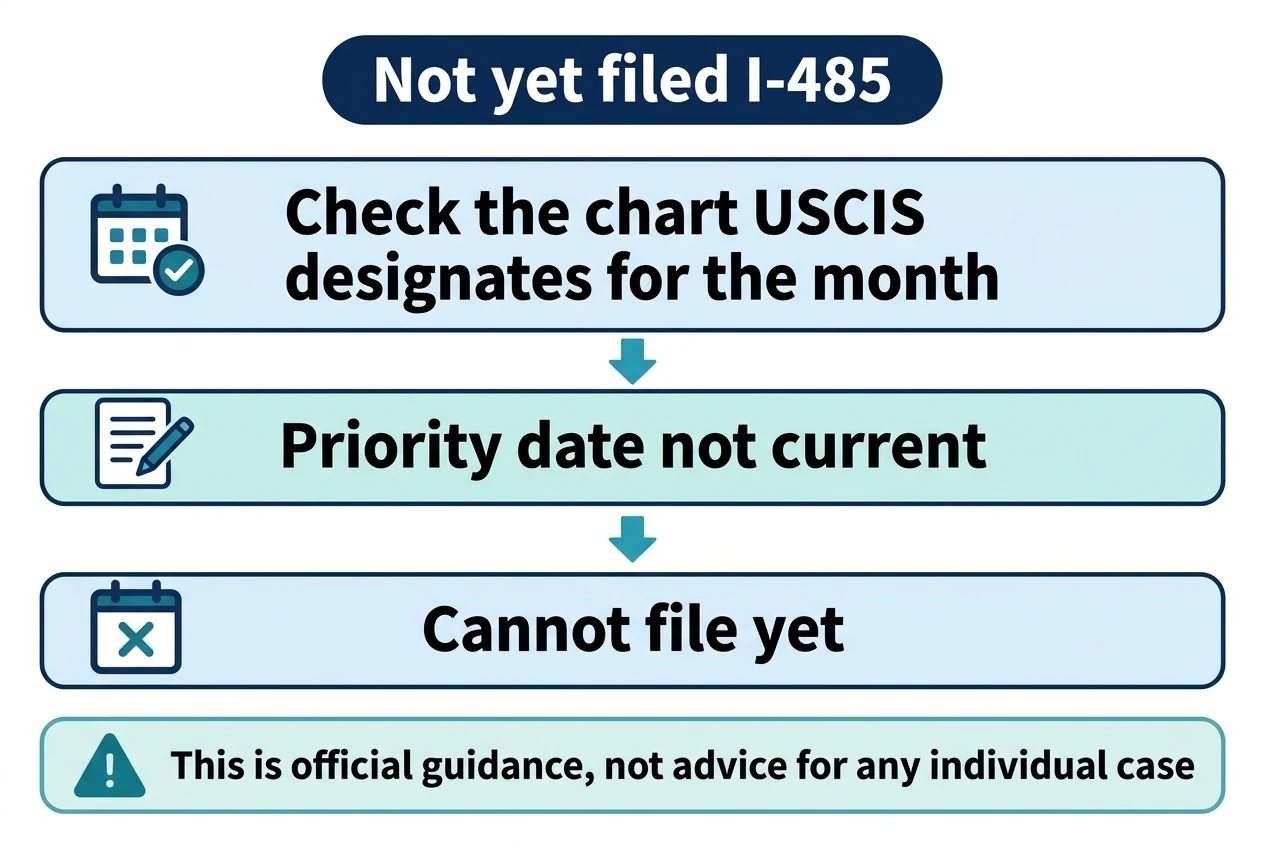
If I have not filed I-485, can I still file after retrogression?
The USCIS Policy Manual (Volume 7, Part A, Chapter 3) says applicants in employment- or family-based preference categories "must generally wait until a visa is immediately available before they may file". Which chart:
"In general, adjustment applicants must use the Application Final Action Dates chart to determine whether a visa is available. However, if USCIS determines there are immigrant visas available for the filing of additional adjustment applications, the Dates for Filing Applications chart may be used…"
So USCIS decides each month which chart to use and names it on its adjustment of status filing charts page within a week of the State Department publishing. See Chart A or Chart B. After retrogression, compare your priority date with the date in your category and country column of that designated chart; your date must be earlier than the chart date.
This is what the official pages say, not advice for your case. Your facts may differ; ask an immigration lawyer.
How common is retrogression? Our data
Our bulletin database covers the October 2015 to October 2026 bulletins: 133 bulletins, 132 month-to-month changes (the religious workers SR category is excluded because it flips to U when its statute lapses). We compare the final action dates (Chart A). A month counts as a retrogression month if any category or any country column moved earlier than the month before, or turned to U:
- 54 of the 132 changes (41%) had at least one retrogression. It clusters in June to August: 21 of those 33 changes (64%), against 33 of the other 99 (33%).
- Looking only at EB-1, EB-2 and EB-3 for all chargeability there were 21 retrogressions in ten years (including EB-2 and EB-3 this October). In 18 of them the date later returned to its pre-retrogression level: the fastest took 1 month, the median 2 months, and the slowest, EB-2 from December 2022, 40 months. Three have not recovered yet (EB-3 from May 2023, and this month's EB-2 and EB-3).
These are past frequencies, not a forecast: the State Department has not said when any category will recover, and we do not predict it.
This does not contradict our other article. Why hasn't my priority date moved counted only the main China, India and family categories, with 2 retrogressions in 357 observations over three years. Here every country column and every category is pooled, so retrogression looks more common. What matters to you is your own column.
How can I see retrogression coming?
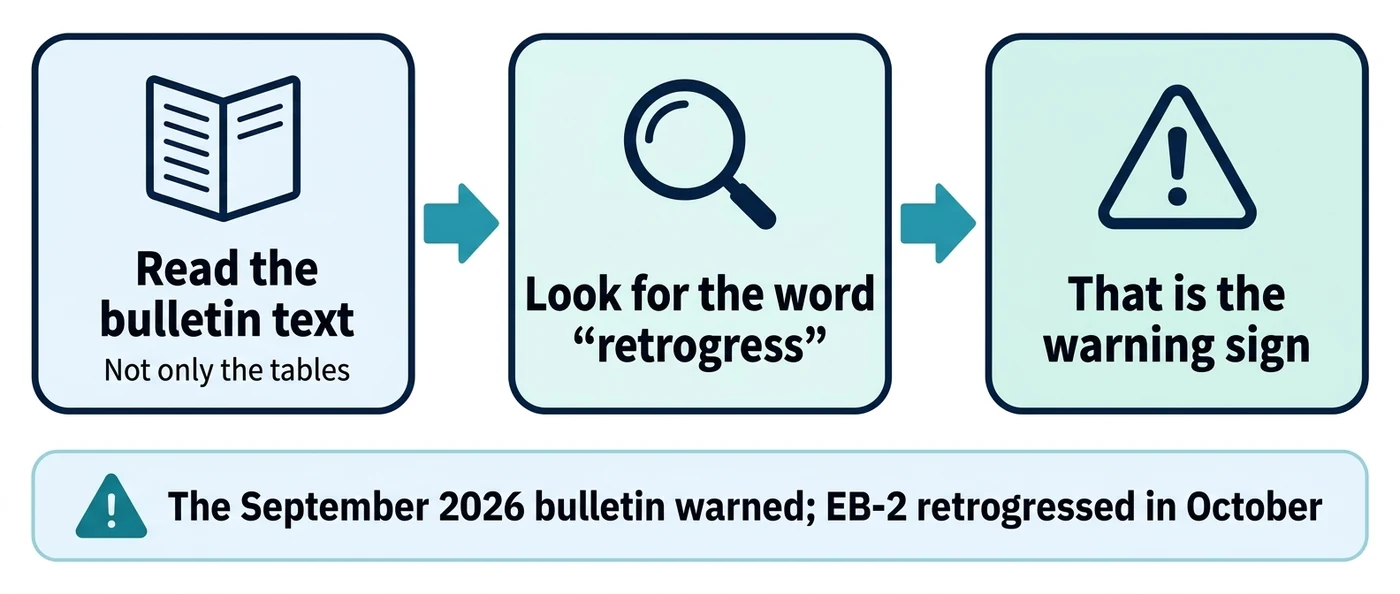
The State Department usually writes it in the bulletin text first. The September 2026 bulletin said: "Sufficient demand and increased number use in the EB-2 visa category may make it necessary to retrogress the final action date or make the category unavailable before the end of the fiscal year…" The next month, EB-2 all chargeability went from C to 2025-01-01. So read the text of the bulletin, not only the tables (see Why hasn't my priority date moved). Bulletins usually come out between the 11th and 17th, later in the last year: When is the visa bulletin published. The latest tables are on the latest bulletin page, and the daily feed flags the next one.
Sources
- USCIS Visa Retrogression (Last Reviewed/Updated 10/11/2024).
- USCIS Policy Manual, Volume 7, Part A, Chapter 3: Filing Instructions.
- State Department Visa Bulletin, September and October 2026 issues (text and tables).
- Career Engine's own bulletin database: final action dates, October 2015 to October 2026, month-by-month comparison as described in the data section.
Based on public government data and notices; for information only, not legal advice. We are not a law firm.