

The short version: EB-5 (the employment-based fifth preference, the investor green card) filing fees roughly double on November 30. The I-526E that most investors file (the regional-center investor petition) goes from $3,675 to $7,850, and the I-829 to remove conditions goes from $3,750 to $5,000. The rule uses the postmark date: anything mailed before November 30 still pays today's fee.
This is a final rule, with no new comment period. DHS filed it on September 29 and it appears in the Federal Register on September 30 (official text, 91 FR 61940); USCIS posted an alert the same day. If you are about to file anything EB-5, here is what matters.
01 Which fees change, and by how much?
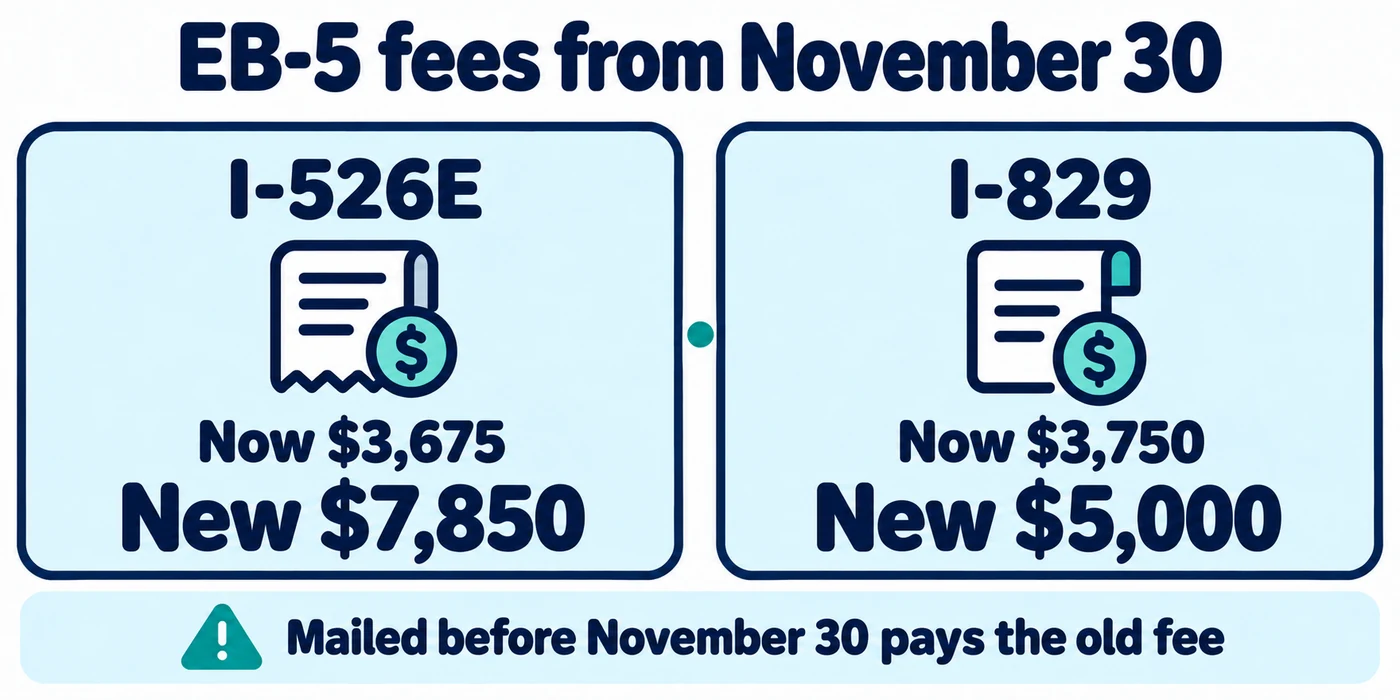
The fees that investors themselves pay:
| Form | Now | From Nov 30 |
|---|---|---|
| I-526E (regional-center investor petition, initial) | $3,675 | $7,850 |
| I-526 (standalone investor petition) | $3,675 | $7,615 |
| I-526E amendment | $3,675 | $7,775 |
| I-829 (removal of conditions) | $3,750 | $5,000 |
| I-527 (amendment to a legacy I-526, new form) | none | $10,330 |
| Integrity Fund fee charged with an I-526E | $1,000 | $1,100 |
A few places where people miscount:
- The $7,850 and $7,615 figures already include the $75 technology fee. Don't add it again.
- The Integrity Fund fee is separate. An initial I-526E therefore costs $7,850 + $1,100 = $8,950.
- The I-829 is $5,000 each. A spouse or child not included on the investor's I-829 files their own, and each pays $5,000.
- No fee waivers are available for these EB-5 fees; the rule says so explicitly.
Regional centers see changes too: the I-956 designation application rises from $17,795 to $44,115, while the I-956G annual statement drops from $3,035 to $2,165, and the annual regional-center Integrity Fund fee rises 10%. These are mainly project costs, but they may show up in the administrative fees projects charge investors, so it is worth asking before you sign.
02 Why "double", not "triple"?
You may have seen EB-5 filing fees quoted at over $11,000. That was the April 2024 fee schedule ($11,160 for both I-526 and I-526E).
In November 2025, a federal court in Colorado stayed those 2024 EB-5 fees in a lawsuit, and USCIS went back to the 2016 fees, which are today's $3,675. The new rule is based on a fresh cost study required by the EB-5 Reform and Integrity Act.
So the accurate way to put it: about double today's fees, but lower than the 2024 schedule. The rule also says people who paid the higher 2024 fees will not get refunds.
03 When should you file? The postmark counts
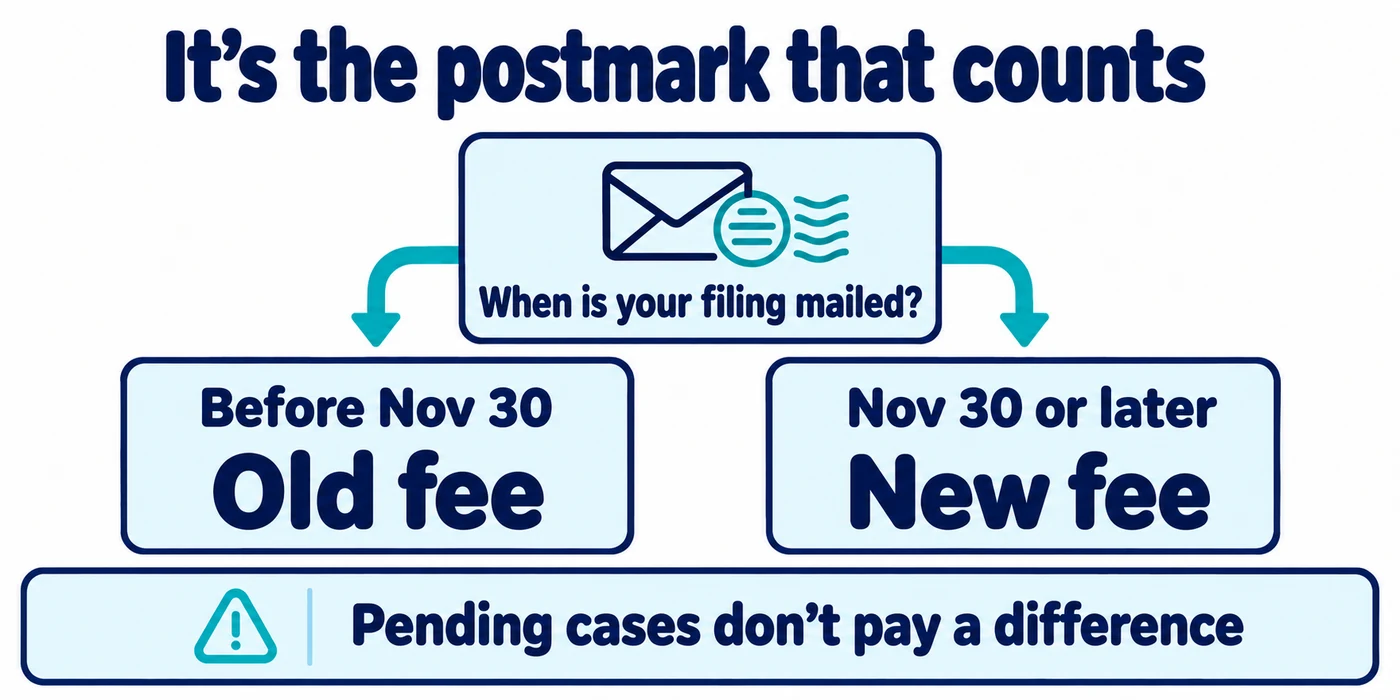
The rule says anything postmarked on or after November 30 must include the new fee. In practice:
- Mailed (or filed online) before November 30: you pay today's fee.
- Pending cases do not pay a difference. The rule does not ask filed cases to pay more.
- If you were going to file an I-526E or I-829 around December anyway, filing before November 30 saves you thousands of dollars. Only if the package is genuinely ready, though: an incomplete filing rushed to beat the date can cost more in RFEs (requests for evidence) or a denial.
The I-829 has a fixed filing window: the 90 days before your conditional green card expires. You cannot file before it opens, so not everyone can "beat November 30". Check when your window opens first.
For where each EB-5 category stands in this month's bulletin, see our October 2026 Visa Bulletin analysis.
04 Chart B moved 4 years in October: what you can do now
You may have heard that EB-5 "moved forward 4 years." To be precise: in the October bulletin, China mainland EB-5 unreserved Chart B (dates for filing) jumped from March 1, 2017 to March 1, 2021, a 1,461-day move. Chart A (final action date) stayed at December 1, 2016.
What this means:
- If your priority date is before March 1, 2021 and you are in the US, you can file the I-485 in October, because USCIS is accepting employment-based filings under Chart B this month.
- You can file for a work permit (EAD) and advance parole together with the I-485, which makes working and travel much easier while you wait.
- The green card itself can only be approved once Chart A reaches your priority date. Chart A is at December 2016, so anyone with a 2017 or later priority date still has to wait, and nobody can promise how long.
For the full October bulletin, see the October 2026 Visa Bulletin analysis; for how long I-485 filers have been waiting, see the I-485 progress tracker.
05 Legacy investors: who needs the new I-527?
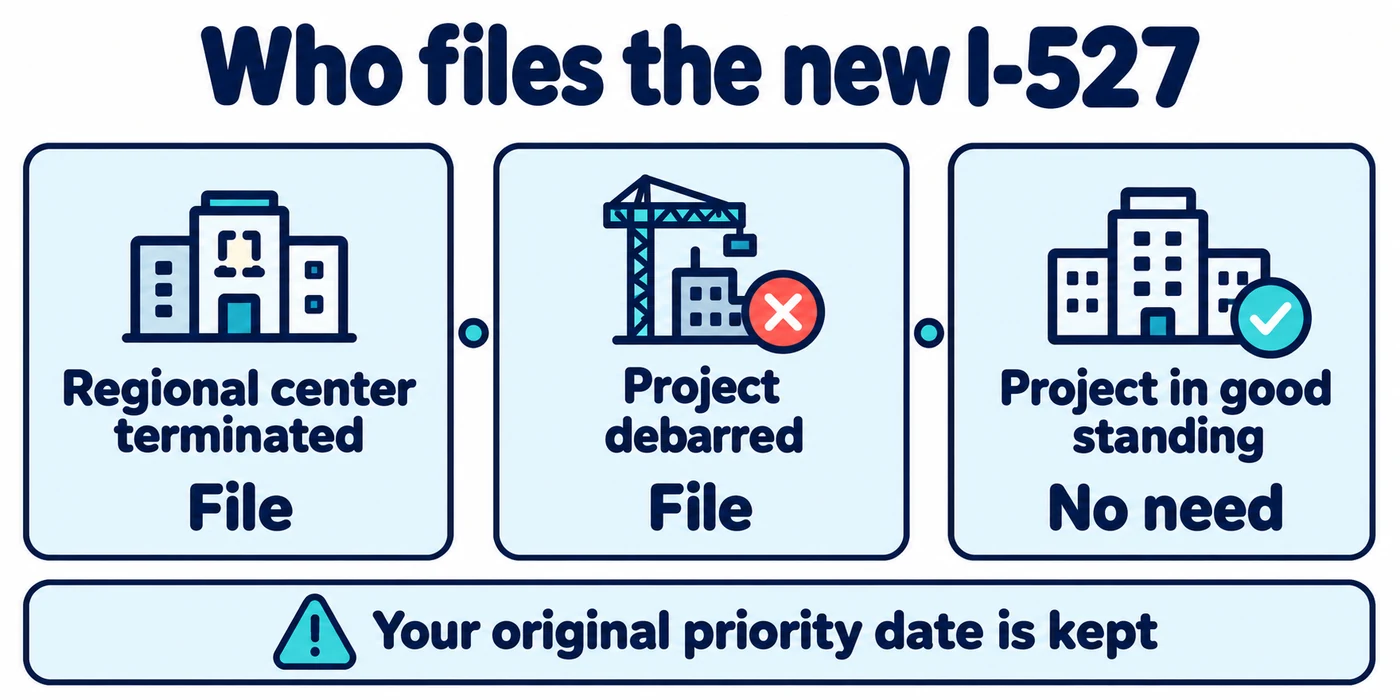
The rule creates a new form, I-527 (an amendment to a legacy I-526), at $10,330. It is for legacy investors who filed I-526 before March 15, 2022, but not every legacy investor needs it:
- You file it if your regional center was terminated or the project was debarred and you need to move to another project to keep your eligibility.
- Your original priority date is kept; USCIS does not treat it as a new petition.
- If your project and regional center are in good standing, you don't need an I-527.
If you have both a legacy EB-5 and an EB-2 (employment-based second preference) case and are deciding which one to file I-485 on, we covered that recently: Legacy EB-5 or EB-2 when both are current on Chart B.
06 Do higher fees buy faster processing?
The rule says the fees are meant to recover the program's full cost and to work toward statutory processing-time goals: an average of 240 days for investor petitions (I-526/I-526E) and I-829, and 120 days for investor petitions in targeted employment areas (rural or high-unemployment).
These are goals, not promises. DHS says in the rule that it is not writing these time frames into the regulation. Don't read "240 days" as a guarantee that comes with the fee.
What is still unclear
- Whether the $1,100 Integrity Fund fee applies to I-526E amendments: the new regulatory text has no exception, while the current fee schedule says amendments are exempt. We will know when USCIS posts the new G-1055 fee schedule.
- The EB-5 regional center program's authorization expires September 30, 2027; the rule's numbers assume Congress extends it.
When you really need a lawyer
- You want to file an I-526E or I-829 before November 30 but your documents are not complete
- Your regional center or project is in trouble and you are considering an I-527
- You have an EB-5 case and a case in another category at the same time
Sources: DHS/USCIS, "U.S. Citizenship and Immigration Services Employment-Based Immigrant Visa, Fifth Preference (EB-5) Fee Rule", final rule (RIN 1615-AC93, DHS Docket No. USCIS-2025-0139, Federal Register document 2026-20016, 91 FR 61940, published September 30, 2026, effective November 30, 2026; checked against the official September 30 publication); USCIS alert of September 29, 2026, "USCIS Adjusts EB-5 Fees to Cover Program Costs and Strengthen Integrity Measures"; USCIS fee schedule G-1055 (edition 09/09/26); proposed rule of October 23, 2025 (90 FR 48516). This article is not legal advice.
One email each month when the bulletin lands. Unsubscribe anytime.