

On September 4, the Department of Homeland Security (DHS) issued a new rule on birthright citizenship that took effect the same day.
Under the rule, certain children born in the US no longer automatically become US citizens. Instead, they can apply to register as permanent residents.
But in the same document, the agency itself wrote this:
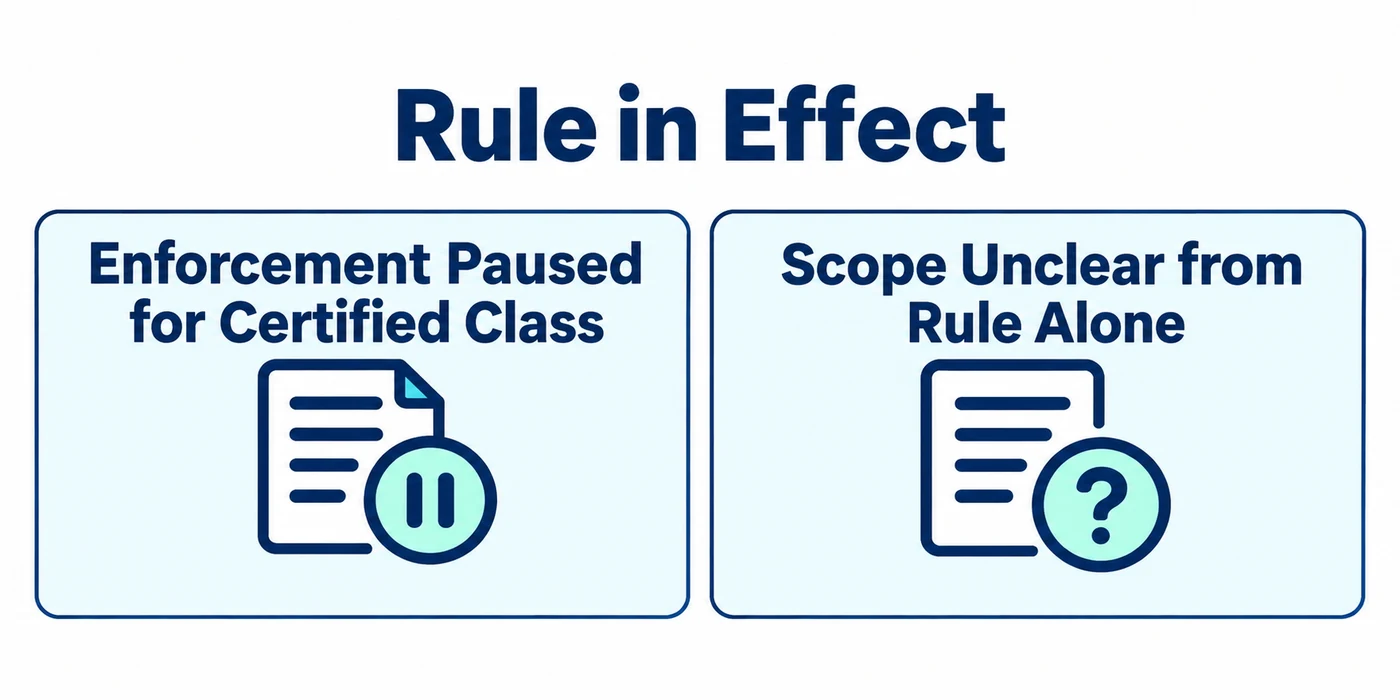
Given the injunction currently in place in Casa Inc. v. Trump ... DHS will not take actions to implement the rule specifically to any member of the certified class, or otherwise conflict with the preliminary injunction, unless and until the government obtains relief from the injunction.
A rule that takes effect the same day says in its own text that it won't be enforced for now. That gap is the most important thing to know about this story right now.
What is the injunction?
The lawsuit is Casa Inc. v. Trump. It was filed in federal district court in Maryland on January 21, 2025, the day after the previous birthright citizenship executive order was issued. The case is still going.
The injunction mentioned in the rule is dated September 2, 2026, two days before the rule was even submitted for public inspection.
So the sequence is: the court issued the injunction on September 2, and DHS issued the rule on September 4, stating in it that it would comply with the injunction.
One thing needs to be made clear: the rule does not say who is in the "certified class". The phrase appears only once in the whole document. So this document alone can't tell you who is protected by the injunction and who isn't. We won't speculate.
Who does the rule itself cover?
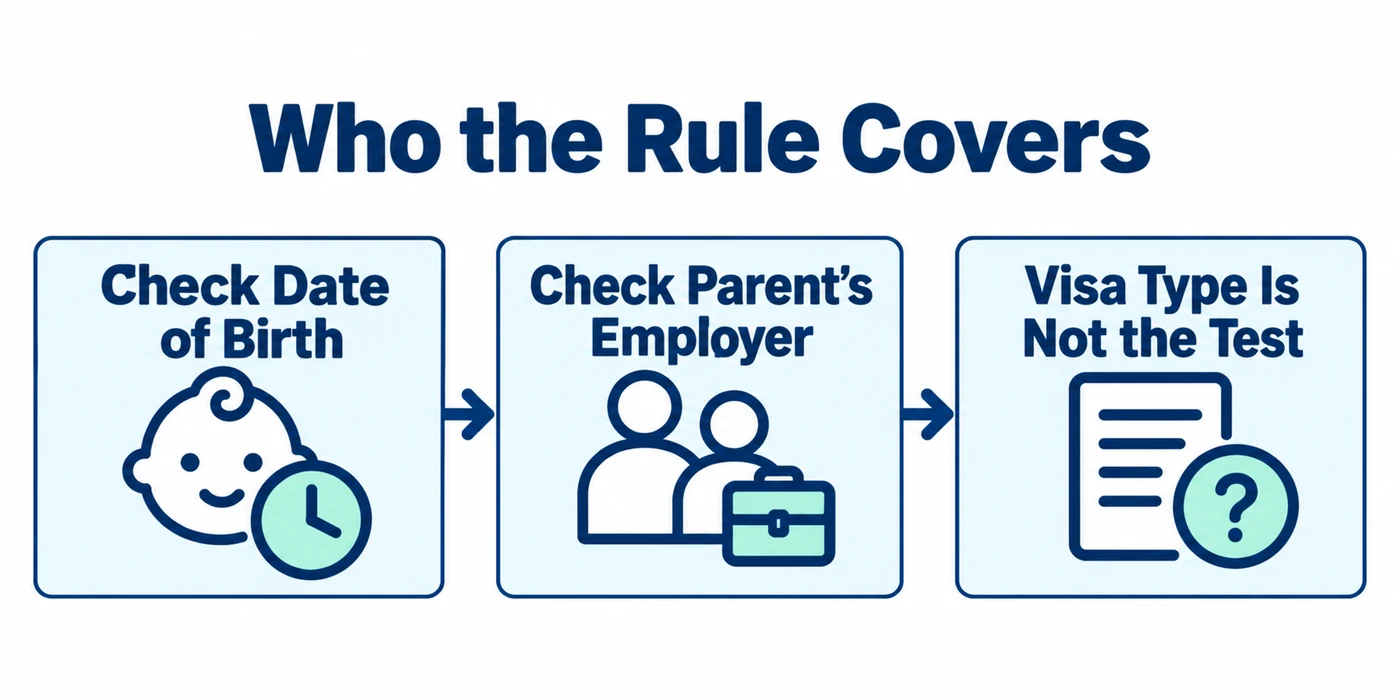
Setting the injunction aside, this is the scope the rule sets.
There are two tests. The first is timing: it applies only to children born on or after September 4, 2026. If your child was born before that date, the rules in effect at the time of birth apply, and this rule doesn't touch them.
The second is where the parent works. This is the part most easily misunderstood, so let's be clear: what matters is who the parent works for, not what visa the parent holds.
The four groups that count are the following, and in each case the person is not a US citizen:
- Ambassadors
- People who work at a foreign embassy or consulate and are nationals of that country
- People employed by a foreign government in an official capacity
- People employed by an international organization with immunities. This means organizations such as the United Nations and the World Bank that have been specifically designated by presidential executive order to receive immunities
If you work for a private company, you don't meet this test, no matter what visa you hold. H-1B, H-4, L-1 and F-1 status on their own don't decide anything. Your employer does.
Who the rule explicitly says is not covered
This list may be more useful than the one above, because it rules out several situations people might wrongly think apply to them:
| Situation | Covered? |
|---|---|
| Assistants, drivers or household staff personally hired by a foreign official (employed by the official as an individual, not by the government) | No |
| Employees of state-owned enterprises, as long as they don't hold an A or G visa | No |
| Third-country nationals working for a foreign government agency, including at an embassy or consulate | No |
| Employees of an international organization that has not been designated by executive order as having immunities | No |
| Contractors for a foreign mission, international organization or foreign government, as long as they don't hold an A or G visa | No |
| Foreign government employees who came to the US in a private capacity this time, not on official business | No |
If you work for a state-owned enterprise or do contract work for a foreign agency, you're not covered by this rule as long as you didn't come in on an A or G visa.
What about children who do fall within the scope?
The bottom line first: these children won't end up without any status. What the rule does is open a path for them to register as permanent residents. If you really do fall into one of the four groups above, this section is for you.
The process is to file Form I-485 (Application to Register Permanent Residence or Adjust Status) with US Citizenship and Immigration Services (USCIS, the agency that decides immigration applications), and show that the child has not abandoned residence in the US.
Two things are worth knowing. First, this registration is voluntary, not a mandatory procedure. Second, once approved, the child's permanent resident status dates back to the day of birth, not the approval date, which makes a real difference when counting time toward naturalization later.
As for cost, based on the rule's own figures: the filing fee is $1,440 on paper or $1,390 online. Adding biometrics and other costs, the total comes to about $1,993 or $1,906 per person.
How many people will this affect?
DHS admits in the rule that it can't estimate this.
The only reference point it gives is a State Department figure: foreign mission members and their families across the US total more than 124,000 people. But there's no data on how many of them have a US citizen spouse or how many left the US before their child was born, so it's impossible to estimate further.
What to watch next
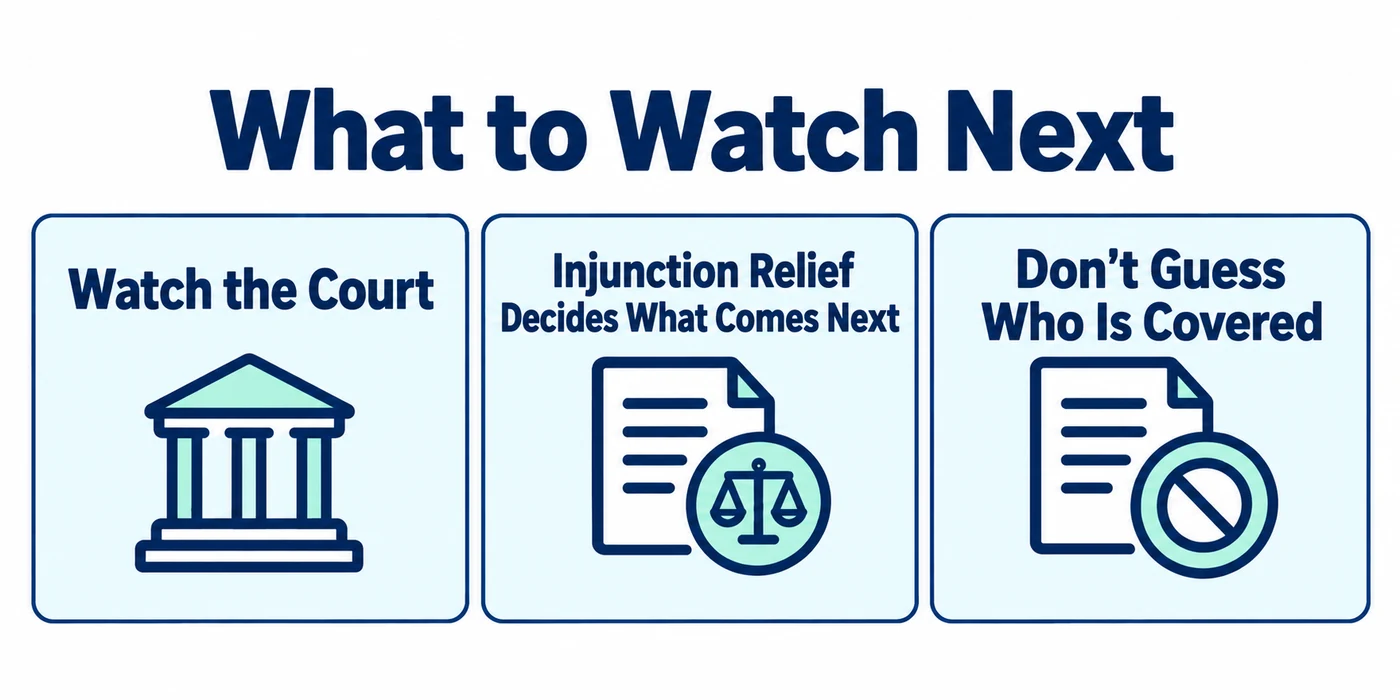
The rule is an "interim final rule," meaning it takes effect first and takes comments afterward. The comment period is 30 days.
What really decides how far it goes isn't the comment period but the lawsuit. The rule itself states it flatly: unless the government obtains relief from the injunction, it won't be enforced against members of the certified class. So the next milestone is in court, not at the agency.
Sources
- DHS rule "Registration of Lawful Permanent Residence for Children Born to Foreign Government Employees in the United States," RIN 1615-AD24, Federal Register document number 2026-18345, full public inspection text; submitted for public inspection and effective immediately on September 4, 2026, officially published September 9; amends 8 CFR parts 101 and 264
- The statement about suspending enforcement, the four covered groups, the six exclusions, and the fee and population figures all come from the text of the rule above
- Lawsuit: Casa Inc. v. Trump, case number 8:25-cv-00201, US District Court for the District of Maryland, filed January 21, 2025; the preliminary injunction cited in the rule is dated September 2, 2026
- Executive Order 14418 (91 FR 51991), signed August 6, 2026 and published August 11; the four-part definition of "foreign government employee" comes from Section 2(b)
This article does not constitute legal advice. If your child was born around September 4, or your employer may fall into one of the four groups above, please consult a qualified immigration lawyer.
One email each month when the bulletin lands. Unsubscribe anytime.