

Update (September 28, 2026): As of the evening of September 28 Eastern Time, the State Department still has not published the October 2026 visa bulletin (the first bulletin of fiscal year 2027). It is the latest release in the seven years we have on record, already four days later than the previous latest, September 24, 2020. You lose nothing by waiting: the September bulletin stays in effect through September 30, and the new fiscal year's visa numbers can't be used until October 1. As soon as the bulletin is out, our homepage and bulletin emails will update right away.
As of Friday evening, September 18 (Eastern Time), the State Department still had not published the October 2026 visa bulletin. This is the first bulletin of fiscal year 2027, and in past years it usually came out in the first half of September. Since Wednesday, people in our community have been asking every day, "Why isn't it out yet?" This article lays out the data we have.
The short answer: it's late, but not unprecedented. The September bulletin stays in effect through September 30, you can't file an October application before October 1 anyway, and waiting these few days costs you nothing.
When will the October visa bulletin come out?
Nobody knows the exact day. The State Department never announces the release date in advance. We can say two things: the latest release in past years was September 24, 2020 (see the table below), and this year is already past that; and none of the bulletins in the last seven years came out on a weekend, so it will most likely be a weekday. Once it is out, our homepage updates automatically, so there is no need to keep refreshing the State Department site.
When did the October visa bulletin come out in past years?
Here is when our system picked up each October bulletin, by Eastern date:
| Fiscal year | October bulletin | Published | Day |
|---|---|---|---|
| 2020 | October 2019 | September 18 | Wed |
| 2021 | October 2020 | September 24 | Thu |
| 2022 | October 2021 | September 13 | Mon |
| 2023 | October 2022 | September 7 | Wed |
| 2024 | October 2023 | September 15 | Fri |
| 2025 | October 2024 | September 11 | Wed |
| 2026 | October 2025 | September 12 | Fri |
In six of those seven years, the bulletin came out on or before September 18. The one exception was 2020, when it slipped to September 24. So "the latest in five years" is accurate; "unprecedented" is not. (Update, September 25: this year's bulletin is now later than 2020's September 24 release, making it the latest of the seven years.)
None of those seven came out on a weekend. Going back to early 2019, only 1 of 92 bulletins landed on a Saturday (the June 2022 bulletin). September 18 is a Friday, so if it didn't come out that evening, the next likely date was Monday, September 21.
Has it been slipping all year?
Yes. It isn't just the October bulletin that is suddenly late. Since the middle of the year, every bulletin has come out later than the year before. Again using the Eastern dates our system recorded:
| Bulletin | Published | Day of month |
|---|---|---|
| June 2026 | May 13 | 13 |
| July 2026 | June 16 | 16 |
| August 2026 | July 20 | 20 |
| September 2026 | August 21 | 21 |
| October 2026 | Not yet published | Past 18 |
For the twelve bulletins from October 2024 through September 2025, the median release date was the 11th day of the month, and the latest was the 14th. This year the August and September bulletins landed on the 20th and 21st, a full week later than the latest bulletin of the previous fiscal year. The October bulletin just pushes that curve one more step to the right.
Why is it late?
The State Department has not given any explanation. Below we gather the explanations we could find and label which are facts, which are guesses and which are just sentiment.
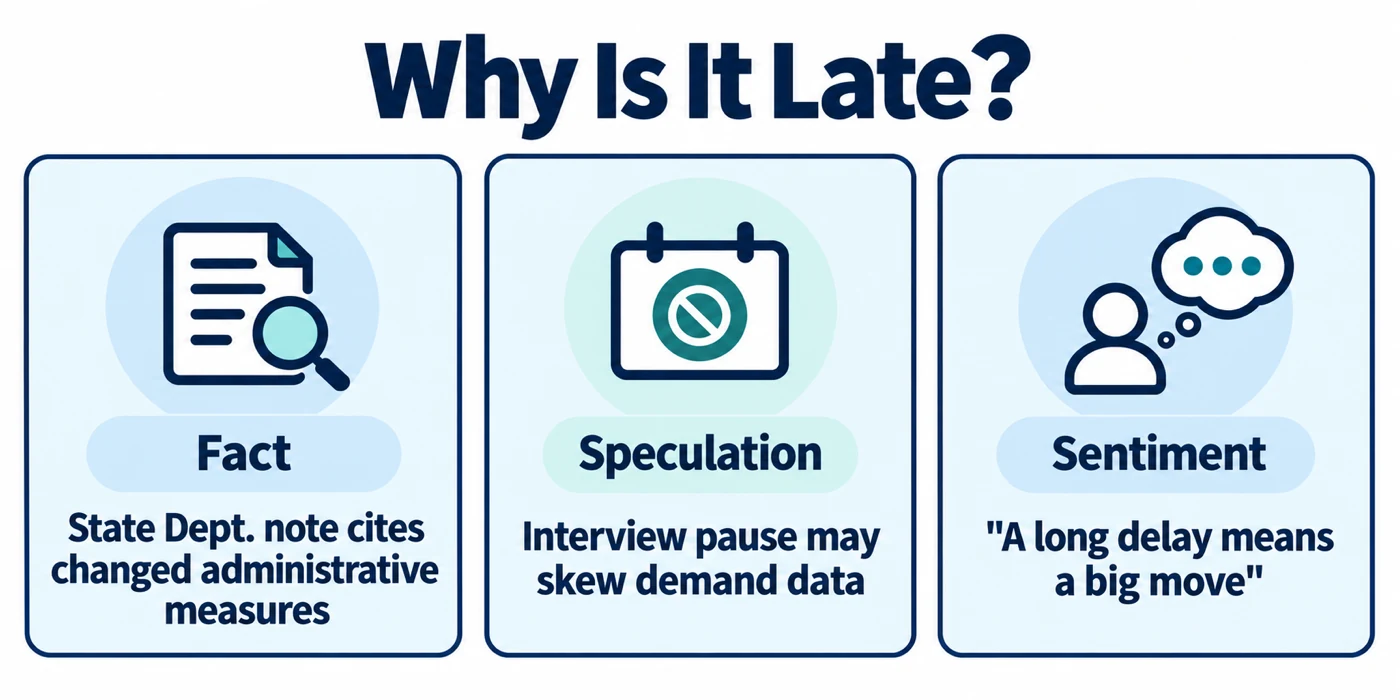
What the State Department itself wrote in the September bulletin (fact). The general notes in the September bulletin say that as more immigrant visa demand materializes, or if administrative measures are modified, retrogression may be necessary in the coming months to keep issuances within the annual limits. A section specifically on EB-2 (second preference, advanced-degree professionals) says demand is ample and usage is rising, and that it may be necessary to retrogress the category or make it "unavailable" before the end of the fiscal year. Wording about administrative measures being modified is not common in past bulletin notes. Our reading: the people who set the cut-off dates were already factoring policy actions into their quota math in September. That is our interpretation, not a State Department statement.
The pause in consular interviews has scrambled the demand data (the dominant view on forums and in our community, which we can partly confirm). Starting in early August, the State Department began training staff at embassies and consulates worldwide on new public charge review standards. Immigrant visa interviews at many posts were postponed, and as of today no general resumption date has been announced. We wrote about this on August 26 (see "State Department Postpones Immigrant Visa Interviews Worldwide: Who Is Affected and Who Isn't"). In a September 18 discussion on a Chinese-language immigration forum, one poster tied this directly to the bulletin delay: consular processing was blocked all last month, so whoever sets the dates may still be working out how far to move this month. Someone in our community put it this way: "Everyone's off at training, there's no way there'll be any movement this month."
The part we can confirm: the September bulletin moved the family-based Final Action Dates for mainland China forward a lot. F3 (married sons and daughters of US citizens) advanced 890 days, F4 (brothers and sisters of US citizens) 781 days, and F2B (unmarried adult sons and daughters of green card holders) 598 days (our data). A large share of family-based immigrants go through consular processing. The visa numbers were released, but the interviews stopped, so the visas can't be issued. One forum poster summed up the contradiction bluntly: last month family categories got a "multi-year jump," and then consular processing "essentially shut down." How to set the next bulletin when numbers have been released but can't be issued is a genuinely new problem. But the step "so that's why the bulletin is late" is a guess. The State Department has never said the two are connected.
A long delay means a big move (sentiment, not supported by the data). On forums and in our community, people say things like "It's taking this long, there must be a big change" and "They're going to pull something big this year." We lined up the release dates of the 91 bulletins since 2019 against the change in mainland China Final Action Dates in each one. For EB-2, there is no relationship at all: the median movement is 14 days whether the bulletin came out early or late. For EB-3 (third preference, skilled workers) there's a faint hint: the 33 bulletins released after the 16th had a median advance of 31 days, versus 0 for the 58 released before the 16th. But the correlation coefficient is only 0.11, far too weak to rely on. We note it here as sentiment only.
How much will October move? Lawyers, forum users and our poll voters disagree
The bulletin isn't out, but there are plenty of predictions. Below we put what each source says about mainland China Final Action Dates for EB-1 (first preference, extraordinary ability and similar), EB-2 and EB-3 in one table, then check them against our historical data.
| Who | EB-1 China | EB-2 China | EB-3 China | Family-based |
|---|---|---|---|---|
| Attorney Shusterman (personal predictions page) | 2 to 3 weeks forward | 2 to 3 weeks forward | 4 to 5 weeks forward | 1 to 4 months forward |
| Reddy Neumann Brown (September 8) | Small | Slow or stalled | Gradual | Moderate |
| Shautsova law firm (September 12) | Not listed separately | Current for most countries, not guaranteed | Limited advance | Limited advance |
| Chinese-language immigration forum user (September 18, one person) | Current | 4 months forward | 6 months forward | Not mentioned |
| Our prediction poll (926 votes as of September 18) | 85% bet on advance, 58% on 3+ months | 86% bet on advance, 62% on 3+ months | 88% bet on advance, 74% on 3+ months | Poll not open |
The lawyers are talking weeks; the poll voters are betting months. Who is closer to past years? Here is the actual change from the September bulletin to the October bulletin over the past seven years in our data, mainland China Final Action Dates:
| October bulletin | EB-1 | EB-2 | EB-3 |
|---|---|---|---|
| 2019 | +1035 days | Retrogressed 731 days | +669 days |
| 2020 | +92 days | +46 days | +136 days |
| 2021 | Current | 0 | 0 |
| 2022 | Current | +68 days | +54 days |
| 2023 | +14 days | +85 days | +122 days |
| 2024 | +7 days | +21 days | Retrogressed 153 days |
| 2025 | +37 days | +107 days | +90 days |
Those big 2019 numbers were a recovery after end-of-fiscal-year retrogression, not the norm. Looking at the six bulletins from 2020 on:
- EB-3 China: three of the six advanced 90 days or more, and one retrogressed five months. 74% of our voters bet on "3+ months," which matches the historical frequency, but history also includes a retrogression.
- EB-2 China: only one of the six (2025) moved more than 90 days, and the median is around a month and a half. 62% of our voters bet on "3+ months," clearly above history; the lawyers' two to three weeks is below the historical median.
- EB-1 China: the last three bulletins moved only 7 to 37 days. 58% bet on "3+ months," which has only happened in 2019 and 2020.
This table describes past years, not this year. This year has two variables past years didn't: the pause in consular interviews, and the State Department's own note about administrative measures being modified. On direction, everyone is betting on forward movement; on size, history sits on the conservative side. That's all.
Does the missing bulletin affect October 1?
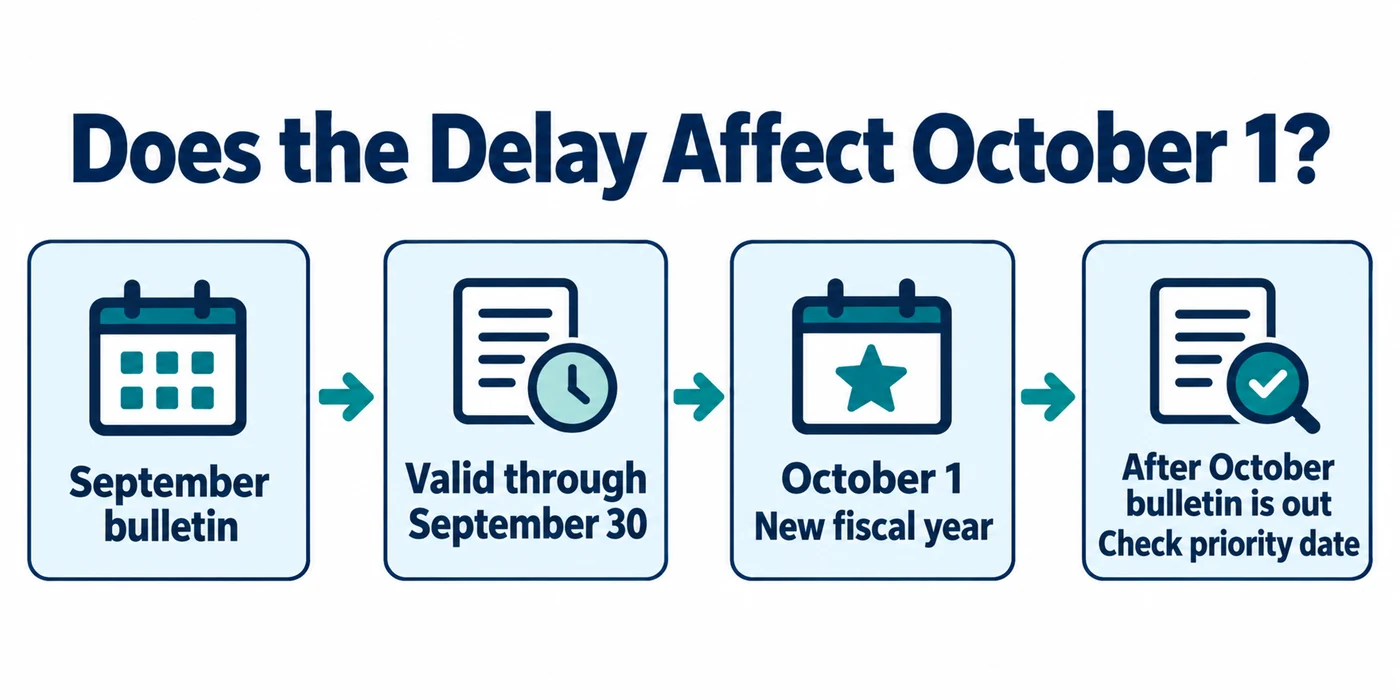
New fiscal year visa numbers become available on October 1. That is set by law and doesn't depend on when the bulletin is published. A late bulletin only shortens how much advance notice everyone gets.
If you are filing an I-485 (Application to Register Permanent Residence or Adjust Status) inside the US: every month, USCIS designates whether to use Chart A or Chart B only after the State Department publishes the bulletin, and posts it on USCIS's filing charts page. As of September 18, that page still showed the September designation. You can't file your October application until October 1 anyway, so as long as the bulletin comes out before then, the actual process is no different from any other year.
We found no October bulletin since 2019 that was published after October 1.
What you can do now
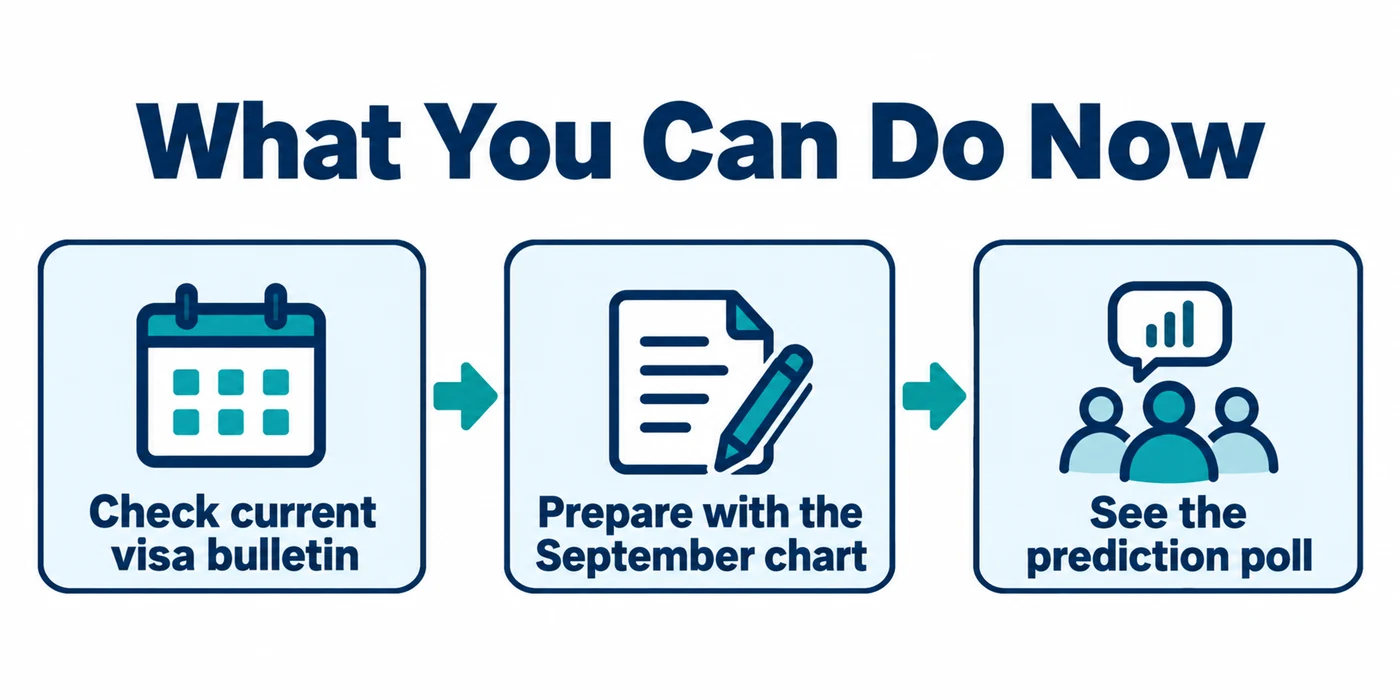
- The September bulletin stays in effect through September 30. The dates on our current visa bulletin chart are the dates that apply now; for changes by category, see our September visa bulletin analysis.
- If you plan to file with the "October wave," preparing your documents based on the current September chart won't be wasted effort. Once the October chart is out, just check your priority date against it.
- If you want to see how others are guessing, more than nine hundred people have voted on EB-1, EB-2 and EB-3 in our October visa bulletin predictions. The poll settles automatically once the bulletin is out.
Once the bulletin is published, our visa bulletin page is updated automatically by our system, usually within minutes, and readers subscribed to visa bulletin emails are notified at the same time. We will add the actual release time to this article after publication.
Data sources: past bulletins on the State Department's visa bulletin page, including the notes in the September 2026 bulletin. Release times are when our system picked up each bulletin and may differ from the official release time by a few hours. Sources of opinion: Shusterman predictions page, Reddy Neumann Brown, Shautsova, a September 18 discussion on a Chinese-language immigration forum, and our visa bulletin discussion group and prediction poll. Law firm predictions are their own views, not official information.
One email each month when the bulletin lands. Unsubscribe anytime.