

The short version: Starting in August 2026, the US State Department paused immigrant visa (green card) interviews worldwide so consular officers could be trained on new public charge review standards. A State Department official confirmed this to reporters on August 25. Scheduled interviews have been canceled and rescheduled one after another, and as of now (September 20) no date for resuming has been announced. Processing before the interview continues as usual, so NVC is still clearing cases quickly; what is stuck is the interview itself. Guangzhou is currently scheduling only cases that became documentarily qualified in March 2025.
Update (September 29, 2026): interviews are delayed, so why are employment dates still moving?
After the October bulletin, many readers asked: aren't all immigrant visas stopped? Why did employment categories move while family categories stayed put?
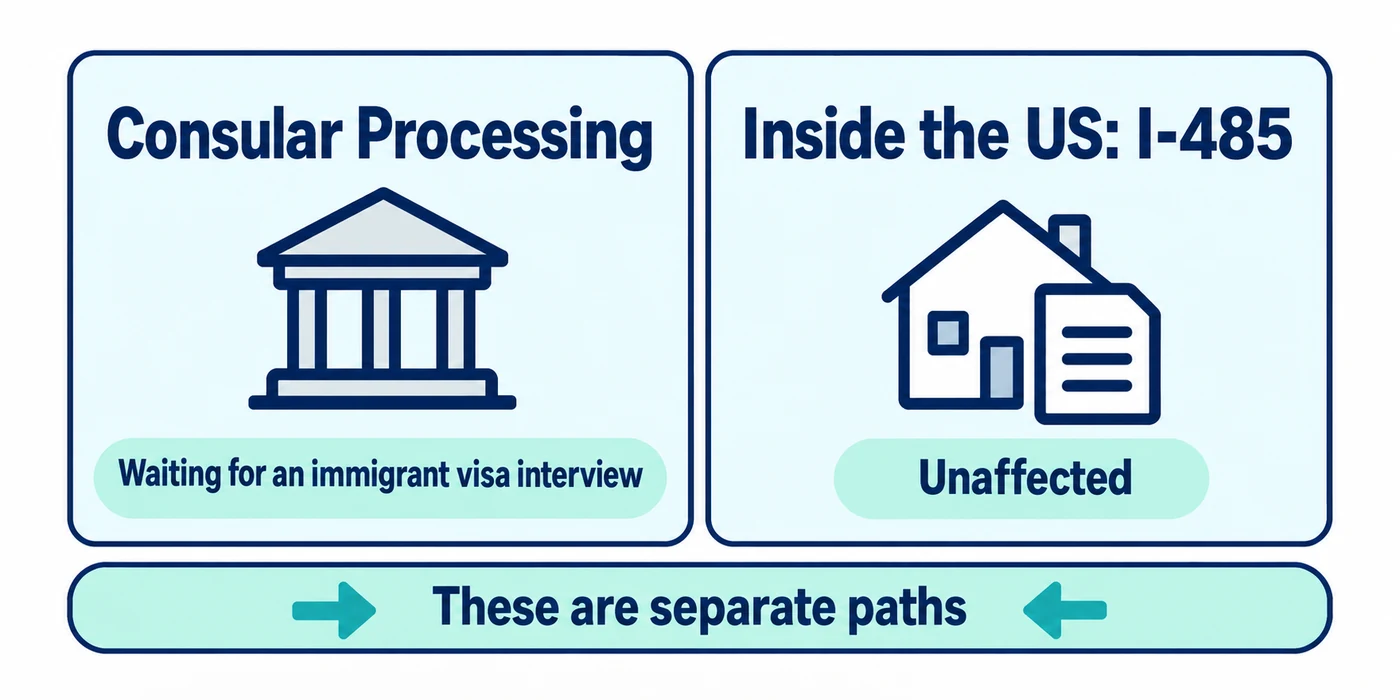
First, a correction to the premise: what is delayed is immigrant visa interviews at embassies and consulates, not green cards in general. If you are in the US and file I-485 (adjustment of status), your case goes through USCIS and is not affected by this delay.
Why employment categories can still move
- Most employment-based visa numbers are used by people adjusting status inside the US through USCIS. Charlie Oppenheim, the former head of State's visa control office, has put that share at about 85%. The interview delay does not block that path, so the numbers keep getting used.
- October is the first month of fiscal year 2027, when numbers reset, and USCIS confirmed that employment-based applicants can file I-485 using Chart B (Dates for Filing) in October. China EB-3 Chart B moved 814 days and EB-2 Chart B moved 365 days; Chart A (Final Action Dates) moved only a few days: EB-2 by 30 days and EB-3 by 7.
Why family categories did not move
- In October only F2A (spouses and minor children of green card holders) Chart A moved, by 31 days. Every other category stayed put.
- The State Department has not given a reason. Two things are worth knowing. First, no movement in the first month of a fiscal year is common: for China F4, the September-to-October change was zero in five of the past ten years (2016–2025). Second, family categories had just made a large jump in September (F3 moved 890 days).
- This next point is our analysis, not an official statement: most family-based applicants are abroad and need a consular interview to get a visa. While interviews are delayed, advancing the dates would not get visas issued any faster.
What this means for you: if you are in the US and filing I-485, this delay does not affect you. Family-based applicants waiting abroad for an interview have to wait for the State Department to announce that interviews are resuming. Our full reading of the October bulletin is here.
Update (September 19, 2026): Reuters reported exclusively on September 8 that US embassies and consulates in Hungary and Poland had resumed immigrant visa processing the previous week, on instructions from the White House; immigrant visa interviews in other countries remain delayed. The report quoted people familiar with the matter as saying the new training works like this: each post first trains itself using materials sent from Washington, then consular officers travel from post to post to complete certification, so the delays "could last months." A State Department spokesperson declined to explain why only these two countries resumed, saying only that changes to visa appointments are communicated directly to applicants by each embassy or consulate. As of September 19, the State Department had still not issued any public document. Separately, the new public charge rule took effect on September 18, and we covered it in a separate article; the long-delayed October visa bulletin may be related to this pause, see this article. Source: Reuters (via Yahoo).
Since early August, the US State Department has been training consular officers at embassies and consulates around the world on new public charge review standards. To free up time for the training, large numbers of immigrant visa interview appointments have been postponed. Reuters, The Wall Street Journal, the Financial Times, The Guardian and The Washington Post all reported on it between August 25 and 26.
Bottom line first: if you are inside the United States and applying for your green card through Form I-485 (the adjustment of status application, the form used to get a green card from within the US), this does not affect you.
The people affected are those outside the United States who are getting an immigrant visa through an embassy or consulate, that is, those going through consular processing. If you are waiting for an interview notice from an embassy or consulate, what follows applies to you. Chinese-language headlines often phrase this as "global suspension of US immigrant visa processing," which can lead people waiting in line inside the US to think they have been stopped too. The two paths are separate: consular processing belongs to the State Department, while adjustment of status on Form I-485 belongs to USCIS (US Citizenship and Immigration Services). USCIS has not announced any corresponding pause.
What the State Department itself said
A State Department official told reporters:
In early August, we launched a global training initiative at all of our embassies and consulates worldwide. To accommodate this in-depth training, appointments for visa services will be adjusted.
Pay attention to the wording: the official line is that "appointments for visa services will be adjusted," not that "immigrant visa interviews are suspended". The word "suspension" comes from reporters describing what was actually happening at individual posts; it is not the State Department's wording. So far the State Department has not issued any public document: no Federal Register notice, no press release, and no update to the Foreign Affairs Manual (FAM). The only information right now comes from two sources: media reports, and the rescheduling notices applicants have received.
Where we looked: all 19 documents the State Department has published in the Federal Register since August 1 (the only one involving visas is the August 3 "Visa Bond Program," which is unrelated), the State Department press release page, and the visa news page on travel.state.gov. None of them mentions this training or any appointment adjustments.
Posts where applicants have reported receiving rescheduling notices include Hong Kong, Manila, Seoul, Nairobi, Santo Domingo, Ciudad Juárez, Ankara, Guatemala City and Dhaka.
How long the training lasts: According to reports, most embassies and consulates scheduled the training for the last week of August. The State Department has not announced when normal scheduling will resume.
One email each month when the bulletin lands. Unsubscribe anytime.
Who is affected and who is not
Affected
- People outside the United States waiting for an immigrant visa interview, in both family-based and employment-based categories (EB-1 through EB-5, the first through fifth employment-based preferences)
- People who have already been scheduled for an interview but have not yet had it: you may receive a rescheduling notice
- Diversity Visa (DV) lottery selectees. DV cases can only go through consular processing, and they face a hard deadline of September 30
Not affected
- People inside the United States who have filed Form I-485 to adjust status: you are not within the scope of this adjustment
- Nonimmigrant visa applicants: interviews and renewals for B1/B2, F-1, H-1B and L-1 visas continue as usual
- People who already have their immigrant visa and are on their way to the US
What is still unclear: If you have already had your interview and are waiting for the visa to be issued, are you affected? No source addresses this.
This is not the same as January's "suspension"
In 2026, three different things have all been called a "suspension of immigrant visas." Mixing them up leads to wrong conclusions:
| When | What | Status | |
|---|---|---|---|
| 75-country suspension | From 2026-01-15 | Suspended immigrant visa issuance to nationals of 75 countries by nationality, on the grounds that nationals of those countries posed a higher risk of relying on public benefits | Struck down by a federal court on 2026-08-21 |
| Proclamation 10998 | — | Restricts visa issuance and entry for nationals of 39 countries on national security and vetting grounds | Still in effect, not affected by the ruling above |
| This training pause | From 2026-08 | Worldwide postponement of immigrant visa interviews to make time for consular officer training | Ongoing, no end date |
On August 21, Judge Jeannette Vargas of the US District Court for the Southern District of New York ruled that the 75-country policy was "patently unlawful," because the Immigration and Nationality Act prohibits discrimination based on nationality in the issuance of immigrant visas, and the policy barred specific groups from immigrant visas based on nationality alone. The ruling also noted that federal law expressly withholds this authority over consular officers' immigrant visa decisions from the Secretary of State.
Please treat the following as analysis, not established fact: what was struck down was the blanket, nationality-based approach. Reviewing individual applicants case by case for whether they are likely to become a public charge is a separate mechanism that this ruling did not address. Both start from public charge concerns, but they rest on different legal footing. We have no evidence that this training is a response to that ruling: the training began in early August, before the ruling.
Why now: September 18
The Department of Homeland Security's public charge final rule (RIN 1615-AD06, Federal Register document number 2026-14539) was published on July 20, 2026 and took effect on September 18, 2026. The rule broadens the definition of "public benefits" to include need-based benefits such as housing assistance, food stamps and college financial aid in the review. We have written about this rule, and if you plan to file an I-485 after September 18, it is worth going back to read: see "The New Public Charge Rule Takes Effect September 18."
In terms of timing, the consular officer training took place a few weeks before that rule took effect.
One point to be clear on: that rule is a DHS regulation governing how USCIS adjudicates I-485s. Consular officers apply INA Section 212(a)(4) and the State Department's own guidance. The two standards run in parallel; they are not the same document. Some reports say the State Department sent a cable to consulates in November 2025 expanding the public charge factors, but that cable was never published, and we cannot verify what it says.
The September 30 fiscal year deadline
Immigrant visa numbers are allocated by fiscal year, and numbers not used in a given year cannot be carried over; they are lost for good. The current fiscal year ends on September 30, and this postponement falls right in its final month.
For DV lottery selectees, this is the most urgent issue: DV-2026 visas must be issued by September 30. After that they expire, and there is no remedy.
As for the effect on next year's visa bulletin, the mechanism works like this: under 8 U.S.C. 1151(d), the employment-based total for the next fiscal year equals 140,000 plus the family-based numbers left unused in the current fiscal year. A large share of family-based immigrants go through consular processing, so in theory a slowdown on the consular side would push up the number of employment-based visas available next fiscal year.
But we cannot verify this, and it should not be the basis for any planning. Actual issuance figures for a fiscal year are published only about a year after the fiscal year ends, so right now nobody, including us, can calculate how many numbers were used this fiscal year. And if the training really lasts only about a week, the effect may be too small to notice. This section explains the mechanism; it is not a forecast.
What you can do now
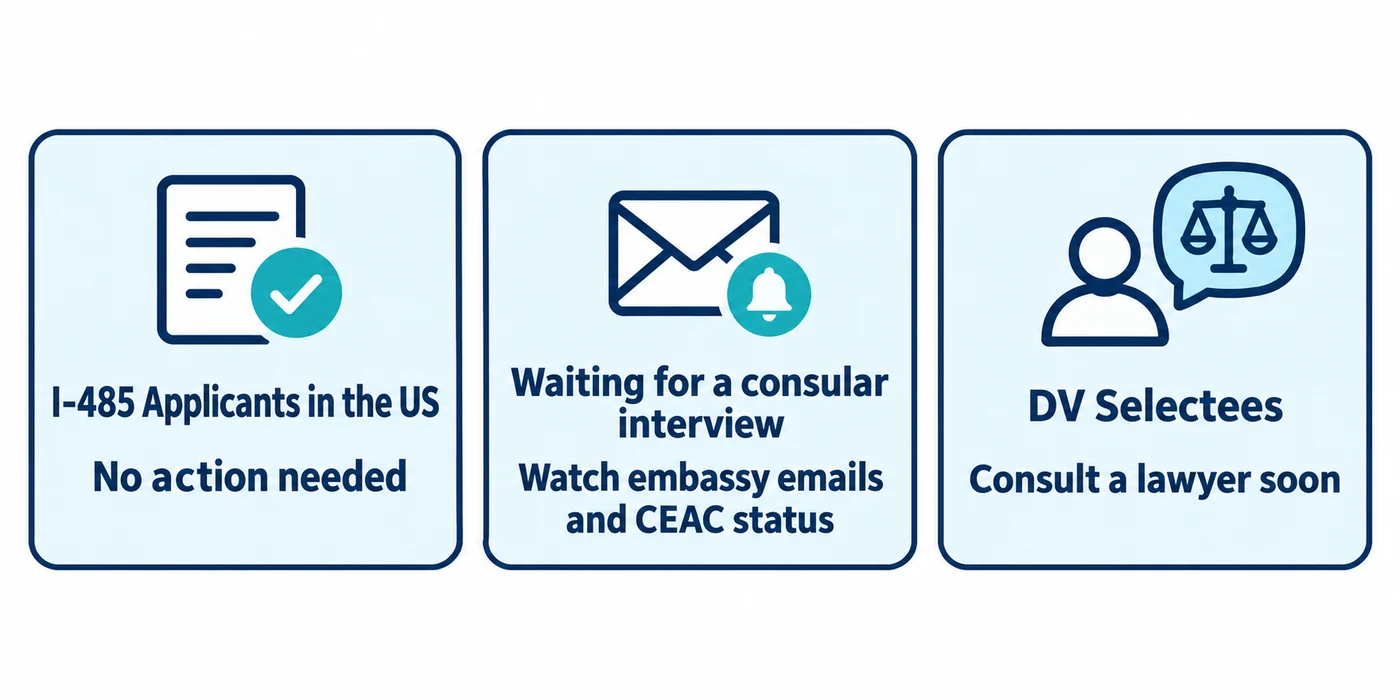
- I-485 applicants inside the US: You do not need to do anything. What you really need to watch is the new public charge rule that took effect September 18, and what it requires for I-485s filed on or after September 18.
- People waiting for a consular interview: Watch for emails from the embassy or consulate and check your status in CEAC. Rescheduling notices go out case by case. The State Department has not announced a single date for resuming.
- DV selectees: The September 30 deadline is not extended because of this postponement. If your interview has been postponed and the end of the month is approaching, this is a situation where you should consult a lawyer as soon as possible.
- Everyone: There is no official document on this, and information will only come through individual notices from embassies and consulates. When you see a headline like "global suspension," first figure out which event it is talking about; three different events have shared that label this year.
How long has the pause lasted, and how much longer will it go?
It has been nearly four weeks since a State Department official confirmed the postponement on August 25, and no date for resuming has been announced.
Until now, the only way to gauge this was through scattered individual notices. Now there is an official number you can check directly: the State Department's "IV Scheduling Status Tool" shows, for each embassy and consulate, which "documentarily complete" month (often called the DQ month) it is currently scheduling interviews for. As of the September 9, 2026 update, Guangzhou shows:
| Category | DQ month being scheduled | Equivalent wait after DQ |
|---|---|---|
| Employment-based | August 2023 | About 3 years |
| Family preference | March 2025 | About 18 months |
| Immediate relatives | April 2026 | About 5 months |
The trend is even more telling. We have three readings on record: October 2025 on July 8, back to August 2025 on August 7, and back to March 2025 on September 9. This number is moving backward, and a normal queue does not move backward.
To be clear: the State Department has never explained why this number is moving backward. The timing overlap described above is our observation, not a cause-and-effect relationship stated by the government.
Why do some people say "NVC is fast" while others can't get an interview?
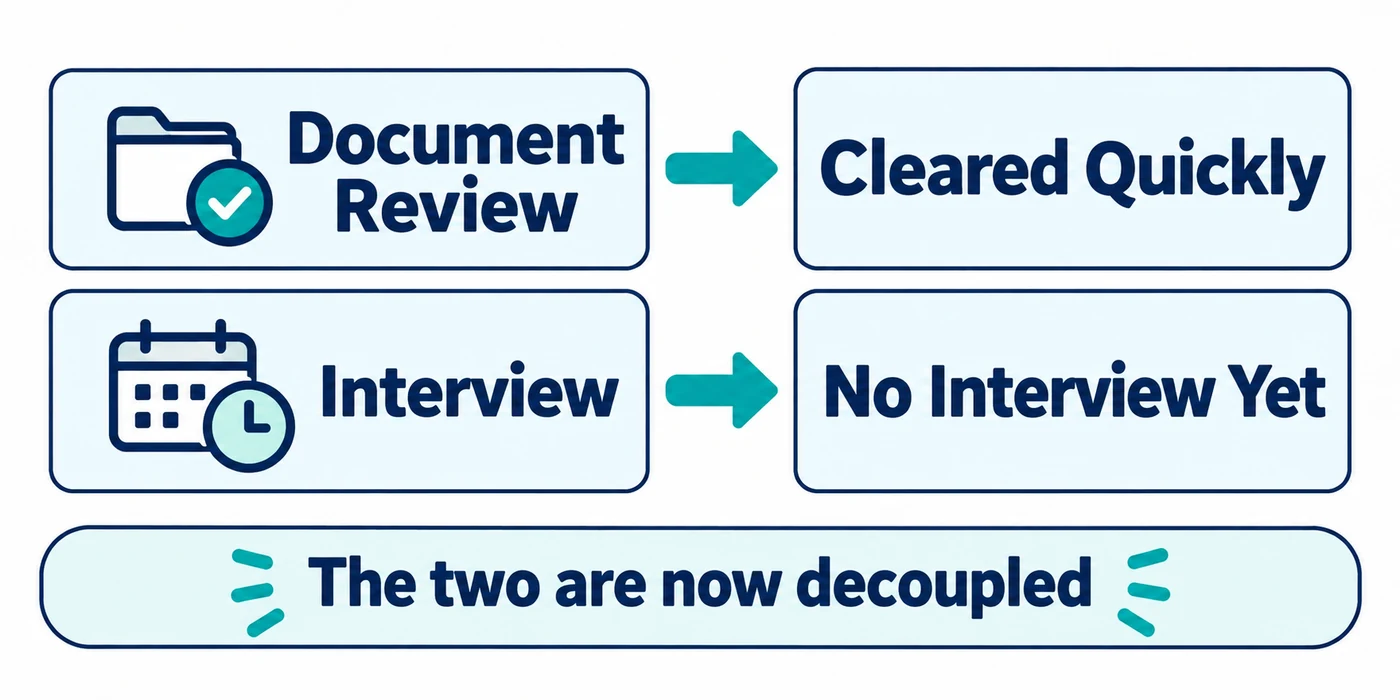
There is one easily overlooked detail about this postponement: processing before the interview is continuing as usual.
That explains something that looks contradictory. In the Chinese community you will see two kinds of posts at the same time: some people showing off "NVC cleared in four days" or "DQ in seven days," and others asking "it's been ten weeks since my case was cleared and I still have no interview notice."
Both are true, because they are in two different queues: document review has stayed fast, while the interview queue has stopped. So "my documents went through smoothly" does not mean "I'll have my interview soon." The two are now decoupled.
This matters especially for families whose priority dates became current for the first time after the big jump in the September 2026 visa bulletin. When your date becomes current, a one-year deadline to act starts running, and not being able to get an interview does not extend that deadline. We wrote a separate article on this: After F4 Jumped 781 Days: Your One-Year Clock Has Started, and Guangzhou Is Still Scheduling March 2025 Interviews.
We will keep following this
We will update this article as soon as the State Department issues a formal explanation, updates the FAM or announces when scheduling will resume. The September 8 resumption in Hungary and Poland and the "could last months" report have been added at the top; the three readings of the interview scheduling month were added on September 20. The new public charge rule took effect September 18 and is covered in a separate article.
This article is based on publicly available government data and announcements. It is for reference only and does not constitute legal advice.